
Stetson Valley vs Sonoran Foothills for TSMC Engineers: Long-Hold Bet
For a TSMC engineer planning a five-to-ten-year hold, is Stetson Valley or Sonoran Foothills the better appreciation bet? Here's how the two North Phoenix communities compare as Phase 2 and Phase 3 ramp.
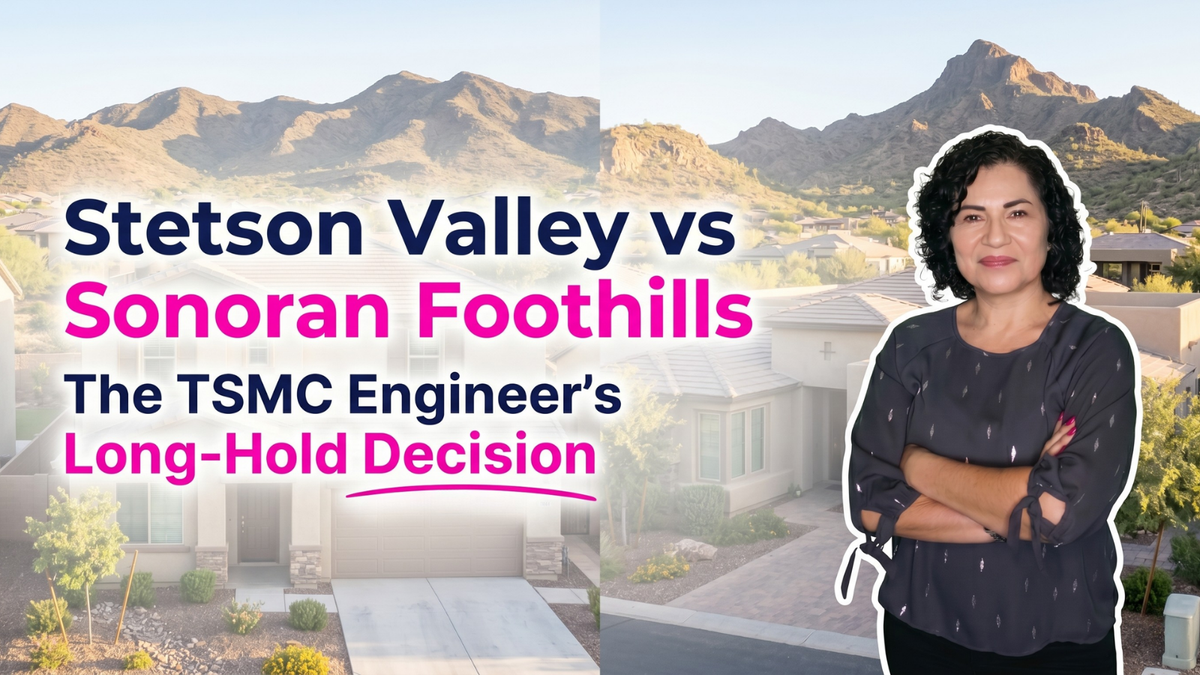
For a TSMC engineer, is Stetson Valley or Sonoran Foothills the better long-term bet for appreciation as TSMC Phase 2 and Phase 3 ramp up over the next 5–10 years?
Both communities sit close enough to the TSMC campus at I-17 and Loop 303 to ride the same general demand wave from Phase 2 production starting in 2027 and Phase 3 coming online later in the decade. The honest answer is that Sonoran Foothills has the closer proximity and the natural-amenity premium, while Stetson Valley has the slightly lower entry point and a more established resale market. Neither is a clear long-term winner — the choice is more about lifestyle fit and price-per-square-foot than appreciation math.
For engineers relocating into a TSMC role, the trap is treating this purely as an investment decision. The communities don't behave like assets — they behave like neighborhoods that will or won't fit the way your family actually lives for the next decade. Let me walk through how the two compare on the dimensions that actually matter.
Proximity to the TSMC Campus and Daily Commute
Sonoran Foothills wins on proximity. Sitting near the intersection of North Valley Parkway and Cloud Road, against the base of the rugged Sonoran Desert mountains, it's roughly a ten-minute drive to the TSMC campus at I-17 and Loop 303 — close enough that I've seen listings explicitly cite the commute distance in the marketing copy. The community sits inside zip code 85085, just south of Carefree Highway and minutes from I-17 access.
Stetson Valley is a bit further south, nestled against the Deem Hills in zip code 85083, and the typical drive to the TSMC campus runs closer to fifteen to twenty minutes depending on which part of the neighborhood you land in and whether you take I-17 or Happy Valley Road. Both are easily inside the practical commute window for a daily drive, but if you're working long shifts or rotating schedules, the five-to-ten minutes of difference matters more than it looks on a map.
What I watch for here is whether the commute is short enough that you'll actually use the time you save at home, versus just enough that you'll fill it with errands. For engineers working compressed schedules or rotating between Fab 1 and the Fab 2 buildout, the Sonoran Foothills proximity is a real quality-of-life lever. Test the actual drive at the actual hours before you let appreciation math override commute math. The post on timing your move for the best inventory and commute trade-offs covers the framework for sequencing this.
What You Actually Get for the Money
Stetson Valley homes are mostly newer-construction product from the early-to-mid 2000s built by national builders, with home sizes ranging from medium three-bedroom layouts up through larger four-and-five-bedroom plans. Recent market data shows median home pricing in the low-to-mid $600K range with DOM averaging around fifty days — slightly tighter than the broader Phoenix market. Inventory tends to be in the medium-to-large single-family category, with strong owner-occupancy and a tight vacancy rate.
Sonoran Foothills runs higher on average. Built primarily by Toll Brothers, Pulte, and Taylor Morrison, with home sizes from roughly 1,800 to over 4,000 square feet, average list prices have been running in the upper-$700Ks across the gated and non-gated sections. The community is wrapped around the 36-mile Sonoran Preserve trail system, includes a resort-style central park with basketball, splash pad, pickleball, tennis, sand volleyball, and a dog park, and sits inside a low-density master-planned footprint. Both gated and open-access sections exist within the community, with the gated sections commanding meaningful premiums.
The price-per-square-foot is roughly comparable between the two when you control for finish level, but the all-in price points are higher in Sonoran Foothills because the typical product is larger and the lot premiums are heavier. That matters when you're underwriting the monthly payment. A $625K Stetson Valley home and a $775K Sonoran Foothills home produce very different payments at any given rate environment — and that delta needs to be evaluated against five-to-ten years of carry, not just the closing day.
— Mandi S, Waddell, AZ
The Appreciation Question — What's Actually Driving It
Both communities are inside the structural TSMC demand zone. The campus is at I-17 and Loop 303, total investment is now in the $165 billion range across six planned fabs, Fab 2 construction completed in April 2026 with tool installation starting Q3 2026, and Halo Vista — the 2,300-acre supporting development that wraps around the TSMC site — is breaking ground at the top of 2026. As Phase 2 reaches production in 2027 and Phase 3 follows later, the engineering and operational headcount drives demand for homes in exactly the commute window where Stetson Valley and Sonoran Foothills sit.
That demand pressure is real, and it's reflected in pricing patterns already. But the appreciation math doesn't favor one community over the other in any structural way. Both are inside the catchment zone. Both will benefit from the same broad demand. Both are constrained on supply by geographic limits (Sonoran Preserve to the north, mountain topography to the east, existing master plans to the west and south). The differential, if there is one, comes from:
- The natural-amenity premium. Sonoran Foothills' direct trail access and elevation views command a recurring premium that compounds slowly but reliably. That's been true historically and is likely to remain true.
- Product-mix tightness. Stetson Valley's owner-occupancy is unusually high and resale supply is consistently constrained. That tends to support pricing in firming markets and protect downside in softening ones.
- Buyer pool depth. Sonoran Foothills draws from a wider buyer base because of its gated/private sections and the larger product mix. Stetson Valley's buyer pool is more concentrated in the family-with-school-age-kids segment.
None of those differentials adds up to a clear "this one will outpace the other by a meaningful margin." If you're forecasting compounding appreciation over a five-to-ten-year hold, the realistic answer is that both communities track within a few percentage points of each other annually, and the bigger swing factor is which one you'd actually want to live in. Don't let appreciation modeling override commute and lifestyle fit. The appreciation difference, if any, is smaller than the lifestyle difference.
Schools, Family Infrastructure, and Long-Term Fit
This is usually where the decision gets made for families, not investors. Stetson Valley sits inside the Deer Valley Unified School District and includes elementary and middle schools within walking distance for most of the community. Stetson Valley's character skews family-focused with strong owner-occupancy, six community parks, and a Walk Score that classifies it as car-dependent with some bikeability — typical for a North Phoenix master plan.
Sonoran Foothills also draws on Deer Valley Unified, with Sonoran Foothills School serving as the primary on-site option, and benefits from the broader Norterra-area school and shopping infrastructure to the south. The community character runs slightly more upscale and lower-density than Stetson Valley, with the gated sections trending toward larger homes and longer holds. Both communities pull from the same general school district pool, so the school decision is less about district-level differences and more about which specific school assignments work for your kids' ages and programs.
A note on relocation reality: for engineers moving in for TSMC roles, the school search needs to be embedded in the home search, not added on after. Buyers who lock in a community first and then discover the school assignment doesn't match what they assumed end up regretting it. The post on the relocation home-buying process from first virtual tour to closing walks through the practical sequencing, and the one on writing an offer that protects you after inspections when relocating covers the contract protections that matter when you're closing sight-unseen.
— Dustin T, Glendale, AZ
Risk Considerations — Wildfire, Heat, and Long-Hold Capital Costs
Both communities sit in the desert-preserve interface, and that comes with a specific risk profile worth understanding before a long hold. Sonoran Foothills' immediate adjacency to the 36-mile Sonoran Preserve trail system is a major lifestyle asset, but it also places the community in a higher wildfire-exposure zone than urban Phoenix. Insurance underwriting in fire-adjacent areas of the Phoenix metro has tightened materially over the past few years, and rates can run meaningfully higher than for non-fire-adjacent properties. Verify quoted premiums on any specific property before assuming the carry cost will match what you've modeled.
Stetson Valley sits in a similar interface against the Deem Hills, but the wildfire exposure profile is generally less severe because the surrounding terrain is less continuous wildland. Heat exposure — including the long-term trend toward more days over 110°F — applies to both communities equally and is worth factoring into HVAC sizing, insulation expectations, and long-term maintenance budgeting. A five-to-ten-year hold means you'll be paying for at least one major HVAC service event and probably one full system replacement on either community's typical home, regardless of how new it looked at closing.
A note on the broader market context: as of spring 2026, the Phoenix market sits in a balanced posture with modest year-over-year price softening, days on market in the fifty-to-sixty range, and inventory around 1.5 to 2 months of supply depending on the source. That's a meaningfully different environment from the 2021-2022 peak, and it means you'll have time to inspect, negotiate, and walk away if a specific property doesn't pass underwriting. Use that leverage. The post on writing an offer that protects you when relocating sight-unseen covers how to structure contingencies that survive a remote purchase.
FAQ
How close is Sonoran Foothills to the TSMC campus?
Sonoran Foothills is roughly a ten-minute drive to the TSMC campus at I-17 and Loop 303 via I-17. Several listings in the community explicitly cite the commute distance.
How close is Stetson Valley to the TSMC campus?
Stetson Valley is roughly fifteen to twenty minutes to the TSMC campus depending on which part of the community and the route taken. Both I-17 and Happy Valley Road provide reasonable access.
Which school district serves both Stetson Valley and Sonoran Foothills?
Both communities are part of the Deer Valley Unified School District. School assignments vary by specific address, so verify the school assignment for any property under consideration.
What's the typical price range in each community?
Stetson Valley has been running in the low-to-mid $600K range as of early 2026. Sonoran Foothills tends to run higher, with average list prices in the upper-$700Ks across gated and non-gated sections, reflecting larger home sizes and lot premiums.
Is wildfire risk a factor for either community?
Yes for both, though the exposure is higher in Sonoran Foothills due to its direct adjacency to the Sonoran Preserve. Verify insurance premiums on any specific property before finalizing the budget.
Will TSMC Phase 2 and Phase 3 actually drive appreciation in this area?
The structural demand from TSMC's $165 billion investment, six planned fabs, and the adjacent Halo Vista development is real and ongoing. Whether that translates into outsized appreciation in any specific community within the commute zone is harder to forecast — both Stetson Valley and Sonoran Foothills sit inside the demand catchment, with no clear structural advantage for one over the other.
The Bottom Line
If commute proximity, direct preserve and trail access, and a slightly higher-end lifestyle setting are the priorities, Sonoran Foothills is the natural fit and you'll pay for that in the entry price. If a tighter resale market, a more family-focused community character, and a lower all-in price point matter more, Stetson Valley is the cleaner answer. The appreciation math, over a realistic five-to-ten-year hold, is unlikely to be the deciding variable.
What I tell engineers in TSMC relocations: don't optimize for the TSMC story alone. Optimize for the home you'll actually live in, the schools your kids will actually attend, the commute you'll actually drive, and the carry cost you can comfortably absorb across rate cycles. The TSMC tailwind helps both communities. The lifestyle fit is what determines whether you'll still be happy you bought there in year seven.
About the Author
Kasandra Chavez | Chavez Dream Home Team | Recognized among the top 5% of real estate professionals in the Greater Phoenix area. Kasandra works with buyers and sellers across the West Valley and North Valley submarkets, helping align strategy with lifestyle, family timeline, and long-term goals so each decision lands with clarity rather than pressure. Her focus is on guiding clients through complex transitions — relocation, sell-and-buy coordination, new construction navigation — without the noise.