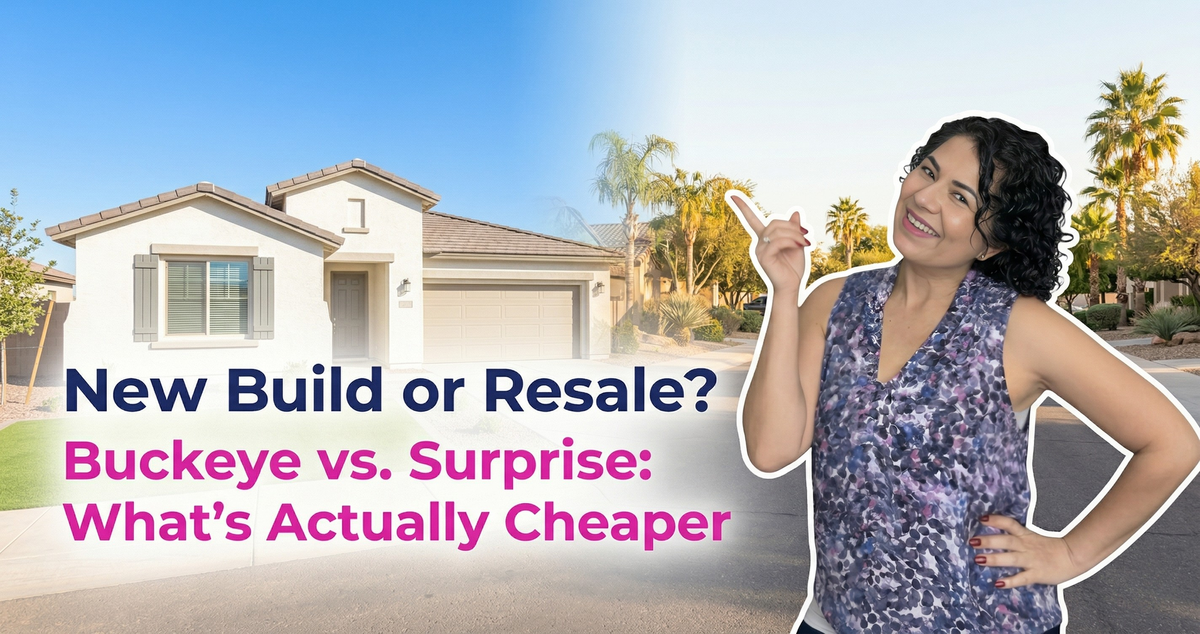
New Build in Buckeye vs. Resale in Surprise: What's Actually Cheaper Right Now?
Trying to decide between a new build in Buckeye and a resale in Surprise? Here's what the numbers actually look like — and the factors that matter more than sticker price.
Is it cheaper to buy a new build in Buckeye or a resale in Surprise right now?
On paper, new builds in Buckeye are currently starting in the high $300s and sitting at a median around $430,000–$433,000, while resale homes in Surprise are hovering around $415,000–$430,000 — making the sticker prices remarkably close. But sticker price is not total cost, and which option is actually cheaper for you depends on a set of factors that vary by buyer: the upgrades a builder bundles (or charges extra for), HOA structures, lot premiums, closing cost incentives, and how much negotiating leverage exists in each market right now.
What the Numbers Look Like Right Now
When buyers ask me which city is "cheaper," I usually start by separating list price from total acquisition cost — because in both Buckeye and Surprise right now, there's meaningful distance between those two numbers.
In Buckeye, the new construction market has deep inventory — over 28 builders active across roughly 50 communities, with new build pricing ranging from the low $300s in more outlying subdivisions to well over $500,000 in communities like Verrado. The median new build price currently sits around $432,990. That number reflects the base home before lot premiums, structural upgrades, or design center selections. A buyer who visits a model home and falls in love with what they see should understand that the base price and the model price are rarely the same number. Builders like D.R. Horton, Meritage, and Lennar are active here with competitive entry-level options, but upgrade costs add up quickly.
In Surprise, the resale market is showing something different. Median sold prices are running between $415,000 and $430,000, and around 60% of resale homes are currently selling below their initial asking price. Homes are averaging roughly 70–75 days on market — which is longer than sellers would like and better than buyers might expect. That pace gives you time to make decisions, conduct your inspections, and negotiate on price or repairs without the pressure that defined the market just a few years ago.
So purely on median price, the two markets are nearly identical. Where they diverge is everything around the purchase.
The Hidden Cost Layer: What Builders Charge That Resale Sellers Don't
This is usually where I slow buyers down, because new construction enthusiasm tends to outpace new construction math.
When a builder prices a home at $399,990, that number often does not include the lot premium for a corner lot or one that backs to open space. It does not include the structural options — an extended patio, an extra bedroom in place of a den, a larger garage. It does not include the design center upgrades that make the model home look the way the model home looks. A buyer who upgrades flooring, cabinetry, countertops, and appliances to something close to what they saw in the model can easily add $30,000 to $80,000 to the base price. In some communities, the gap between base price and fully upgraded is well over $100,000.
On the other side of the ledger, builders do offer something resale sellers rarely can: closing cost assistance. Several Buckeye builders — including Meritage — are currently offering up to 3% of the purchase price toward closing costs, pre-paids, or rate buydowns when using their preferred lender. That's a meaningful incentive. On a $430,000 purchase, 3% amounts to $12,900 that can reduce your out-of-pocket costs or help buy down your interest rate, which affects your payment every single month. The catch is that preferred lender programs don't always offer the most competitive rate on the market. It's worth running the comparison before assuming the incentive is the best financial move.
According to NAR's 2025 Profile of Home Buyers and Sellers, buyers who favor new construction most often cite the desire to avoid renovations and the ability to personalize design features — while buyers who choose resale point to better overall value and lower price. Both instincts are valid in the current West Valley market; the question is which total-cost scenario actually pencils out for your budget.
With a resale home in Surprise, you're buying what you see. The upgrades are already in the home — or they're not — and you're negotiating against market comps, not a builder's price sheet. In a market where 60% of homes are selling below asking and days on market are elevated, there is genuine room to negotiate on price, closing cost contributions, or repair credits after inspection. Under the Arizona Association of Realtors purchase contract, you have a 10-day inspection period to identify any concerns and bring them back to the negotiation table. That leverage is real, and it's the kind of thing a buyer shouldn't leave on the table.
— Gloria B, Buckeye, AZ
HOA, Water, and the Ongoing Costs That Shift the Real Math
One of the things I always walk buyers through is the total monthly cost of ownership — not just the mortgage payment. In both Buckeye and Surprise, HOAs are common, but the structures are different and the details matter.
In Buckeye, larger master-planned communities like Verrado carry HOA dues that can range from $100 to well over $200 per month, depending on the community and the amenities included. Some communities also carry sub-association fees layered on top of the master association. Beyond the HOA, Buckeye's growth has created some water supply nuances buyers should be aware of. Many newer subdivisions in Buckeye are part of the Central Arizona Groundwater Replenishment District (CAGRD), which adds an annual assessment to the property tax bill. It's not a large number, but it's one that surprises buyers who didn't know to look for it. I always ask about CAGRD status before an offer goes in.
In Surprise, HOA fees vary widely — active adult communities like Sun City Grand have their own fee structures, while newer all-ages communities like Prasada and Asante typically run in the $60–$130 per month range. Older resale homes from the 1990s or early 2000s in Surprise may carry lower or no HOA fees, which can make a meaningful difference in monthly cost. It's also worth asking how often HOA dues have increased over the past few years, and whether any special assessments are pending. Those are questions every buyer in an HOA community should be asking before removing contingencies.
Energy costs are one area where new construction in Buckeye has a measurable advantage. Modern builds typically include higher-grade insulation, energy-efficient HVAC systems, and smart home features that can reduce summer utility bills meaningfully compared to a resale home built in the 1990s or early 2000s. Estimates suggest potential savings in the range of $150–$250 per month in utility costs compared to older housing stock. Over the course of a year, that adds up — and it's a real factor in the total cost comparison that often gets overlooked. For a broader look at how buyers are navigating this kind of new-construction-vs-resale decision in today's market, the highlights from NAR's annual buyer and seller profile are worth a read.
Timeline and Certainty: Where Resale Wins on Predictability
At this stage, I help clients narrow their focus to the question of when they need to be in a home, because this is where new construction and resale diverge most clearly.
A resale home in Surprise closes in approximately 30 days once an offer is accepted under the AAR contract. You know the address, the neighborhood, the views, and the neighbors before you sign. What you see is what you're buying. Your move-in date is calculable. For buyers relocating from out of state, managing a job transition, or working around a school enrollment deadline, that certainty has real value.
A new build in Buckeye — depending on the community and the stage of construction — may be a quick move-in home that's available in 30–60 days, or it may be a home that's 6–9 months from completion. Some buyers are fine with that timeline; others find that the uncertainty creates stress and expense (extended leases, storage costs, double moves). Quick move-in inventory in Buckeye exists and is worth exploring if timeline matters — but it also typically means fewer personalization options, since the design choices have already been made.
Buckeye's long-term growth story is well-documented and relevant for buyers thinking about equity. The city has consistently ranked among the fastest-growing in the country, and the City of Buckeye has reported that its planning area — still only about five percent built out — has significant room for continued expansion. For buyers with a 7–10 year horizon, that trajectory matters. For buyers who need certainty in the next 60 days, Surprise's established neighborhoods offer something no new build can: a move-in date you can plan your life around.
— Paul, Surprise, AZ
Resale vs. New Build: What Each Path Looks Like in Practice
The comparison ultimately comes down to what kind of buyer you are — and what "cheaper" means in the context of your full financial picture.
If you need the lowest possible monthly payment today and have flexibility on move-in timing, a new build in Buckeye with a builder incentive package — especially one that includes a rate buydown through the preferred lender — can be a compelling option. You're getting new systems under warranty, energy efficiency, and the ability to personalize your home. The West Valley's long-term growth in Buckeye supports the equity story for buyers with a longer time horizon, and you can explore the current new build inventory in Buckeye to get a real-time picture of what's available across communities and price points.
If you need negotiating leverage now, a defined close date, and a neighborhood that's already built out with established schools, parks, and retail, a resale home in Surprise gives you all of that. With roughly 60% of homes selling below asking price and sellers willing to contribute to closing costs in the current market, a well-priced Surprise resale can close for less than its list price — and sometimes less than a comparable new build after upgrades are factored in.
Neither path is universally cheaper. The right question isn't "which city?" — it's "which total-cost scenario fits my budget, my timeline, and how I plan to live in this home?" For buyers weighing these options across the West Valley, browsing more West Valley home buying guides can help frame the full decision.
Frequently Asked Questions
Do new construction builders in Buckeye pay buyer's agent fees? Most builders in Buckeye do work with buyer's agents and have commission structures in place. However, this varies by builder and community. More importantly, most builders require that your agent accompany you on your first visit to the sales center — if you walk in alone, the builder may not honor your representation. Contact your agent before your first builder visit.
Can I negotiate on a new build in Buckeye? Builders rarely reduce the base price, but incentives are negotiable. Closing cost contributions, rate buydowns, included appliances, and design upgrades are all areas where there is typically room to work. In the current market, many builders are offering meaningful packages to move standing inventory.
Is Surprise a buyer's market right now? Yes, Surprise is currently leaning toward buyer-friendly conditions. Homes are sitting on the market for 70 or more days on average, and a majority of resales are selling below their initial list price. Sellers are more open to concessions, including closing cost contributions, than they were during the 2021–2022 period.
What is the inspection process for a new build in Arizona? Under the AAR contract, the inspection period is 10 days. New construction buyers have the right to bring in an independent inspector — even if the builder discourages it. A third-party inspection on a new build often catches issues that the builder's own walkthrough misses, and it's a step I always recommend.
How do HOA fees compare between Buckeye and Surprise? Both cities have extensive HOA communities, particularly in master-planned developments. Fees vary widely — from under $60 to over $200 per month depending on the community and amenities. Always ask about the HOA history, any pending special assessments, and how frequently dues have increased before removing contingencies.
What Actually Matters in This Decision
The sticker price between a new build in Buckeye and a resale in Surprise is closer than most buyers expect. What's not close are the variables underneath that number — builder incentives, upgrade costs, lot premiums, HOA structures, energy costs, water assessments, timeline certainty, and negotiating leverage.
Buyers who approach this comparison with only the list price in mind often end up surprised at closing. The ones who approach it with the full cost picture — monthly payment, HOA, utilities, taxes, and the actual out-of-pocket to close — make decisions they're confident in for years. That's the conversation worth having before you visit a single model home or submit a single offer.
About the Author
Kasandra Chavez is a real estate advisor serving the West Valley of Greater Phoenix, Arizona, recognized among the top 5% of real estate professionals in the Greater Phoenix area. She works with buyers and sellers to develop strategy aligned with their lifestyle and goals, providing the kind of decision-making support that turns a complicated process into a clear path forward. Kasandra specializes in managing the timelines, contingencies, and market variables that matter most — so her clients are never in the dark and never in breach.
More Helpful Real Estate Videos from Kasandra
Stay confident in your real estate journey with Kasandra’s latest Arizona tips and insights.