
Is It Worth Moving to Buckeye AZ Given the Water Situation and Commute?
Buckeye offers some of the most affordable new homes in the West Valley — but buyers have real questions about water and commute. Here's how to think through both before you decide.
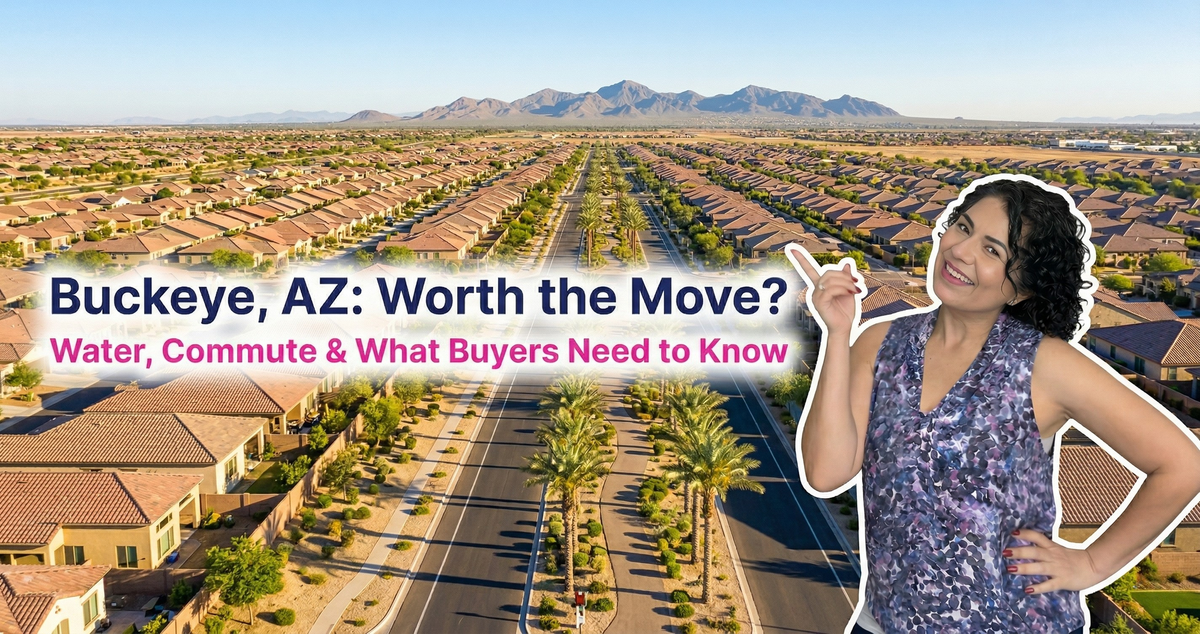
For most buyers, yes — but only if you understand what you're actually choosing. Buckeye offers newer homes, more square footage per dollar, and master-planned communities with amenities that would cost significantly more elsewhere in the West Valley. The water situation affects new development, not the water you drink or your existing home's security. The commute is real and manageable, but it rewards buyers who plan around it rather than ignore it.
If you've been researching Buckeye, you've probably come across headlines about water shortages and long drives. It's enough to make anyone pause — and it should. These are real factors. But context matters enormously here, and most of what you've read online is written for a national audience that doesn't understand how Arizona's water system actually works, or what the commute from Buckeye to central Phoenix actually looks like on a Tuesday morning.
The West Valley has been growing at a pace most cities never see, and Buckeye has been at the front of that wave. With that growth comes complexity — and buyers who ask the right questions before they sign a contract are the ones who feel confident in the decision afterward. That's where having the right guide matters. If you want more context on buying in the West Valley broadly, you can read more about buying in the West Valley — but this post goes deep on Buckeye specifically.
This post is for buyers who are close to a decision and want clarity, not more noise. Let's work through the two questions that actually matter.
What the Water Headlines Are Really About (And What They're Not)
When Arizona's Department of Water Resources paused groundwater certifications for new subdivisions in 2023, the headlines read like Buckeye was running dry. That's not what happened.
The state's action affected one specific thing: the approval process for new housing developments that planned to rely solely on groundwater. Under Arizona's Assured Water Supply program, every subdivision in an Active Management Area must prove a 100-year water supply before selling lots. The 2023 update to groundwater modeling determined that new certifications based on local groundwater alone could no longer be issued in certain areas — including parts of Buckeye. If you bought a home in Verrado, Sundance, Festival Ranch, or most of Buckeye's established communities, your water supply is not in question. Those neighborhoods already hold their Certificate of Assured Water Supply — meaning the state verified their 100-year water access before those homes were ever sold.
What slowed down was the pipeline for brand-new subdivisions that hadn't yet secured a diversified water source. That's a development issue, not a drinking water issue. In fact, the City of Buckeye has confirmed that all existing homes and businesses in the city have a 100-year Certificate of Assured Water Supply already issued by the state. The study's results affect only future development planning — not existing residents.
Buckeye has been actively working to diversify where its water comes from. The city purchased land in the Harquahala Groundwater Basin — a source containing roughly 8 million acre-feet of water — and was approved in 2025 to withdraw thousands of acre-feet annually under a 110-year agreement. The city is also expanding its use of reclaimed water, pursuing effluent water strategies, and working toward becoming a designated water provider under the state's Alternative Designation of Assured Water Supply program.
The practical question for a buyer today is straightforward: does the specific home and community you're considering already have its water certification? That's something you verify before you're under contract — not something to assume.
— Gloria B, Buckeye, AZ
How to Read the Commute Honestly
Buckeye sits approximately 30 miles west of downtown Phoenix via I-10. In off-peak traffic, the drive runs about 45 minutes. In peak rush hour — 7 to 9 a.m. and 4 to 6:30 p.m. — you should plan for 60 to 75 minutes depending on where in Buckeye you're leaving from and where in Phoenix you're headed.
That's a real commute. It's not a short one. And it's worth sitting with rather than rounding down in your head.
The buyers who do well with a Buckeye commute tend to fall into one of a few categories: remote workers who commute two or three days a week rather than five; buyers whose job is in the West Valley itself — Goodyear, Avondale, or the growing industrial and logistics corridor along I-10; families where one partner commutes and the other doesn't; and buyers who deliberately choose an earlier or later start time to shift around the worst of the traffic.
Valley Metro Route 563 — the Avondale/Buckeye Express — offers a park-and-ride option into Phoenix for buyers who don't want to drive every day. It's not a perfect substitute for a short commute, but it's worth knowing about if flexibility is part of your household plan. The city of Buckeye also offers Route 685 connecting to Phoenix, Monday through Friday.
The commute question is really a lifestyle math question: how many days a week will you be driving, what hours, and how much does the space and value proposition of Buckeye offset it? This is usually where I slow buyers down — not to discourage them, but to make sure they've actually run that math for their specific situation rather than a generic one.
What Buckeye Actually Gives You in Return
According to recent market data from Redfin, the median sale price in Buckeye was approximately $400,000 in late 2025. Buyers are getting newer construction, larger lots, and master-planned amenities at price points that simply don't exist closer in. Communities like Verrado, Sundance, and Festival Ranch offer resort-style pools, walking paths, fitness centers, and established retail — without the premium you'd pay to be 15 miles closer to downtown.
New builds are still moving in established communities where water certifications are in place. And because Buckeye's growth was partially constrained by the development pause, there's less speculative overbuilding pressure than you might expect — which matters if you're thinking about long-term value, not just today's entry price.
HOA fees are part of the picture in nearly every Buckeye master-planned community. Before you fall in love with a specific neighborhood, it's worth understanding current dues, how often they've increased in recent years, and whether there are any pending special assessments. Some communities have reviews scheduled for exterior paint standards and shared infrastructure — factors that affect your true monthly cost.
The Real Calculus: What Kind of Buyer Does Well in Buckeye?
Buyers who tend to thrive after moving to Buckeye share a few things in common. They either work locally or have flexibility in how and when they commute. They prioritize space — square footage, yard size, community amenities — over proximity to the urban core. They've bought into an established neighborhood with verified water supply, not a speculative fringe development. And they've looked honestly at the full monthly cost picture: mortgage, HOA, and the reality of fuel and time for their specific commute pattern.
At this stage, I help clients narrow their focus to the specific communities within Buckeye where both the water certification question and the commute math work for their household — because not every neighborhood inside city limits tells the same story.
The buyers who run into trouble are usually the ones who bought on price alone, picked the most affordable lot at the furthest edge of the development map, and underestimated what five days a week on I-10 would feel like by month six.
— Eli R, Buckeye, AZ
What to Verify Before You Make an Offer
There are four things worth confirming before you go under contract on any Buckeye property.
First, confirm the community's water certification status with your agent. Established neighborhoods with a Certificate of Assured Water Supply are in a fundamentally different position than speculative developments that were affected by the 2023 pause. The Arizona Department of Water Resources maintains records of all certified areas and designated providers.
Second, get the real HOA picture — current dues, the history of increases, any scheduled community reviews, and rules around storage of RVs, boats, or trailers if those matter to your household. What I watch for here is the gap between what buyers assume HOA fees cover and what they actually pay for once they're inside a community.
Third, drive the commute yourself — at rush hour, on a weekday, from the specific neighborhood you're considering to wherever you'll actually be going. A 45-minute off-peak drive becomes a different conversation at 7:45 a.m.
Fourth, understand Arizona's purchase process before you're in it. The Arizona Association of Realtors residential contract includes a 10-day inspection period and five contingency clauses, each with its own timeline. In Arizona, your title company handles escrow and closing — not an attorney — and closings typically happen in approximately 30 days. These aren't things to learn after you're already under contract.
Frequently Asked Questions
Is the water safe to drink in Buckeye right now? Yes. The water situation in Buckeye involves the approval process for new development, not the safety or availability of water for existing residents. The city's drinking water meets state and federal compliance standards, as documented in its annual Water Quality Report.
Which Buckeye communities have their water supply secured? Established master-planned communities including Verrado, Sundance, Festival Ranch, and Tartesso have Certificates of Assured Water Supply already in place. Newer or more remote developments may have different situations — this is a question to ask specifically about any community you're considering. [VERIFY - Arizona Accuracy: confirm current CAWS status of specific communities before publishing]
How long does the commute from Buckeye to Goodyear or Avondale take? Goodyear and Avondale are significantly closer — most Buckeye residents can reach Goodyear in 15 to 20 minutes, making the growing West Valley employment corridor a realistic daily drive.
What does the AAR contract inspection period look like in Buckeye? Under the Arizona Association of Realtors residential purchase contract, the standard inspection period is 10 days. This applies to both resale and, in many cases, new construction — though builder contracts can differ and should be reviewed carefully.
Will the water issue affect my home's future resale value in Buckeye? This is a fair concern, and the honest answer is: it depends on the community and how Arizona's water policy continues to evolve. Homes in certified communities in established neighborhoods have held their value. The long-term picture for the city's overall portfolio is more positive than 2023 headlines suggested, given the Harquahala basin agreement and the state's ADAWS pathway — but no agent can give you a definitive prediction on policy outcomes.
IN CONCLUSION
Buckeye is not the right move for every buyer. But for buyers who are honest about their commute reality, who choose an established community with secured water infrastructure, and who value space and newer construction over proximity — it's a legitimate and often very smart choice.
The questions you're asking are exactly the right ones. The work is in getting specific answers for your specific situation: the neighborhood you're looking at, your actual drive pattern, your household's lifestyle priorities. That specificity is what the decision should be built on, not headlines.
About the Author
Kasandra Chavez is a real estate advisor serving the West Valley of Greater Phoenix, Arizona, recognized among the top 5% of real estate professionals in the Greater Phoenix area. She works with buyers and sellers to build strategy aligned with their lifestyle and goals, providing decision-making support through every stage of the transaction. Kasandra is known for managing timelines and contingency periods so her clients are never caught off guard during the process.