
Can I Afford a 4-Bedroom Home in Verrado If I Work at the New 303 Corridor Logistics Hubs?
If you work at one of the 303 corridor logistics hubs in Goodyear or Glendale, a 4-bedroom home in Verrado is closer than you might think — here's how the numbers actually work.
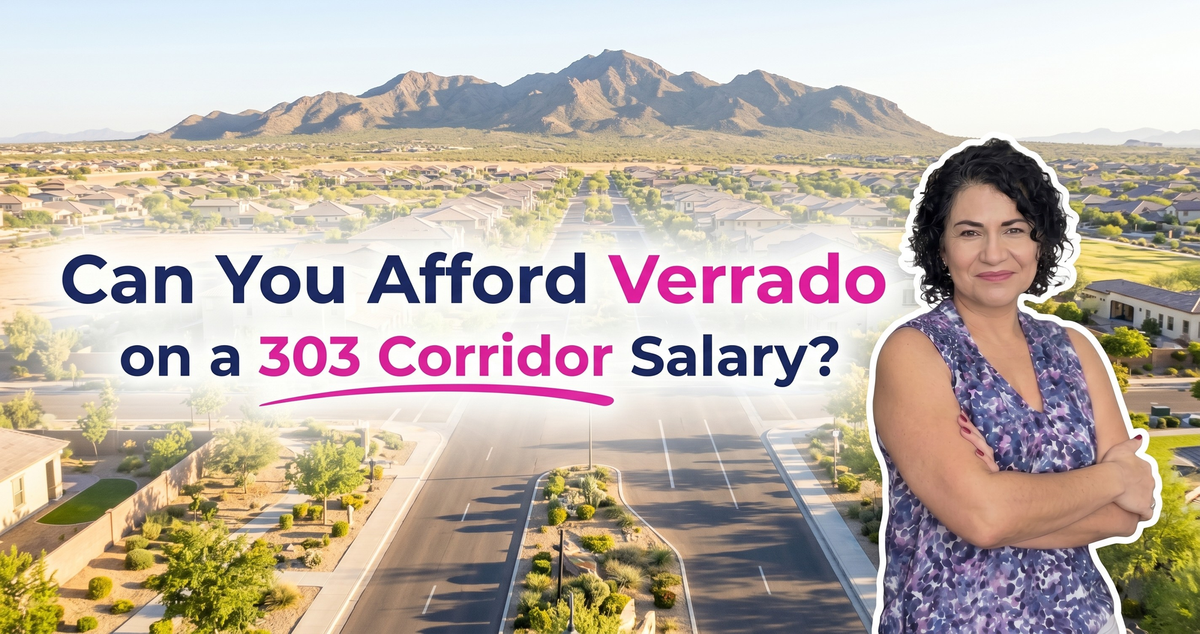
Yes — for many households earning between $75,000 and $110,000 annually, a 4-bedroom home in Verrado is within reach, particularly when you factor in down payment assistance programs and Verrado's range of price points. The math is tighter than it was two years ago, but it's not out of reach if you know exactly what to target and how to position yourself before you start shopping.
You've landed a job — or you're about to — at one of the distribution centers, logistics parks, or manufacturing facilities that have transformed the Loop 303 corridor into one of the most economically active stretches of freeway in the Southwest. Amazon, Boeing/XPO, FedEx, UPS, Daimler Trucks, and dozens more have made the Goodyear and Glendale stretch of the 303 one of the most significant industrial zones in the country. And the natural question is: if I'm going to work out here, can I actually live out here? Specifically, can I get into Verrado — that master-planned community sitting right at the base of the White Tank Mountains in Buckeye — with four bedrooms and enough space for my family?
That question deserves a real answer, not a generic affordability calculator result. Because Verrado isn't a monolith. There are price points you've probably never seen in a quick Zillow search, HOA layers that affect your monthly number in ways that aren't obvious, and timing decisions that could either open the door for you or close it. This is where I help buyers stop guessing and start planning.
What 4-Bedroom Homes in Verrado Actually Cost Right Now
Before anything else, you need to know the actual price landscape. Verrado's median home price has hovered around $525,000, but that number masks a wide range. Four-bedroom homes in Verrado can run anywhere from the mid-$400s on the resale side — particularly for older inventory or homes without upgraded finishes — up into the $600s and beyond for newer builds with premium lots. If you're curious about how Verrado compares to nearby communities before going further, the HOA Fees in Verrado vs. Tartesso guide breaks down the cost-of-living differences for buyers working within a $450K budget.
The community is divided into distinct districts: Verrado Heritage, Verrado Village, Verrado Highlands, and the 55+ Victory section. For a working family focused on a 4-bedroom footprint, Heritage and Village tend to offer the most options at the most accessible price points. Highlands skews newer and often carries higher price tags. Builders like Toll Brothers, David Weekley, Ashton Woods, Lennar, and Meritage are active in Verrado, and new construction sometimes comes with builder incentives — rate buydowns, closing cost credits — that can meaningfully change your monthly payment even at a higher purchase price.
The important frame here: you're not just buying a home. You're buying into the HOA structure, Main Street access, 70-plus parks, the school system, and a commute that puts you 10–20 minutes from the heart of the Loop 303 industrial zone depending on where your facility sits. That commute math matters when you're comparing Verrado to something cheaper further out in Buckeye or across town.
Running the Affordability Numbers for 303 Corridor Workers
Here's where I slow buyers down, because most people come to this conversation with a salary figure and a purchase price and assume the gap between them is the only thing that matters. It isn't.
Logistics and distribution roles along the 303 corridor range widely — from operations and warehouse positions in the mid-$50,000 range to supervisory, logistics management, and technical roles pushing $85,000 to $110,000 or more. The NAR Housing Affordability and Supply report puts useful context around this: households earning $100,000 annually can access roughly 37% of listings nationally — a figure that's still below pre-pandemic norms but has improved modestly year over year. In the West Valley, where supply has been more active than many coastal markets, that access is somewhat broader for buyers who shop strategically.
If you're in the $70,000–$90,000 range as a household (solo earner), the 4-bedroom conversation in Verrado requires a careful construction of your offer: a meaningful down payment, a solid pre-approval, and ideally some seller concessions built into your offer strategy.
A dual-income household at that same range shifts the picture considerably. Two earners bringing in a combined $120,000–$140,000 are looking at a genuinely comfortable entry into the mid-$400s to low-$500s in Verrado without overextending.
The general guideline I walk clients through: your housing costs (mortgage principal and interest, property taxes, HOA, insurance) should stay at or under 35–40% of gross monthly income. For a $475,000 purchase with 5% down at current interest rates, your principal and interest alone is likely in the $2,800–$3,000 range depending on your rate. Add Verrado's HOA fees, property taxes, and homeowner's insurance, and you're realistically looking at $3,400–$3,800 per month in total housing costs before utilities. That math works comfortably for a household clearing $110,000–$120,000 annually. For a household at $80,000–$90,000, it works but leaves less margin.
Earnest money in the Phoenix metro typically runs 0.5–1% of the purchase price under current market conditions — so on a $475,000 home, you're looking at roughly $2,400–$4,750 upfront, which then applies toward your down payment at closing.
— Donna R, Peoria, AZ
Understanding Verrado's HOA Structure Before You Fall in Love With a Price
This is a piece most buyers miss until it's too late. Verrado operates with layered HOA fees, meaning there's a master HOA and potentially a sub-HOA depending on which district and builder section you're in. The master HOA covers the community's amenities — the pools, fitness center, parks, Main Street maintenance, and community programming. A sub-HOA may cover additional neighborhood-specific maintenance. For a deeper look at how Verrado's HOA structure stacks up against other Buckeye communities on a similar budget, the 303 Expansion: Is Verrado Getting Too Crowded or More Valuable? post covers how that growth is reshaping the value proposition here.
The combined HOA cost can range from roughly $100 to $200+ per month depending on the section. That's not a trivial number when you're building a monthly budget. At the top end, it could add $2,400 or more annually to your housing costs over and above what shows up in a mortgage payment estimate. It also affects how much a lender will qualify you for, since HOA fees are factored into your debt-to-income calculation.
At this stage, I help clients narrow their focus to the specific districts and price bands within Verrado where the HOA structure aligns with their pre-approval and budget, rather than starting with aesthetics and working backward. A home that looks right at $490,000 can become the wrong home fast if the combined HOA adds $180 per month you hadn't planned for.
Beyond the monthly fees, it's worth knowing how often HOA dues have increased in recent years, whether any special assessments are pending, and — especially if you're planning to park an RV or boat — exactly where the HOA stands on that. Verrado has specific rules, and knowing them before you fall in love with a property saves everyone a difficult conversation.
The Commute Advantage That Makes Verrado Make Sense
One of the underappreciated arguments for Verrado is the commute logic. The City of Goodyear Economic Development office lists more than 30 major employers along its 303 and Cotton Lane corridors — including Amazon, Boeing/XPO, FedEx, Daimler Trucks, UPS, PepsiCo, and Home Depot. If your job is at one of these facilities, Verrado puts you 10 to 25 minutes from work depending on traffic and exact facility location.
Compare that to buying in a lower-priced market further east, where your dollar goes further but your commute adds 45–60 minutes each way. That time has real value: fuel costs, vehicle wear, hours of your life. When buyers do that math honestly, the effective cost difference between Verrado and a cheaper East Valley option shrinks considerably.
Verrado also positions you inside the Buckeye city limits, which is one of the fastest-growing cities in the country and sits in the direct path of continued 303 corridor expansion. The infrastructure growth — the new Verrado Marketplace with Target and Safeway, Buckeye Commons anchored by Costco, and ongoing retail development — means your quality of life isn't dependent on driving 20 miles for groceries or errands. For families with kids, the A-rated Verrado schools (Verrado Elementary, Verrado Middle School, and Verrado High School) add a dimension to the value that doesn't show up in a square footage comparison.
What the Buying Process Looks Like in Arizona for This Transaction
Arizona closings are handled by title companies — not attorneys. There's no attorney review period. Once you're under contract on a home in Verrado using the Arizona Association of Realtors (AAR) purchase contract, you'll have a 10-day inspection period under the standard terms. That window is your opportunity to bring in inspectors, review the Seller's Property Disclosure Statement (SPDS), flag concerns, and negotiate repairs or credits if something turns up.
Closing in Arizona typically runs approximately 30 days from the time you're under contract. For buyers who are relocating from out of state and coordinating a move with a job start date, that timeline matters enormously. Getting your pre-approval in place — fully, not just a soft pre-qualification — before you start shopping in Verrado is non-negotiable. The market moves, and if you find the right 4-bedroom home, you need to be ready to move without delay.
If you're considering new construction from one of the active Verrado builders, the timeline is different — often 6 to 12 months for a true custom build, with a range of options in between for quick-delivery inventory homes. Builder contracts operate differently from the standard AAR form, and having representation in those conversations protects you from conceding terms that an experienced buyer's agent would typically negotiate.
— Gloria B, Buckeye, AZ
Frequently Asked Questions
How much do I need to earn to afford a 4-bedroom home in Verrado?
A household income of $100,000–$120,000 puts a 4-bedroom home in the $450,000–$525,000 range within comfortable reach, keeping total housing costs at roughly 35–40% of gross monthly income. Dual-income households have more flexibility across Verrado's price spectrum.
Are there down payment assistance programs available for Buckeye buyers?
Yes. Arizona offers programs through the Arizona Department of Housing (ADOH) and the Home Plus program that provide down payment and closing cost assistance for qualifying buyers. Income and purchase price limits apply. [VERIFY - Arizona Accuracy]
How does Verrado's HOA affect my mortgage qualification?
Lenders factor HOA fees directly into your debt-to-income ratio. Combined HOA fees in Verrado can range from approximately $100–$200+ per month depending on the district. This reduces the purchase price you qualify for compared to a non-HOA community, so it's critical to account for this before you start shopping.
Is Verrado a good fit for shift workers at the 303 corridor facilities?
Verrado's proximity to the Goodyear and Glendale industrial parks makes it a practical choice. The Loop 303 and I-10 access is direct, and the community's amenities — on-site schools, Main Street retail, and parks — reduce the need to drive elsewhere for daily needs, which matters when you're working non-standard hours.
What happens during the 10-day inspection period in Arizona?
Under the AAR contract, you have 10 days from contract acceptance to conduct inspections and review the seller's SPDS disclosure. If material issues arise, you can negotiate repairs, request credits, or — if the issues are serious enough — walk away and receive your earnest money back within the inspection window.
Closing
The 303 corridor isn't just a place to work anymore — it's anchored a whole geography of living in the West Valley, and Verrado sits at the center of that shift. The community was designed for exactly the kind of family you're building: one that wants A-rated schools, walkable Main Street access, mountains in the backdrop, and a commute that doesn't consume the hours you're trying to protect.
Whether a 4-bedroom home in Verrado works for your income comes down to building the budget correctly — not just the mortgage payment, but the HOA layers, property taxes, and where your salary actually sits on the qualification scale. Those numbers, run with precision before you fall in love with a property, are what make this decision feel clear instead of overwhelming. You don't have to figure that out alone.
Kasandra Chavez is a real estate advisor serving the West Valley of Greater Phoenix, Arizona, recognized among the top 5% of real estate professionals in the Greater Phoenix area. She works with buyers and sellers to align strategy with lifestyle and long-term goals, providing the decision-making support that turns a complicated process into a clear one. Her approach centers on managing timelines, protecting her clients from avoidable risk, and keeping every transaction on track from pre-approval through close.