
Litchfield Square or Verrado Main Street for Walkability?
One walkable West Valley core is finished and working. The other is still being built. Here's how to choose between Litchfield Square and Verrado's Main Street.
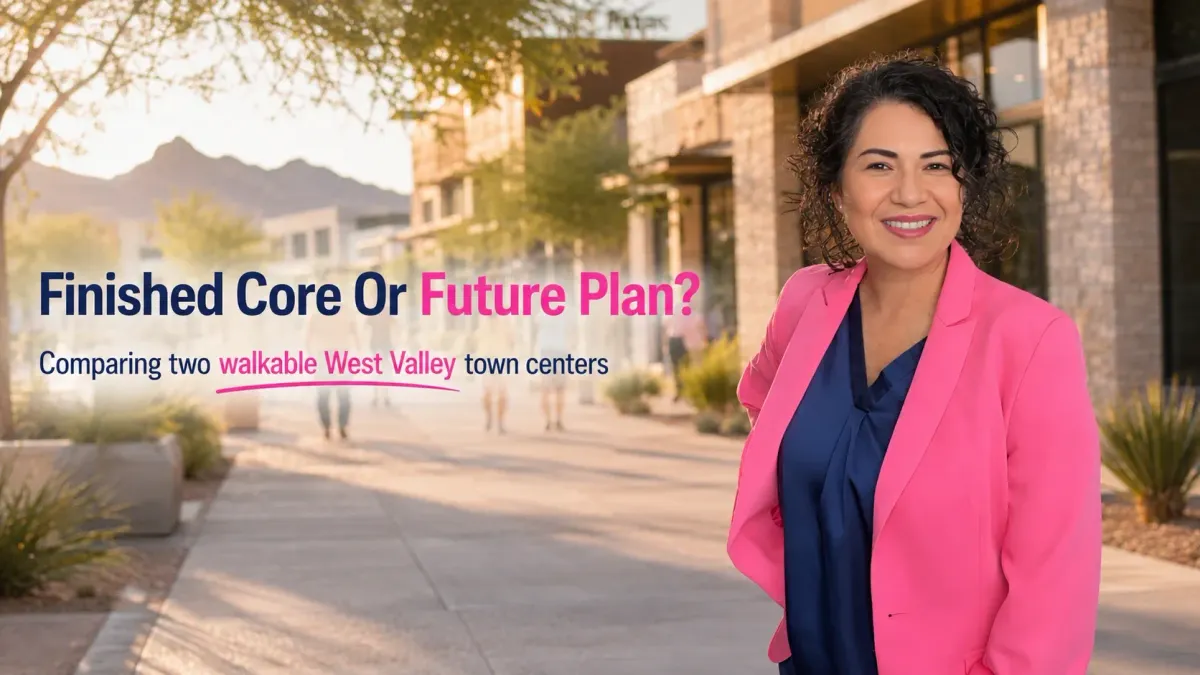
Which West Valley walkable town center is the better buy — Litchfield Park's new Plaza del Parque at Litchfield Square, or Verrado's Main Street?
They're at completely different stages, and that's the whole decision. Verrado's Main Street in Buckeye is a finished, functioning walkable core you can experience today. Litchfield Square in Litchfield Park is a 26-acre downtown under construction, where Plaza del Parque broke ground in June 2026 and future phases are still being planned. If you want walkability now, Verrado delivers it. If you're willing to buy ahead of a core that's still forming, Litchfield Park is the bet.
Walkability has become one of the most requested features in the West Valley, and it's genuinely scarce here. Most communities are built around driving, so the handful of places with a real pedestrian core attract a premium and a lot of buyer attention.
That scarcity also creates confusion, because "walkable town center" gets used to describe both a district that's been operating for two decades and one that exists mostly in renderings. Those are very different purchases with very different risks. What I watch for here is a buyer paying a finished-core premium for a core that hasn't been built yet. Here's where each one actually stands.
What Is Litchfield Square and Where Does Plaza del Parque Fit?
Litchfield Square is Litchfield Park's new downtown — a 26-acre mixed-use urban hub the city describes as walkable and community-oriented, with 40,000 square feet of commercial space under construction, an additional 64,000 square feet under review, and future phases planned to add more than 200,000 square feet of buildable area.
Plaza del Parque is the second major project inside it. Developers broke ground in June 2026 at North Litchfield Road and West Village Parkway on a three-story building planned to hold retail, a dining space with a large outdoor patio, office suites, and landscaped public gathering areas. Heritage Place, the first project, has been under construction ahead of it.
The honest read for a buyer: Litchfield Square is real, funded, and moving, with the city publishing construction progress as it goes. It is also years from being the finished downtown the renderings depict. Buying in Litchfield Park today means buying into an established small city of roughly 7,000 people whose walkable core is under construction, not complete.
How Verrado's Main Street Compares as a Finished Walkable Core
Verrado's Main Street in Buckeye is the West Valley's most established example of what Litchfield Square is trying to become. It has been operating for roughly two decades as part of the Verrado master plan at the base of the White Tank Mountains, with a pedestrian-oriented street of shops, restaurants, and gathering space woven into surrounding neighborhoods.
The practical difference is that you can visit Verrado's Main Street on a Saturday and know exactly what you're buying. You can see which storefronts are occupied, how busy it is at dinner, whether the walk from the neighborhoods you're considering is actually pleasant in June. None of that is available to a Litchfield Park buyer yet, because the answer doesn't exist.
The trade-off runs the other way on price and appreciation. A finished amenity is already reflected in what homes near it cost. I've written more on Verrado's long-term picture in whether Verrado in Buckeye is a smart long-term buy and on how growth pressure is affecting it in whether the 303 expansion is making Verrado too crowded or more valuable.
— Dustin T, Glendale, AZ
Buying Into a Finished Town Center Versus One Still Forming
The two purchases carry opposite risk profiles, and the table below is the clearest way to see it.
| What you're weighing | Verrado Main Street, Buckeye | Litchfield Square, Litchfield Park |
|---|---|---|
| Stage | Established and operating | Under construction, phased over years |
| What you can verify today | Tenants, foot traffic, the actual walk | Plans, entitlements, construction progress |
| Setting | Master-planned community with its own neighborhoods | Established small city with existing housing stock |
| Housing near the core | New construction and resale within the master plan | Mostly existing homes, limited new supply |
| Main risk | The amenity is already priced in | Timeline and final tenant mix are unknown |
Read the last row as the real question. In Verrado you are paying today for something you can confirm. In Litchfield Park you are paying less for the amenity because it isn't finished, and taking on the risk that it lands differently or later than planned.
What I Watch For When Buyers Pay a Premium for Walkability
I check whether the walk is actually walkable from the specific home, because proximity on a map and proximity in July are different things in Arizona. This is usually where I slow buyers down, since the premium attaches to the idea of walking to dinner far more reliably than to the practice of it.
When a buyer is weighing a home for its access to a town center, five things determine whether that premium is worth paying:
- Real walking distance: Measure the actual route from the front door, not the straight-line distance, and account for arterial crossings.
- Summer viability: A ten-minute walk is pleasant eight months a year in the West Valley and punishing in the other four, which changes how often you'll really use it.
- Tenant durability: In a forming core, early tenants turn over. Ask what's signed and open versus announced.
- Parking and traffic spillover: Homes closest to a successful town center absorb the event traffic and evening parking that come with it.
- What the premium already reflects: In a finished core the walkability is in the price, so the question is whether you'd pay it again on resale.
Which Fits Which Buyer: Litchfield Park or Verrado?
Verrado in Buckeye fits a buyer who wants the amenity now and is comfortable paying for a proven one. If your reason for choosing a walkable community is that you intend to use it this year — dinners out, weekend mornings, events you can walk to — buy the finished core. You'll also have a wider range of housing to choose from, since Verrado offers both new construction and resale within the master plan.
Litchfield Park fits a buyer with patience and a longer horizon who likes the city as it is today, independent of Litchfield Square. That last part matters. If the existing character, the Wigwam Resort area, and the established housing stock appeal to you on their own, then the downtown build-out is upside rather than the whole thesis. If Litchfield Square is the entire reason you're interested, you're buying a plan. For more on the city itself, see whether Litchfield Park's historic core is worth paying more for and how the downtown project affects residential property values.
Frequently Asked Questions
Is Litchfield Square finished?
No. It is a 26-acre downtown under construction, phased over years. Roughly 40,000 square feet of commercial space is under construction with more under review, and future phases are planned to add substantially more buildable area.
When did Plaza del Parque break ground?
June 2026, at North Litchfield Road and West Village Parkway. It is the second major project within Litchfield Square, following Heritage Place, and is planned as a three-story mixed-use building.
Is Verrado's Main Street already built?
Yes. Verrado's Main Street in Buckeye has been operating for roughly two decades as the pedestrian core of the Verrado master plan, so buyers can evaluate tenants, activity, and the walk itself before committing.
Which is the better investment, Litchfield Park or Verrado?
It depends on risk tolerance. Verrado's walkability is proven and already reflected in nearby home prices. Litchfield Park's is cheaper today because it is unfinished, with timeline and tenant-mix risk attached.
Can you walk to Litchfield Square from most Litchfield Park homes?
It varies considerably by neighborhood. Measure the actual walking route from a specific address rather than relying on the city's small overall size, and consider what that walk feels like in summer.
The Bottom Line
This isn't really a comparison of two town centers. It's a choice between buying a finished amenity and buying a plan, and both are legitimate depending on your timeline.
If you want to walk to dinner this year, Verrado's Main Street is the West Valley's proven option and you should expect to pay for that certainty. If you're drawn to Litchfield Park on its own merits and can wait out a multi-year build, Litchfield Square is a genuine opportunity to be there before the core is complete. What doesn't work is paying a finished-core premium in a place where the core is still under construction — so before you decide, walk both, and measure the route from the actual front door.
I'm Kasandra Chavez, REALTOR® and Team Lead of the Chavez Dream Home Team with Real Broker, serving the West and Northwest Valley of Greater Phoenix, Arizona, and recognized among the top 5% of real estate professionals in the Greater Phoenix area. If walkability is driving your search, I'm happy to walk both with you and look honestly at what each one delivers today versus what it's promising later.
Have Questions About West Valley Real Estate?
Kasandra Chavez provides free, no-obligation consultations for buyers, sellers, and investors.
Schedule a Consultation