How the Litchfield Park City Center Project Affects Home Values
The Litchfield Park City Center is moving from concept to construction. Here is how the project realistically affects nearby home values and seller timing.
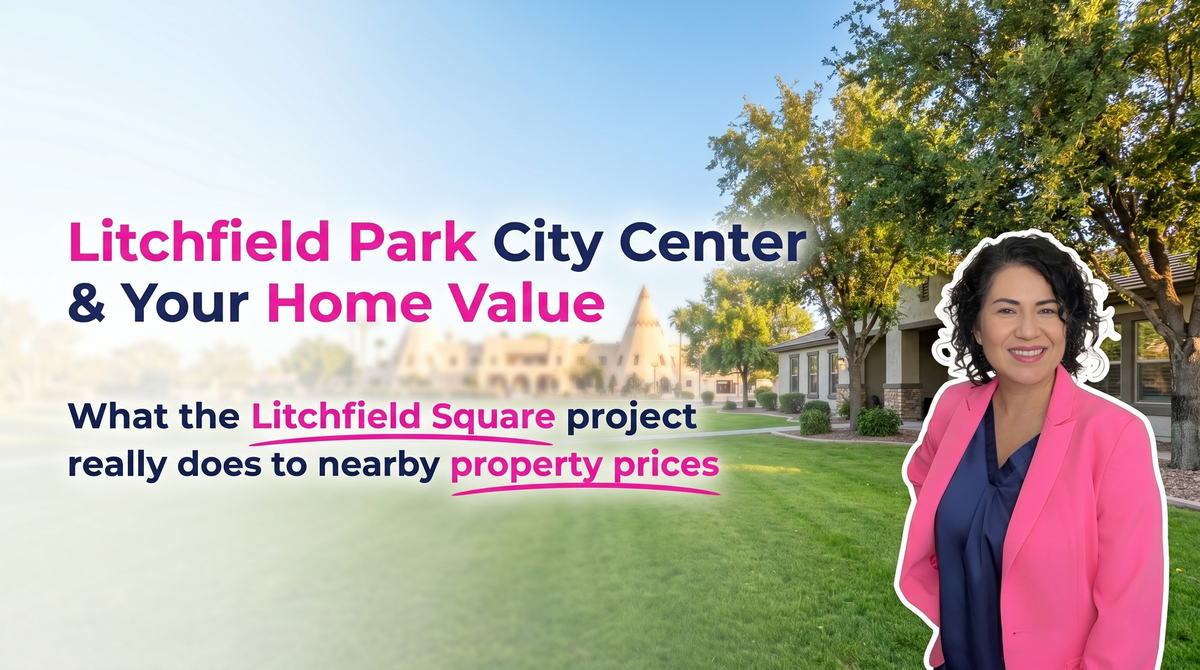
The City Center — now branded as Litchfield Square — is a long-term value anchor, not a short-term price spike. Expect modest appreciation lift on nearby homes during the early construction years, stronger lift once tenants are open and operating, and the strongest lift for properties within walking distance of the 26-acre site. Selling before the project is fully built out typically leaves some value on the table, but only if holding longer actually fits your plans.
You are sitting on a Litchfield Park home, watching cranes and grading equipment work the dirt north of Wigwam Boulevard, and wondering whether to list now or wait. I get it. This is one of the most common timing questions I am hearing from Litchfield Park owners in 2026, and there is no universal answer — but there is a clear framework.
What the Project Actually Is in 2026
Litchfield Square — the 26-acre mixed-use development many locals still call "City Center" — is planned for approximately 400,000 square feet of retail, restaurant, office, and residential space across more than a dozen buildings in five phases. The site sits on the east side of Litchfield Road, north of Wigwam Boulevard, across from the Wigwam Resort. The first commercial building, Heritage Place at Litchfield Square, is a roughly 40,000-square-foot cluster of office, restaurant, and retail space on the northern portion of the site. The Arizona Department of Forestry also sits nearby with related infrastructure work underway.
Demolition and site prep have been ongoing. The master plan has been approved, phase one commercial construction is active, and the City of Litchfield Park's FY2026-FY2031 Capital Improvement Program has funded major adjacent projects, including the Brinton Avenue Roundabout (targeted for August 2026) and the Litchfield Road Underpass (targeted for spring 2027). Together, these projects are rebuilding the heart of downtown Litchfield Park, not just adding a shopping center.
How Projects Like This Actually Move Home Values
Here is what I see from similar West Valley projects that have come online over the last five to seven years: nearby home values respond in three phases. Phase one is the "approval and announcement" lift — typically a small, quiet uptick driven by buyer psychology and long-term investor interest. Phase two is the "construction drag" — a neutral-to-slightly-negative window where noise, dust, and traffic reroutes make daily life less pleasant, and some price-sensitive buyers will shave their offers. Phase three is the "operational lift" — often the biggest jump, which arrives once tenants are actually open and neighbors can walk or bike to coffee, dinner, offices, and community events.
Litchfield Park in 2026 is somewhere in the middle of phase one and phase two, depending on your block. If your home is within a short walk of the site, you are closer to phase two dynamics right now — some construction noise and disruption, but long-term value being built around you. For a broader view of how infrastructure and market timing interact for West Valley sellers, this look at how to think about selling timing in an evolving market is useful background.
Who Benefits Most — And Who Benefits Least
Not every Litchfield Park home will see the same lift. The homes most likely to benefit strongly are those within walking distance of the Litchfield Square site, older homes that already have mature landscaping and can market "walkable downtown lifestyle," and properties near the Wigwam Resort corridor that already benefit from the Four-Diamond hotel's draw. The homes least likely to see a meaningful lift from Litchfield Square itself are those several miles out, especially homes whose primary buyers are commuting east to Phoenix and whose daily lives will not actually change when a restaurant opens on Litchfield Road. Those homes will still benefit from Litchfield Park's overall trajectory — the city has one of the highest median household incomes in Arizona — but attributing a specific lift to Litchfield Square is harder.
— Michael R, Avondale, AZ
Should You List Now or Wait?
This is usually where I slow sellers down. The reflexive answer — "wait until the restaurants are open and I can sell at the peak" — is not always right, for a few reasons. First, you are trading known market conditions today for unknown conditions in two or three years. Mortgage rates, buyer demand, and even broader price trends could all move in ways that offset the Litchfield Square lift. Second, many of the biggest value gains from projects like this show up gradually, which means you may not capture a dramatic single-year spike regardless of timing. Third — and this is the one most owners underestimate — the next two years will include construction dust, extra traffic, and temporary disruption that some buyers will actively discount.
What I watch for here is whether your life needs the move now. If you need to downsize in 2026, you need to downsize in 2026. If you are moving for a job, you move for the job. The Litchfield Square premium is real, but it is not large enough to hold a home you genuinely want to sell. On the other hand, if you are indifferent about timing and your financial situation allows you to wait until roughly 2028 or beyond when more tenants are operating, there is a reasonable case for holding. For more on how to evaluate whether a timing decision actually serves your goals, this breakdown of seller timing considerations walks through the key questions.
Pricing a Home Near an Active Project
If you do list during active construction, pricing strategy matters more than usual. Buyers will often ask for disclosures about construction timelines, noise, truck routes, and what the view will look like when phase two buildings go vertical. Under the Arizona Association of Realtors (AAR) purchase contract framework, the Seller's Property Disclosure Statement (SPDS) is where material information about the neighborhood and property conditions gets formally shared. Your listing agent should be proactive about explaining what is under construction, what is already approved, and where the project timeline stands — because guessing at this on the buyer's side almost always produces lower offers than honest, upfront disclosure.
A properly priced listing also factors in the reality that the typical AAR 10-day inspection period applies in the Phoenix metro, earnest money is typically 0.5-1%, and closings run approximately 30 days. Sellers near active construction sometimes see buyers use the inspection period to renegotiate over things they feel they "found" after the contract, when in fact those things were fully disclosed up front. Strong disclosure protects your price and the deal.
— Amanda A, Anthem, AZ
What Other Litchfield Park Developments Are Doing in Parallel
Litchfield Square is the headline, but it is not the only thing moving in Litchfield Park in 2026. The P.W. Litchfield Heritage Center broke ground in March 2026 and will convert the historic Litchfield/Denny home into a museum focused on the region's history. Sun Health is developing LakeSide at La Loma at the NWC of Litchfield and Camelback Roads. Adjacent infrastructure — including the Brinton Avenue Roundabout and the Litchfield Road Half-Street Improvements targeted for August 2026 — is knitting the downtown core together. For sellers, that is important context: you are not just selling near one project. You are selling in a city that is actively investing in its walkable core, which is exactly what long-term buyers value.
Frequently Asked Questions
Is Litchfield Square the same thing as Litchfield Park City Center? Yes. The development was originally planned and discussed for decades as "City Center" and has been rebranded as Litchfield Square. It is the same 26-acre mixed-use project.
Will my home value drop during the construction years? Not typically. The most common pattern is a small appreciation drag in the immediate construction window, followed by a larger recovery and gain once tenants are operating. The net effect over three to five years is usually positive.
Do I have to disclose the nearby construction to buyers? Arizona law requires sellers to disclose material facts known to them about the property and neighborhood. The Seller's Property Disclosure Statement is the standard vehicle for this under the AAR contract framework.
Does the project affect property taxes? The City Center project itself does not directly change your home's property taxes. Property taxes in Arizona are driven primarily by assessed valuation, levy rates, and state law — not by nearby commercial development.
Should I renovate before selling a home near Litchfield Square? Usually no. Most ROI studies show that major renovations just before listing often underperform cosmetic updates. Focus on paint, curb appeal, and minor repairs rather than full remodels unless your home has a major condition problem.
The Bottom Line
Litchfield Square is a real and meaningful value anchor for nearby Litchfield Park homes, but its effect is gradual, not dramatic. The homes closest to the site benefit most. The construction years are messy. The operational years are strong. If you need to sell now, sell now — the premium from waiting is rarely large enough to justify holding a home you want to move out of. If you are on the fence, it is worth modeling what holding one to three more years would actually cost you, and weighing that against the likely appreciation lift when phase two and phase three tenants open their doors. The city is investing in its core, and long-term Litchfield Park owners have good reason to feel confident about where their equity is heading.
Kasandra Chavez is a real estate advisor serving the West Valley of Greater Phoenix, Arizona, and has been recognized among the top 5% of real estate professionals in the Greater Phoenix area. She helps buyers and sellers align strategy with lifestyle and goals, providing clear decision-making support throughout the home sale process. Her focus is on managing pricing, disclosures, and market timing so homeowners can navigate complex neighborhood-level decisions with confidence.