Is Verrado in Buckeye a Smart Long-Term Buy in 2026?
Is Verrado in Buckeye a good fit if you want small-town feel now but long-term value as Buckeye grows? Here's how the community holds up against both tests.
Is Verrado in Buckeye a good fit if I want small-town feel now but long-term value as Buckeye grows into a major Phoenix suburb?
For most buyers seeking that combination, yes — Verrado is one of the better-positioned master-planned communities in the West Valley to deliver both. The community's New Urbanism design genuinely creates the small-town walkability buyers are looking for, and Buckeye's sustained growth trajectory supports the long-term value side. The trade-offs are commute distance, summer heat exposure on the western edge of the metro, and the same construction-phase timing questions every active master plan involves.
This is one of the more thoughtful buyer questions in the West Valley right now, because it's asking the right thing: does the immediate lifestyle you want today align with what your investment is likely to look like in 5, 10, or 15 years? Most buyers either pick the lifestyle and ignore the appreciation question or chase the appreciation and accept whatever lifestyle comes with it. Verrado happens to be one of the few West Valley communities where those two priorities point in the same direction. The community has been building toward exactly this combination since its 2004 founding, and the data behind both the lifestyle claim and the value claim is strong enough to engage seriously. What follows is the honest version of how that combination actually holds up.
What Verrado Was Designed To Be
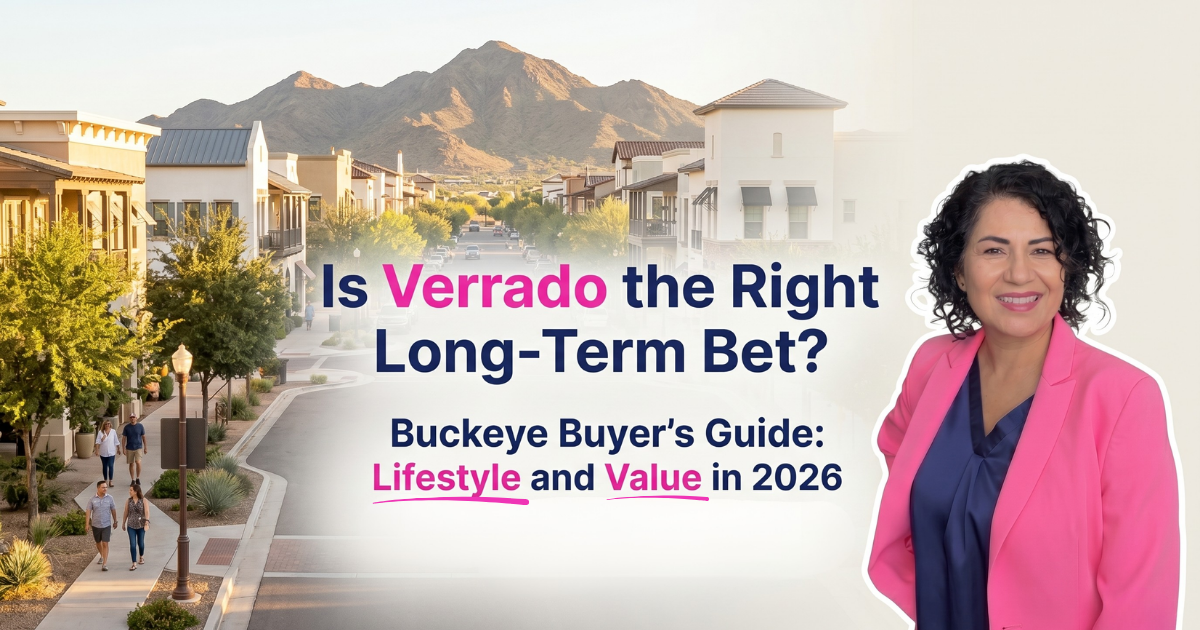
Verrado occupies roughly 8,800 acres against the eastern foothills of the White Tank Mountains, planned to ultimately house up to 14,080 homes plus 4 million square feet of commercial space. The community was designed using New Urbanism principles — a design philosophy that prioritizes walkable streets, mixed-use density at the center, traditional architecture, and front-porch interaction over typical suburban sprawl. The core of Verrado is Main Street, which currently includes more than 26 businesses — coffee shops, restaurants, services, and retail — accessible by foot or golf cart from most of the community. That's not a marketing claim; it's the actual layout of the community. The "small-town feel" buyers are looking for in Verrado is a design outcome, not just an atmosphere.
For a broader look at how to evaluate new construction options across the West Valley, our comparison of resale homes in Glendale versus new builds in Goodyear walks through the warranty and inspection considerations that apply to most West Valley new construction.
Who's Building There Right Now
Active builders in Verrado include Toll Brothers, David Weekley Homes, Ashton Woods, Lennar, Meritage Homes, and several specialty builders in luxury and custom segments — including K. Hovnanian's Four Seasons and William Ryan Homes in the 55+ Victory at Verrado section, Woodside Homes in Black Rock at Verrado, and Capital West Homes in Verrado Highlands. The builder roster has rotated over the years as phases close out and new ones open, but the consistent presence of national and regional builders signals that Verrado continues to be one of the strongest-selling master plans in the West Valley. Home types range from entry-level production homes in the high $300s to custom homes north of $1.5 million, with the bulk of resale and new construction activity concentrated in the $450,000 to $750,000 range. That price range matters because it puts Verrado in direct competition with comparable master-planned communities in Surprise, Peoria, and Goodyear — meaning resale demand is structurally supported by the broader West Valley buyer pool.
— Eli R, Buckeye, AZ
The Long-Term Value Case For Buckeye
Here is where the broader Buckeye story matters more than the specific Verrado story. Buckeye is, by area, the largest city in metro Phoenix and one of the fastest-growing cities in the United States. The city's sustained population growth, the Loop 303 corridor expansion, the planned SR 30 (Tres Rios Freeway) connection scheduled for 2027 construction start, and the ongoing development of Teravalis — a planned 100,000-acre master-planned community in north Buckeye — collectively point to two decades of sustained infrastructure investment and population inflow. That kind of growth trajectory is the strongest possible tailwind for Verrado home values. The community sits in the path of growth without being a speculative bet on a single project. The Loop 303 already terminates near the Verrado area; the Marketside District at the community's edge is anchored by a major Banner Health regional hospital campus; the Buckeye Commons retail development at the I-10 / Verrado Way interchange brings 410,000 square feet of additional retail and dining within easy reach. The macro story supporting Verrado is unusually well-anchored.
What I Watch For In A Verrado Purchase
This is usually where I slow buyers down. The strengths of Verrado are real, but they don't make every property in Verrado a strong purchase. What I watch for: location within the community, because Verrado is large enough that a home on the eastern edge near Main Street has very different walkability and lifestyle characteristics than a home in a newer western phase a mile farther from the core. Phase timing, because newer phases are still under active builder development with adjacent construction, while established phases have settled neighborhoods, mature landscaping, and clearer comp data. The HOA fee structure and CFD assessments, because Verrado's community facilities district adds modest tax obligations on top of standard property taxes that many buyers don't notice until closing. School assignment, because the Buckeye Elementary School District and Agua Fria Union High School District boundaries within Verrado matter for resale demand among families. And commute realism, because a 55-mile round-trip commute to central Phoenix or the East Valley adds up over 5 to 10 years in ways buyers tend to underestimate when they're excited about a new home.
— Jessica Y, Peoria, AZ
The Honest Trade-Offs
The case against Verrado, or at least the considerations that don't show up in marketing, is worth articulating. The commute to Phoenix proper or the East Valley is meaningful — typically 35 to 50 minutes one-way to central Phoenix in standard traffic, longer during peak hours. Buckeye's summer climate is among the hotter parts of the West Valley, with temperatures often a few degrees higher than central Phoenix. The community's distance from Phoenix Sky Harbor airport is roughly 45 to 60 minutes, which matters for frequent travelers. Verrado's HOA, while strong from a maintenance and amenity standpoint, is not the cheapest in the West Valley, and the CFD adds further cost. And while the long-term Buckeye growth story is compelling, individual home price appreciation in Verrado has tracked the broader Buckeye market — strong, but not dramatically faster than alternatives in Goodyear, Surprise, or even Litchfield Park, which have shorter commutes. None of these is a deal-breaker, but they are worth weighing alongside the lifestyle case. The City of Buckeye's official planning resources are useful for tracking what's actually under construction or approved across the city.
The Hold Period That Makes Sense
Verrado tends to work best for buyers planning a 7-to-15-year hold. The community's long-term build-out, the maturing commercial core, the ongoing Buckeye-wide growth, and the typical real-estate carrying cost recovery all favor longer holds rather than shorter ones. Buyers planning a 3-to-5-year hold should look very carefully at the specific phase they're buying in, the active comps, and whether they're paying a builder premium that resale won't immediately recover. What I watch for in shorter-hold buyers is whether the home choice would still make sense if the community appreciated only modestly over the hold period. If the answer is yes, the purchase is probably right. If the answer depends on appreciation matching the marketing brochure, that's where buyers get caught.
Frequently Asked Questions
Is Verrado a gated community?
Most of Verrado is not gated, by design. Victory at Verrado, the 55+ section, includes gated areas. The community's New Urbanism design generally favors walkability and connectivity over gated separation.
What is the commute from Verrado to downtown Phoenix?
Approximately 25 miles via I-10, typically a 35-to-50-minute drive depending on traffic. Peak-hour commutes can extend longer, particularly during winter visitor season.
What schools serve Verrado?
Verrado is served by the Buckeye Elementary School District (K-8) and the Agua Fria Union High School District for high school. Charter and private school options also operate within and near the community.
How does Verrado compare to other West Valley master-planned communities for value?
Verrado is competitive with Vistancia, Estrella, and Asante on lifestyle and value. Its main differentiators are the New Urbanism walkable core, the Main Street commercial district, and the long-term Buckeye growth trajectory.
What is the typical price range for homes in Verrado?
Resale and new construction activity is concentrated in the $450,000 to $750,000 range, with custom homes available above $1 million. Builder base prices in newer production phases can start in the upper $300s.
The Bottom Line
Verrado is one of the few West Valley communities that genuinely delivers on both the lifestyle and the long-term value cases buyers are weighing. The New Urbanism design produces real walkability, the master plan is well-anchored against speculative risk, and Buckeye's broader growth trajectory supports value over a 7-to-15-year hold. The trade-offs are commute distance and summer heat. If those don't disqualify the community for you, Verrado is a strong choice for buyers who want small-town feel today and a defensible investment story tomorrow. Pick the right phase, the right hold period, and the right price relative to comps, and the community delivers what it advertises.
About the Author
Kasandra Chavez is a real estate advisor serving the West Valley of Greater Phoenix, Arizona, recognized among the top 5% of real estate professionals in the Greater Phoenix area. She works with buyers and sellers to align strategy with lifestyle and goals, supporting decisions through every stage of the transaction. Her experience guiding clients through master-planned community decisions across Buckeye, Goodyear, and Surprise helps buyers separate marketing from reality before they commit.