
I-17 Improvements: How They Affect Desert Hills vs Norterra Commute
ADOT's 23-mile I-17 improvement project between Anthem Way and Sunset Point reached substantial completion in late 2025. Here's what it actually changes for a Desert Hills vs Norterra commute decision in 2026.
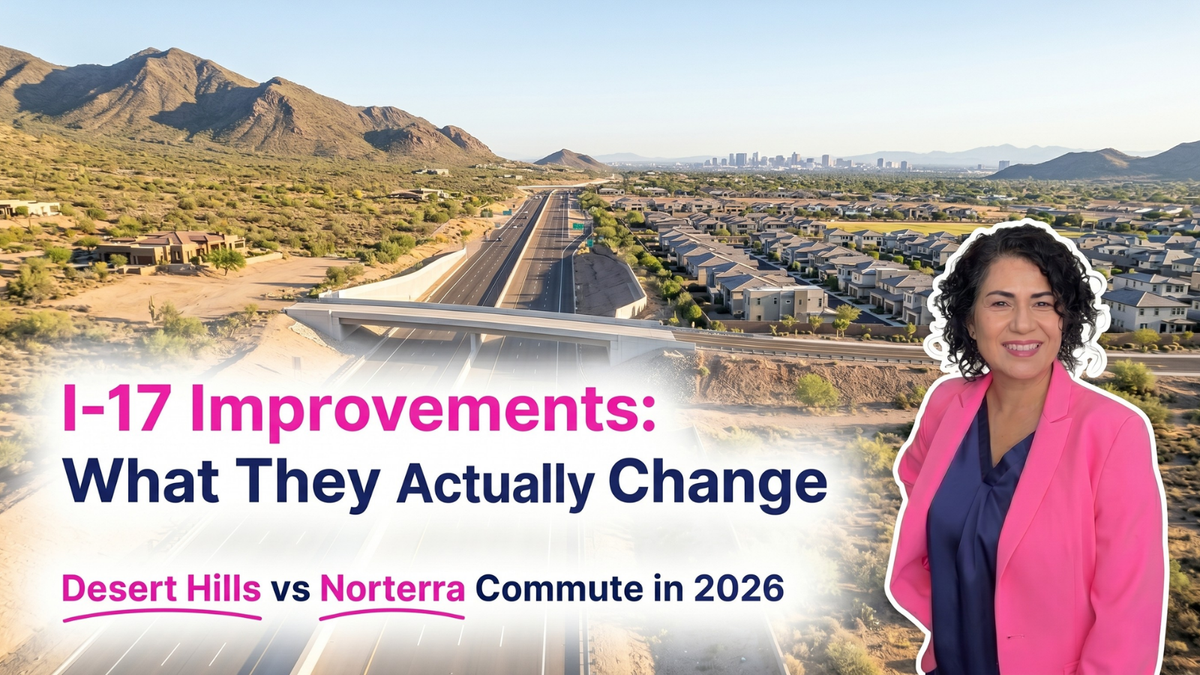
How will the new I-17 improvements between Anthem and Sunset Point affect my daily commute if I buy in Desert Hills instead of staying closer in Norterra?
The I-17 improvements between Anthem Way and Sunset Point — 15 miles of widened third lanes from Anthem to Black Canyon City, and 8 miles of flex lanes from Black Canyon City to Sunset Point — reached substantial completion in late 2025. That work primarily targets the stretch of I-17 north of Anthem, which affects your weekend-trip commute to Sedona, Flagstaff, and the high country rather than your daily Phoenix-area commute. For daily commute purposes between Desert Hills and Norterra, the I-17 improvements help modestly with the long-haul corridor reliability but don't fundamentally change the day-to-day drive.
What actually changes your daily commute decision between these two areas is the difference in lifestyle, density, and product type — not the I-17 corridor work. Let me walk through what the I-17 project actually does, what it doesn't change, and how to think about the real Desert Hills vs Norterra trade-off.
What the I-17 Improvement Project Actually Built
The ADOT I-17 Improvement Project covered 23 miles between Anthem Way (milepost 232) and Sunset Point (milepost 252), with a total project cost of approximately $446 million delivered through a design-build-operate-maintain agreement. The northern 15 miles between Anthem Way and Black Canyon City added a new general-purpose lane in each direction — straightforward freeway widening that adds capacity through the steep, congested stretch leading up to Black Canyon City. The southern 8 miles between Black Canyon City and Sunset Point added flex lanes — Arizona's first — which operate as a separate two-lane roadway that can carry traffic in either direction depending on greatest need.
The flex lanes are a meaningful innovation for the corridor. On a typical Friday afternoon when traffic from Phoenix heading to Flagstaff and Sedona overwhelms the regular northbound lanes, ADOT can open the flex lanes northbound to add capacity. On a typical Sunday evening when traffic returning to Phoenix overwhelms the regular southbound lanes, ADOT can flip the flex lanes southbound. They also serve as a release valve during crashes or other incidents that would otherwise cause major backups on the steep, winding mountain stretch.
The new third lanes were opened earlier in 2025 to accommodate drivers while construction wrapped, and the flex lanes were brought into operation in stages through late 2025. As of early 2026, the entire 23-mile corridor is operating at the expanded capacity. There's a separate ADOT project running through late fall 2026 on the next stretch from Sunset Point to Flagstaff, but that's beyond the Anthem-to-Sunset Point segment the BOFU question references.
What This Means for a Daily Phoenix-Area Commute
The honest answer is: not much directly. The Anthem-to-Sunset Point improvements primarily benefit long-haul north-south traffic — Phoenicians going to weekend cabins, commercial truck traffic moving between Phoenix and Flagstaff, tourist flows to Sedona and the Grand Canyon. If your daily commute is from Desert Hills or Norterra to a Phoenix-area workplace — TSMC, downtown Phoenix, Scottsdale, Glendale, anywhere south of Carefree Highway — your daily drive is on the I-17 segment south of Anthem, which wasn't part of this improvement project.
What the I-17 improvements do indirectly help with: weekend traffic relief through Black Canyon City means that on Friday afternoons and Sunday evenings, you're less likely to encounter the kind of backed-up freeway conditions that used to spill southward and affect your evening or Sunday-night drive home. The reliability of the broader I-17 corridor improves, which over time tends to make the entire stretch a more predictable driving experience. But on a typical Tuesday morning at 7:30 AM, the I-17 project doesn't materially change your commute from Desert Hills or Norterra to a south Valley workplace.
This is usually where I slow buyers down. Don't make a Desert Hills vs Norterra decision based on the I-17 improvement project. Make it based on the actual product, lifestyle, and daily commute realities of the two communities — which are very different from each other regardless of the I-17 work. The post on Peoria AZ or North Phoenix for inventory and commute trade-offs covers the broader North Valley commute decision framework.
What Desert Hills Actually Is — and How That Differs from Norterra
Desert Hills sits in zip code 85086 north of Carefree Highway, primarily rural and semi-rural acreage product with one-acre-plus lots, custom-built homes, and significant horse-property and no-HOA inventory. Median list pricing has been running in the upper-$800Ks with average days on market around 80, reflecting the higher-end custom nature of much of the inventory. The terrain skews mountain-view, the lots skew large, and the lifestyle skews independent — no master-planned community structure, no community pool, no shared amenities. You're buying acreage and a custom home, not a community membership.
Norterra is the opposite product. Master-planned communities including Dynamite Mountain Ranch, Fireside at Norterra, Union Park at Norterra, Sonoran Commons, Valley Vista, and others; median sale price in the low-$600K range with year-over-year appreciation in the low single digits; days on market in the high-sixties; densely organized around the Shops at Norterra and Happy Valley Towne Center retail anchors; full master-planned amenity stack including community pools, parks, trails, and HOA-managed services. You're buying a community membership and a home that's structurally similar to your neighbors'.
The Desert Hills versus Norterra decision isn't really about commute time — those two communities are roughly comparable distances to most Phoenix-area destinations because they're geographically close. It's about whether you want acreage living with custom-home independence and no shared amenities, or master-planned community living with neighborhood density and full amenity stack. Different price points, different lifestyles, different long-term hold profiles.
— Mandi S, Waddell, AZ
The Real Commute Comparison
Both Desert Hills and Norterra are roughly accessed via I-17, with Desert Hills sitting a few miles north of Norterra on the corridor. To the TSMC campus at I-17 and Loop 303, you're looking at roughly 15-20 minutes from Norterra and roughly 20-25 minutes from Desert Hills. To downtown Phoenix, roughly 30-35 minutes from Norterra and 35-40 minutes from Desert Hills. To Scottsdale, you're looking at 35-45 minutes from either depending on exact destination and time of day. The five-to-ten-minute delta between the two areas is real but generally not decisive for most commute patterns.
What does become decisive is the day-to-day logistics around the home itself. From Desert Hills, almost every errand — grocery runs, school drop-off, healthcare appointments, dining out — involves driving down to Anthem, Norterra, or the Carefree Highway corridor. The acreage-living trade-off is that you're geographically isolated from most amenities by design. From Norterra, the Shops at Norterra and Happy Valley Towne Center are at the community edge, the K-8 schools are within the immediate footprint for most communities, and your daily-life logistics involve much less driving overall.
For a family with school-age kids and rotating sports/practice/social logistics, Norterra's compact daily-life loop is meaningfully less time-consuming than Desert Hills' acreage isolation. For an empty-nester couple, a retired buyer, or anyone whose work allows remote flexibility and who actively wants the privacy and space that acreage living delivers, Desert Hills' isolation is a feature rather than a bug. The Mayo Clinic and HonorHealth facilities are accessible from both areas, but the broader healthcare convenience favors Norterra given its denser surrounding development.
The I-17 improvements affect this picture only in the marginal sense of making the long-haul drive to vacation destinations or work trips north of Phoenix more reliable. They don't change the fundamental Desert Hills-acreage versus Norterra-master-plan trade-off.
Price, Inventory, and What You Get for the Money
Desert Hills pricing reflects the acreage and custom-home character — median list pricing in the upper-$800Ks with significant tails reaching into seven figures for newer custom builds on prime view lots. Lower-end Desert Hills inventory exists in the $400K-$600K range but is typically older smaller homes on the acreage, often needing significant updates or operating with shared well agreements. The "horse property" framing is real — much of Desert Hills inventory is set up for horse keeping with shelters, riding access, and proximity to BLM trail systems.
Norterra pricing for the master-planned communities clusters in the low-$600K range with the upper end of Fireside, Union Park, and similar communities reaching into the upper-$700Ks and beyond. The inventory is much more uniform — predictable floor plans, predictable lot sizes, predictable finish levels. You know what you're getting. The trade-off is that you don't get the acreage, the privacy, or the custom-home character.
For roughly comparable monthly carry between the two areas, you're choosing very different product. A $750K Desert Hills custom on an acre with no HOA produces a very different lifestyle than a $700K Norterra master-planned home with HOA and amenities. Neither is better. They're built for different buyer profiles. Some related context in is now a good time to buy in Peoria for the broader buyer environment and in move-in-ready vs fixer-upper for the framework on choosing between move-in-ready master-planned product and the more variable Desert Hills inventory.
— Christopher, Goodyear, AZ
What I Tell Buyers Considering the Move from Norterra to Desert Hills
The buyers who make this exact move and are happy with it five years later usually had a specific reason rooted in lifestyle preference rather than commute math. Often it's: wanting horses or significant outdoor work projects that need acreage. Wanting custom-home control over the design. Wanting privacy that no master plan delivers. Wanting to be away from the social density of master-planned community living. Wanting to be at the edge of the Sonoran preserve.
The buyers who make this move and regret it usually shared one of these patterns. Underestimating how much they'd miss the master-planned daily-life convenience. Underestimating the maintenance burden of acreage living (the well, the septic, the perimeter fencing, the desert landscaping at scale). Underestimating the family-logistics friction of being further from schools, sports, and friend groups. Or — the most common one — making the move during a stage of life when the privacy and acreage felt appealing, only to discover that the next stage of life (parenting school-age kids, aging into needing closer medical access, social-orbit changes) made the isolation feel like a constraint.
A practical framing: spend a Saturday in Desert Hills before deciding. Then spend a Saturday in Norterra. Notice how much driving each day actually requires, how much time you spend at the home itself versus at community amenities, and whether the rhythm matches what you're actually looking for. The I-17 improvements are largely irrelevant to this decision. The lifestyle fit is everything. Related context in the post on is now a good time to buy in Peoria covers the broader buyer environment factors at play.
FAQ
Is the I-17 Improvement Project complete?
The 23-mile project between Anthem Way and Sunset Point reached substantial completion in late 2025, with the 15 miles of new third lanes between Anthem Way and Black Canyon City and the 8 miles of flex lanes between Black Canyon City and Sunset Point all operational. A separate ADOT project continues through late fall 2026 on the next segment from Sunset Point toward Flagstaff.
How much does the I-17 project affect my daily commute from Desert Hills or Norterra to Phoenix?
Minimally. The improvements primarily benefit long-haul north-south traffic between Phoenix and the high country. Your daily commute from either Desert Hills or Norterra to a Phoenix-area workplace travels on the I-17 segment south of Anthem, which wasn't part of this project.
What's the commute time from Desert Hills versus Norterra to the TSMC campus?
Roughly 15-20 minutes from Norterra and 20-25 minutes from Desert Hills to the TSMC campus at I-17 and Loop 303, depending on time of day and exact starting point.
What kind of homes does Desert Hills typically have?
Desert Hills is primarily rural and semi-rural acreage product with one-acre-plus lots, custom-built homes, horse-property setups, and significant no-HOA inventory. Median list pricing has been running in the upper-$800Ks with average days on market around 80.
What kind of homes does Norterra typically have?
Norterra is a collection of master-planned communities including Dynamite Mountain Ranch, Fireside at Norterra, Union Park at Norterra, Sonoran Commons, and Valley Vista. Median sale prices have been in the low-$600K range with full master-planned amenity stack including community pools, parks, trails, and HOA services.
Will the I-17 improvements increase home values in Desert Hills or Norterra?
The direct impact on Desert Hills and Norterra home values is modest because the improvements primarily affect long-haul corridor reliability rather than daily commute experience. The broader Phoenix-area appreciation drivers — TSMC, NorthPark, Halo Vista, Loop 303 corridor growth — are much more material to home values in both areas than the I-17 project itself.
The Bottom Line
The I-17 improvements between Anthem Way and Sunset Point are a meaningful infrastructure win for the broader North Phoenix corridor and the long-haul drive to Sedona, Flagstaff, and the high country. They are not a meaningful factor in a Desert Hills versus Norterra commute decision because the improvements are largely north of your daily commute pattern, and the geographic delta between Desert Hills and Norterra is small enough that the corridor-level reliability gains barely register.
What I tell buyers in this exact comparison: don't let the I-17 improvement story drive a Desert Hills versus Norterra decision. Drive the actual daily commute pattern at the times you'd actually be driving it. Decide whether you want acreage living with custom-home independence or master-planned community living with neighborhood density. The freeway work is a nice corridor-wide tailwind. The lifestyle fit is the actual decision.
About the Author
Kasandra Chavez | Chavez Dream Home Team | Recognized among the top 5% of real estate professionals in the Greater Phoenix area. Kasandra works with buyers and sellers across the West Valley and North Valley submarkets, helping align strategy with lifestyle, family timeline, and long-term goals so each decision lands with clarity rather than pressure. Her focus is on guiding clients through complex transitions — relocation, sell-and-buy coordination, and navigating the trade-offs between master-planned community living and acreage independence — without the noise.
Commute times from Peoria AZ to Phoenix range from 25 to 75+ minutes depending on which neighborhood you choose — and which highway you're closest to. Most people search for the neighborhood with the shortest drive. But the real question is which highway gets you where you're actually going — and whether the lifestyle in that neighborhood makes the commute worth it. In this video, I break down three Peoria neighborhoods that come up most often with my commuter clients, explain the Loop 101, Loop 303, and I-17 dynamics that determine your real drive time, and share the one thing nobody tells you about commute estimates before you buy.