
Union Park at Norterra vs. Dynamite Mountain Ranch Home Values
Union Street at Norterra is bringing walkable national-brand dining next to Union Park. Does that mean its townhomes will hold value better than Dynamite Mountain Ranch homes? The honest comparison.
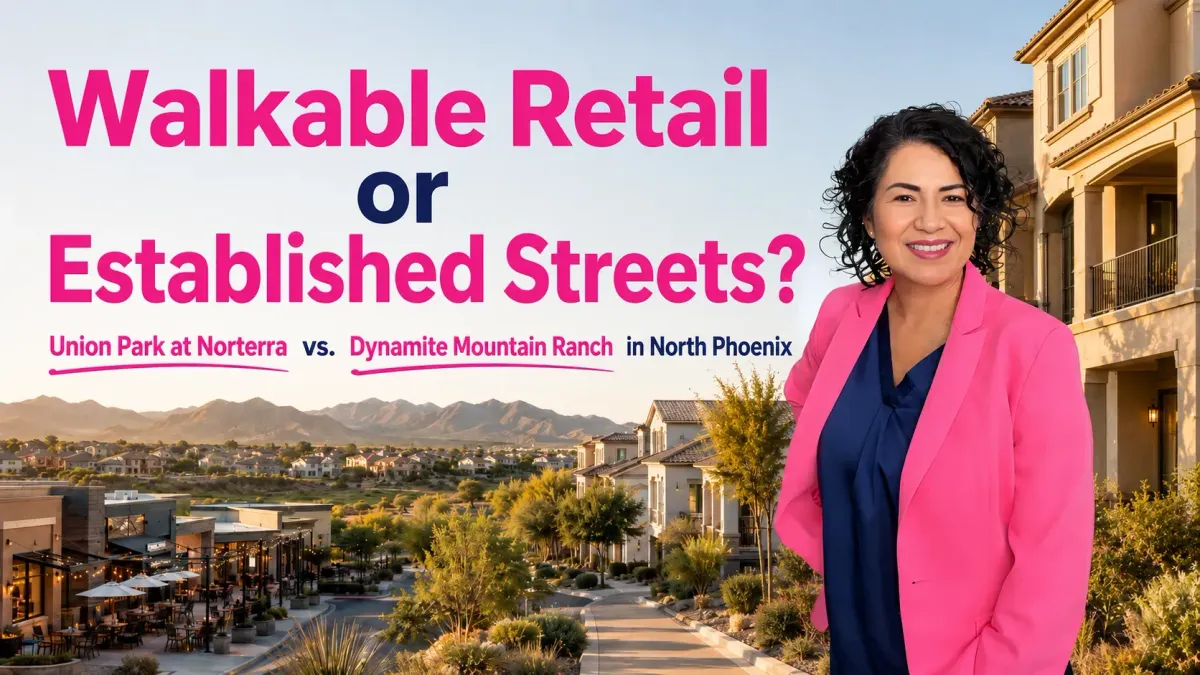
With big-name restaurants and shops coming to Union Street at Norterra, will Union Park at Norterra townhomes hold value better than similar-sized homes in Dynamite Mountain Ranch that don't have that walkable retail node?
Not automatically. The walkable retail node is a genuine, durable demand driver for Union Park—but it doesn't guarantee a townhome outperforms a detached home, because product type, HOA costs, and buyer pool matter as much as the amenity next door. A Union Park townhome and a Dynamite Mountain Ranch single-family home are competing for different buyers, and each holds value through a different mechanism. The right comparison is lifestyle fit plus product fundamentals, not the retail node alone.
This question is exactly the right one to ask before a long hold, because North Phoenix's 85085 corridor is changing fast enough that the neighborhood you buy into isn't quite the neighborhood you'll sell out of. Union Park at Norterra was master-planned from the start to pair homes with a walkable commercial core, and that core is now arriving in visible form. Dynamite Mountain Ranch, meanwhile, represents the more conventional North Phoenix playbook: established detached homes, familiar streets, and retail you drive to in a few minutes rather than walk to. Both sit in the same growth corridor, feed from the same employment story, and will both feel the same macro market. So the value question comes down to what each one offers that the other can't—and what each one asks you to accept in exchange. Here's how I'd weigh it for a buyer planning to own for years, not months.
What's Actually Being Built at Union Street at Norterra
First, ground the "big-name restaurants" claim in what's confirmed. Union Street at Norterra is a roughly 45,000-square-foot, two-phase retail development adjacent to the Union Park community, and the developer has publicly named signed tenants including Shake Shack, CAVA, First Watch, Snooze A.M. Eatery, Paris Baguette, and Firebirds Wood Fired Grill, with openings arriving in waves as construction wraps. It doesn't stop at restaurants: new Marriott-flag hotels have gone up alongside the retail, and Union Park Residences, a 308-unit apartment community, has broken ground on Union Street itself—part of a Norterra district plan that mixes over a thousand homes with commercial and office space. And this new node layers on top of what already exists: the established Shops at Norterra lifestyle center sits just across the way with dozens of dining, retail, and entertainment tenants. In other words, the walkability story here is real, funded, and under construction—not a rendering on a sales-office wall. That matters, because the question of whether an amenity supports value starts with whether the amenity actually shows up.
The Case That Walkability Supports Long-Term Demand
Walkable retail next to residential is rare in North Phoenix, and scarce amenities tend to support demand. The mechanism is straightforward: every year, some slice of buyers—younger professionals, lock-and-leave downsizers, relocating employees who came from walkable cities—specifically shops for "live near things I can walk to," and very few North Phoenix neighborhoods can answer that search. Union Park can, and it was designed to: tree-lined streets, front porches, and a compact footprint deliberately oriented toward the commercial core. That tends to show up less as a dramatic price premium and more as resilience—a deeper buyer pool when you eventually list, which can mean faster sales and steadier pricing in soft markets. It also compounds: national tenants signing leases signals confidence in the area's income and traffic, hotels bring weekly visibility, and the employment base nearby—anchored by major corporate campuses and the broader I-17 corridor's semiconductor-driven growth—keeps feeding the area new households. If you're weighing this corridor against other submarkets, my comparison of Peoria versus North Phoenix for inventory and commute balance covers how this area stacks up regionally.
— Jackson S, Phoenix, AZ
What the Walkability Argument Leaves Out
Now the part the question is really asking: is there a catch? Three of them, honestly. First, the premium is partly priced in already. Union Park has marketed walkability since day one, and today's pricing reflects the retail node's arrival—you're buying the amenity, not getting it free, so the future "pop" some buyers imagine has largely been pulled forward. Second, and most important: a townhome and a detached home are different products with different value mechanics. Detached single-family homes historically draw the broadest buyer pool in Phoenix's suburbs, while attached homes lean on a narrower (though loyal) buyer segment and carry HOA structures that cover shared elements—which means fee trajectories, reserves, and rules directly shape your future resale math. Before buying any attached product. Third, proximity cuts both ways. Living steps from restaurants, two hotels, and a 308-unit apartment community means traffic, parking pressure, patio noise on weekend nights, and a heavier renter mix in the immediate vicinity—trade-offs some owners happily accept and others regret. What I watch for here is honesty about which buyer you are: the same hundred feet that delights a Friday-night walker can wear on a light sleeper.
How Dynamite Mountain Ranch Competes Without the Retail Node
Dynamite Mountain Ranch's answer to all of this is the established-neighborhood playbook, and it shouldn't be underestimated. It offers detached single-family homes on conventional lots—private backyards, garages, room to spread out—at price-per-square-foot figures that typically undercut comparable new or near-new product around the retail core. Its buyer pool is the broad middle of the market: families and move-up buyers who prioritize space, schools, and a quieter street over walking to brunch. And critically, it gives up far less convenience than the framing suggests: the same Union Street and Shops at Norterra tenants sit a few minutes away by car, and Dynamite Mountain Ranch taps the identical employment corridor, freeway access, and North Phoenix growth narrative—including the semiconductor-driven job base expanding nearby—without living inside the activity node. Established neighborhoods also carry fewer unknowns: the streetscape is finished, the HOA's track record is observable, and there's no construction-phase uncertainty left to absorb. The honest summary: Dynamite Mountain Ranch holds value the way most Phoenix suburbs do—through space, condition, and price competitiveness—while Union Park holds value through location scarcity and lifestyle. Those are both legitimate mechanisms. Neither is a guarantee, and in a broad market downturn or rally, both neighborhoods will move with the tide far more than they'll diverge from each other.
Framing the Decision for a Long Hold
For a ten-year hold, I'd put the decision through four filters. One: product type first. If your life fits a detached home—kids, pets, hobbies, garage storage—buy detached, because forcing your household into a townhome to chase an amenity premium usually backfires at resale time when you're marketing a product you outgrew. Two: total cost of ownership. Model the townhome's HOA fees over a decade against the detached home's self-maintained costs, and remember fee increases compound into your buyer's affordability later. Three: the lifestyle dividend is real even if the financial premium is modest—if you'll actually walk to dinner weekly, that's a return you collect every month you live there, and it's a fine reason to choose Union Park on its own. Four: verify rather than project. Walk both neighborhoods at 7 a.m. and 9 p.m., sit in the Union Street traffic pattern on a Saturday, and read both HOAs' documents before committing. At this stage, I help clients narrow their focus to the two or three specific homes that survive all four filters, then we compare them on price, condition, and terms—where the real money is made—rather than on the neighborhood narrative. If you're still earlier in the funnel, my breakdowns of how to weigh commute, amenities, and lifestyle between submarkets and what your budget buys across the Phoenix area are good companion reads.
— Renee A, Phoenix, AZ
Frequently Asked Questions
What restaurants and shops are coming to Union Street at Norterra?
The developer has publicly named signed tenants including Shake Shack, CAVA, First Watch, Snooze A.M. Eatery, Paris Baguette, and Firebirds Wood Fired Grill, with the retail delivered in phases and openings arriving in waves. Tenant lineups can shift before opening, so check current announcements.
Is Union Park at Norterra walkable to the new retail?
Yes—that's the design intent. Union Park was master-planned alongside its commercial core, and Union Street at Norterra sits adjacent to the community, with the established Shops at Norterra also within walking or short biking distance for many residents.
Does Dynamite Mountain Ranch have an HOA?
Yes, Dynamite Mountain Ranch is HOA-governed like most North Phoenix planned neighborhoods, though as a detached single-family community its fees and shared obligations differ structurally from a townhome association. Review the specific subdivision's documents before buying.
Are Union Park townhome HOA fees higher than single-family HOA fees nearby?
Generally, attached-home associations carry higher fees than detached-home associations because they maintain shared building elements and grounds. Exact fees vary by parcel and change over time, so pull the current budget and reserve study for any home you're considering.
Will the new apartments at Union Park Residences affect nearby home values?
A 308-unit apartment community adds renters, activity, and traffic to the immediate node—which supports the retail's success but changes the area's feel. Well-managed Class A apartments near amenities are common in mixed-use districts; visit the area at different hours and decide how the density fits you.
The Bottom Line
The walkable retail node is the most exciting thing happening in this corner of North Phoenix, and it's a legitimate point in Union Park's favor—real tenants, real construction, real scarcity value. But "will the townhome hold value better" is the wrong frame if it skips over the bigger variables: townhome versus detached, HOA economics, and which buyer pool you'll be selling to years from now. A Union Park townhome rewards the owner who genuinely lives the walkable lifestyle and respects the HOA math. A Dynamite Mountain Ranch home rewards the owner who wants space and a proven, conventional resale path minutes from the same amenities. Buy the one whose trade-offs you'll happily live with, verify everything on paper, and let the corridor's growth work for you either way.
About the Author
Kasandra Chavez is a real estate advisor serving the West Valley of Greater Phoenix, Arizona, recognized among the top 5% of real estate professionals in the Greater Phoenix area. She works with buyers and sellers to build strategy around their lifestyle and goals, providing clear decision-making support at every stage. Her approach centers on process control and steady market navigation, so clients always know what comes next.
Kasandra Chavez | Chavez Dream Home Team | chavezdreamhometeam.com