
Pricing a Surprise Home in the Loop 303 Influence Area
You can't price a Surprise home for an interchange that starts construction in 2028. What you can do is price and market to the buyer pool your specific location attracts today.
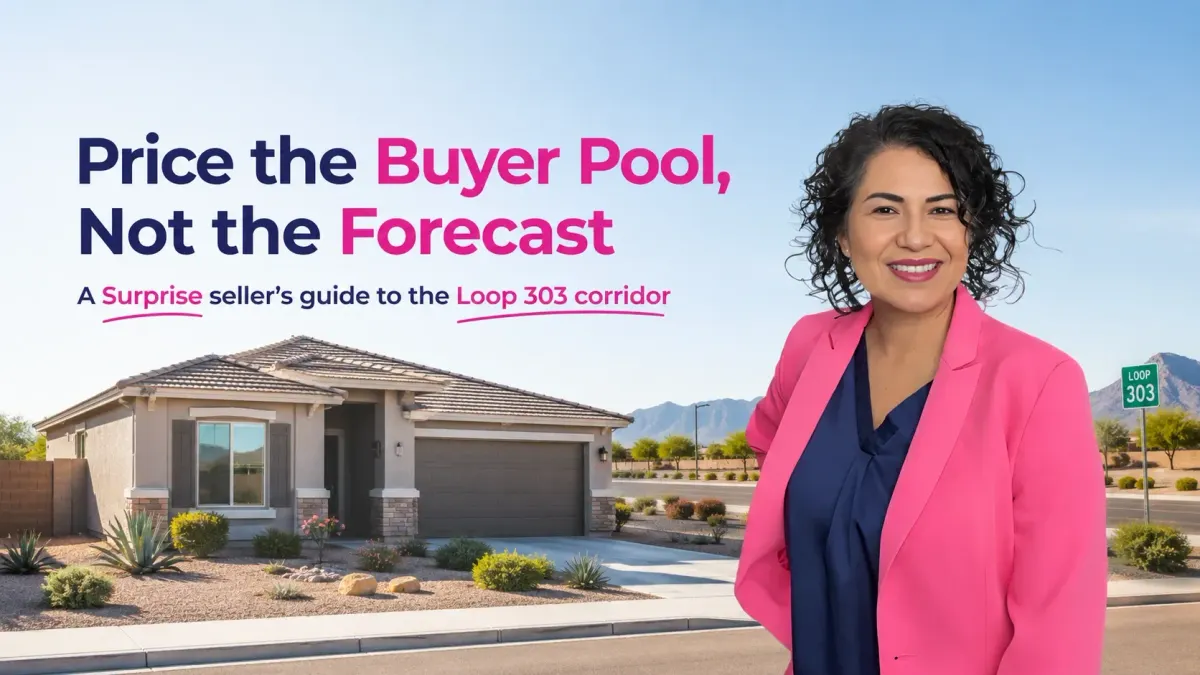
If I'm selling my Surprise home within the Loop 303 influence area, should I price in anticipation of future traffic noise or future commercial demand boosting values?
Neither. You price to closed comparable sales and to the buyer pool your specific Surprise location attracts right now, because the new Loop 303 traffic interchange at 155th Avenue is not anticipated to begin construction until 2028 — there is nothing to price in yet in either direction. What genuinely changes your number is whether your home reads to buyers as a quiet interior lot or a high-visibility location on a busier road, and those two profiles call for different comparable sales and different marketing.
Sellers in the Loop 303 influence area tend to arrive at this conversation already holding two competing stories. One says the corridor will lift everything and they should hold out for it. The other says construction and traffic are coming and they should discount before buyers figure it out. Both are about a future not yet funded into construction, and both distract from what actually determines your outcome: which buyers walk through your door, and what similar homes have sold for. This is usually where I slow sellers down, because a list price built on a forecast is a list price you will be defending against an appraiser who is not allowed to consider forecasts at all. The practical version of this question has a clean answer, and it lives in evidence you can gather before you go live.
Can You Price a Surprise Home for Future Loop 303 Traffic or Demand?
No. An appraiser valuing a Surprise home works from closed sales of comparable homes, and a buyer's lender relies on that appraisal — neither one has a mechanism for pricing in a road project that has not been built.
The timeline is the part most sellers have wrong. According to ADOT's project page for the Loop 303 and 155th Avenue traffic interchange, final design began in March 2026 and runs through late 2027, with construction anticipated to begin in 2028. The project includes extending 155th Avenue, improvements to Pinnacle Peak Road, new bridge crossings, and a noise analysis to determine whether noise mitigation is warranted. The separate Northwest Surprise Transportation Corridor roadway program, built around Loop 303, US 60 (Grand Avenue), and 163rd Avenue, is also phased over a long horizon.
If you are listing this year, none of that has happened yet. Pricing above the comparable sales because of it will cost you weeks on market, and pricing below them because of it hands money to your buyer for a disruption they will not experience for years.
Two Surprise Homes, Two Completely Different Buyer Pools
Two Surprise homes with nearly identical square footage and finishes can attract very different buyers depending on where they sit relative to a busy road, and that difference is real today regardless of what happens in 2028.
A home on a quiet interior street in a Surprise subdivision draws buyers prioritizing exactly that — families with young children, buyers coming from noisier areas, anyone who tours in the evening and listens. A home on a high-visibility location along an arterial draws a different pool: buyers who value fast access over quiet, buyers who are price-sensitive and willing to trade, and investors evaluating rentability. Neither pool is smaller. They are different, they respond to different marketing, and they will not both show up for the same listing.
What I watch for is which pool a seller has quietly assumed. When a Surprise homeowner on a busy arterial prices against interior-street comparables, the listing sits, and the price reduction arrives after the strongest weeks of exposure are already spent. My guide to how long it takes to sell in the West Valley covers what that exposure window actually looks like.
— La Maja, Avondale, AZ
How to Build the Comp Set for Each Surprise Location Profile
Building the right comparable set for a Surprise home near Loop 303 means matching location characteristics, not just subdivision name and square footage — because location is exactly what the two profiles differ on.
When I assemble comparables for a Surprise listing in the corridor, five selection rules do most of the work:
- Match the road relationship: Compare an arterial-facing Surprise home to other arterial-facing homes, and an interior home to interior homes, even if that means reaching outside the immediate subdivision.
- Match the sound environment: A home backing to a wall along a busy road and a home backing to another home's yard are different products, and the closed sales will show it if you let them.
- Check the sale dates: Older closed sales carry less weight, and in a shifting Surprise market a sale from several months back may describe conditions that no longer apply.
- Look at what did not sell: Expired and withdrawn Surprise listings in the same location profile tell you where the ceiling actually sat, which active listings never reveal.
- Separate new construction: Builder inventory in the Surprise Loop 303 communities competes with your resale but sells on different terms, so treat it as competition to position against rather than as a comparable.
That last point matters in Surprise specifically. My guide to pricing a Surprise home with new construction competing nearby covers how to position against builder incentives without undercutting yourself.
| Strategy Element | Quiet Interior Surprise Lot | High-Visibility Arterial Location |
|---|---|---|
| Primary buyer | Families and move-up buyers prioritizing quiet | Access-focused and value-focused buyers, plus investors |
| Comparable sales | Other interior lots, even outside the subdivision | Other arterial-facing homes with similar exposure |
| Marketing emphasis | Street calm, yard use, evening showings | Convenience, freeway access, interior upgrades |
| Pricing posture | Hold to the interior-lot evidence | Price to the exposure honestly and win on terms |
| Corridor messaging | Mention access as a neighborhood benefit | Lead with access; address road questions directly |
What Goes in Listing Remarks, and What Goes on Your Disclosure
Marketing language and disclosure serve two different purposes on a Surprise listing near Loop 303, and mixing them up creates problems late in escrow when they are most expensive to fix.
Listing remarks are where you position the corridor as what it genuinely is for your buyer pool — access to Loop 303 and US 60 is a real convenience and belongs in the description of a Surprise home that has it. The Seller's Property Disclosure Statement is a different document with a different job: it is where you disclose what you actually know about the property and the area, in writing. If you have knowledge of planned roadway work near your Surprise home, noise complaints, or anything else material, that belongs there rather than in conversation. The safest posture is straightforward: market the benefits honestly, disclose what you know completely, and let the buyer's ten-day inspection period under the AAR contract do the rest.
Two of my earlier pieces are useful background here — how Loop 303 growth affects Surprise traffic noise and resale covers the noise question directly, and how Loop 303 expansion affects Surprise and Goodyear home values covers the value side across both cities.
What I Watch For in a Surprise Loop 303 Listing
What I watch for in the first two weeks of a Surprise listing near the corridor is whether showing feedback matches the location profile we priced to, because that feedback is the only real-time data either of us gets.
If a home priced as an interior lot draws consistent comments about road noise, the profile was wrong and the correction should happen fast. If a home priced to its arterial exposure draws strong traffic and multiple showings in the first weekend, we may have room. Either way, the response is driven by evidence rather than a theory about 2028. When an offer arrives that is not quite what you hoped for, the question of whether to accept an offer below asking on a Surprise home is worth thinking through before the emotion of the moment.
Frequently Asked Questions
Should I price my Surprise home higher because of the Loop 303 corridor?
No. Appraisers work from closed comparable sales and cannot credit anticipated demand. Pricing above your comparables typically costs you time on market rather than gaining you value.
Should I discount my Surprise home because of future construction noise?
No. The Loop 303 interchange at 155th Avenue is not anticipated to begin construction until 2028, so discounting now hands your buyer money for a disruption they will not experience for years.
Do I have to disclose planned road construction near my Surprise home?
Disclose what you actually know in writing on the Seller's Property Disclosure Statement. If you have knowledge of planned roadway work, noise complaints, or similar material facts, that belongs on the SPDS.
Does being near an arterial road always lower a Surprise home's value?
Not always. It changes the buyer pool rather than simply reducing value, and homes priced and marketed to that pool can sell well. The mistake is pricing to a pool that will not show up.
Is ADOT studying noise on the Loop 303 interchange project?
Yes. ADOT lists a noise analysis among the project elements to determine whether noise mitigation is warranted for the 155th Avenue traffic interchange in Surprise.
The Bottom Line
The Loop 303 influence area is not a pricing variable yet, and treating it like one is the most common way sellers in Surprise leave money or weeks on the table. Your list price should come from closed sales of homes that share your home's actual location characteristics — the road relationship, the sound environment, the exposure — because those are the things buyers are responding to today. Market the corridor's access as the genuine convenience it is, disclose what you know completely, and let the first two weeks of showing feedback tell you whether the location profile was read correctly. When the interchange eventually gets built, whoever owns the home then will deal with that reality. Your job is to sell the house that exists now, to the buyers who exist now.
I'm Kasandra Chavez, REALTOR® and Team Lead of the Chavez Dream Home Team with Real Broker, serving the West and Northwest Valley of Greater Phoenix, Arizona, and recognized among the top 5% of real estate professionals in the Greater Phoenix area. If you're preparing to list a Surprise home near the Loop 303 corridor, I'm glad to build both location-profile comp sets with you so you can see the difference before you choose a number.
Have Questions About Surprise Real Estate?
Kasandra Chavez provides free, no-obligation consultations for buyers, sellers, and investors.
Schedule a Consultation