Maricopa vs. Pinal County Property Taxes: What Buyers in the Greater Phoenix Area Need to Know
If you're deciding between a home in Maricopa County and one just across the county line in Pinal, property taxes are one cost that actually varies — and the difference matters when you're budgeting for the long term.
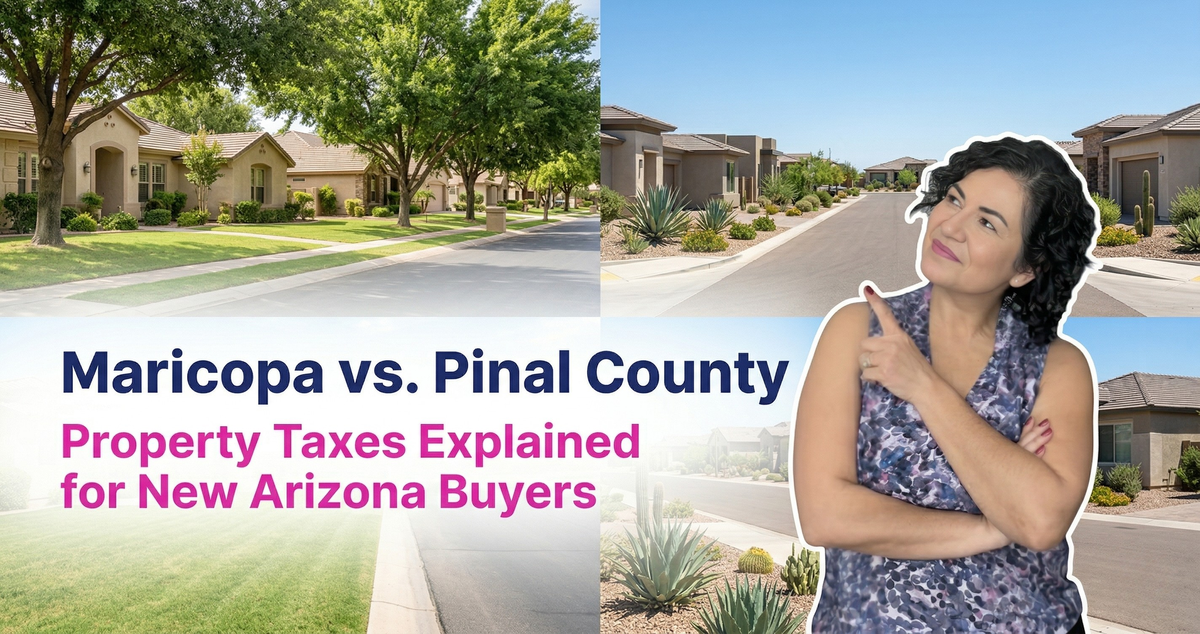
What are the property tax differences between Maricopa and Pinal County for new movers?
Both counties have relatively low property taxes compared to the national average. Maricopa County carries an effective rate of approximately 0.40% of median home value, while Pinal County sits at roughly 0.41% — nearly identical on paper. The meaningful difference lies in how each county's statutory rate (the rate per $100 of assessed value) is structured, how local taxing districts stack on top of it, and what your specific address will actually cost you each year.
Moving to the Greater Phoenix area and comparing homes across county lines is one of the most common situations I see buyers navigate — and property taxes are almost always part of the conversation, usually right after they've fallen in love with a house. The good news is that Arizona is genuinely one of the lower-tax states in the country. The complication is that "Arizona taxes are low" doesn't tell you what your bill will actually look like, because what you pay depends far less on the state and far more on your exact address, your school district, and the special taxing districts layered onto your specific parcel.
Buyers relocating from Texas, California, or the Pacific Northwest are sometimes surprised that there isn't a single, clean number to compare. This guide walks through how property taxes actually work in both counties, what the current rates look like, and how to read the difference in a way that helps you make a sound buying decision — not just find a headline number to justify a choice you've already made. For more guidance on navigating the buying process in the Greater Phoenix area, explore our West Valley home buyer resources.
How Arizona Calculates Property Taxes — and Why the Rate You See Isn't the Rate You Pay
Before comparing counties, it helps to understand the calculation method, because Arizona does this differently than most states buyers are moving from.
Your tax bill is not calculated directly on your home's sale price or even its current market value. Arizona uses a figure called the Limited Property Value (LPV) — a capped figure that can increase by no more than 5% per year under state law, regardless of what the market does. This single feature is why many longtime Arizona homeowners see their tax bills rise only modestly even during hot market cycles. For a buyer who has just purchased at today's prices, the LPV will be set close to your purchase price and will then be capped in its growth going forward.
Once the LPV is established, it's multiplied by Arizona's residential assessment ratio of 10%, giving you the net assessed value — the number your tax rate is actually applied to. So on a $450,000 home, your assessed value for tax purposes starts around $45,000. Your county, city, school district, and any applicable special districts then apply their rates to that $45,000 figure, not to the $450,000.
This is the part that trips up buyers from other states the most. When they see a Pinal County primary rate of $3.45 per $100 of assessed value, it sounds alarming until they do the math: $45,000 ÷ $100 × $3.45 = $1,552 in county-level taxes on that same $450,000 home. That's before city taxes, school district taxes, and any special districts are added — but it frames the county rate properly.
Owner-occupied homes in Arizona also benefit from a primary tax rate cap of 1% of the property's limited value, which keeps total primary taxes from becoming punishing in high-rate areas. There's also a state-funded rebate of 40% of school taxes (up to $600 per year) automatically applied to owner-occupied primary residences. For buyers planning to live in their home — rather than rent it out — these protections are meaningful. You can compare effective rates across all Arizona counties using SmartAsset's Arizona property tax calculator, which provides a clean county-by-county breakdown.
Maricopa County: Rates, Trends, and What West Valley Buyers Should Know
Maricopa County covers most of the Phoenix metro area, including the West Valley cities where many of my buyers focus their search: Peoria, Surprise, Glendale, Avondale, Goodyear, and Buckeye. The county has cut its primary property tax rate for four consecutive years. For fiscal year 2025, the Maricopa County primary rate stands at $1.16 per $100 of assessed value — down from $1.40 in 2021.
The county-level rate is only one layer. Your total tax bill in Maricopa County will include the city or town primary rate, school district rates (primary and secondary), and any special district levies. In Surprise, the city primary levy runs approximately $0.57 per $100 of assessed value. In Peoria and Glendale, rates vary by school district boundaries, which do not always follow city lines exactly. This is why two homes on the same street can carry different tax bills if they fall in different school districts.
At this stage, I help clients narrow their focus to the specific parcel rather than the general area. Looking up the actual tax bill on a property's address through the Maricopa County Assessor's portal gives you the real number — the one that will appear in your mortgage escrow calculation.
The effective property tax rate in Maricopa County works out to approximately 0.40% of median home value, with a median annual tax bill of roughly $1,916. For a $482,800 home (the current median), that's a manageable number. For the newer West Valley builds in the $400,000–$550,000 range that many of my buyers are considering, annual tax bills in the $1,600–$2,200 range are typical before special districts are factored in.
— Paul, Surprise, AZ
Pinal County: Higher Statutory Rate, Similar Effective Rate — and Why That Matters
Pinal County sits just southeast of Maricopa and includes growing communities like Queen Creek, San Tan Valley, Maricopa City, and Casa Grande. It's become an increasingly common consideration for buyers who want more space per dollar, especially as West Valley prices have climbed.
The headline number that surprises buyers: Pinal County's primary property tax rate is $3.45 per $100 of assessed value for FY 2024–2025 — roughly three times the county-level rate in Maricopa. This is the 4th highest county rate in Arizona.
That sounds dramatic. Here's why the effective rate ends up much closer to Maricopa's than the headline suggests: Maricopa County's base rate is low, but its cities and school districts layer in substantial additional rates. Pinal County's base rate is higher, but the overall stack of additional taxes tends to be more moderate in lower-density areas. The result is that effective rates — what you actually pay as a percentage of home value — end up within a few hundredths of a percent of each other.
For a $380,000 home in Pinal County (near the county's median), the math looks like this: LPV of approximately $380,000, assessed at 10% = $38,000. Apply the combined primary rate of $3.45 per $100: $38,000 ÷ $100 × $3.45 = roughly $1,311 in county-level taxes. School district and city taxes add to this, and special districts can be meaningful in certain planned communities, but the total effective burden remains in a range comparable to Maricopa County homes of similar price.
What does shift in Pinal County is the variation across communities. Queen Creek (in its Pinal County sections) carries the highest median tax bills in the county, while more rural or unincorporated areas carry some of the lowest. If a client is weighing a specific address in San Tan Valley against a specific address in Buckeye, I pull the actual tax records for both — not to make the decision for them, but to make sure the number in their budget is accurate.
Special Districts: The Variable You Can't Ignore in Either County
This is usually where I slow buyers down, because special taxing districts are the biggest source of sticker shock when a buyer's actual tax bill arrives and doesn't match what they expected.
In both Maricopa and Pinal County, planned communities and master-planned subdivisions often sit within Community Facilities Districts (CFDs) or other special taxing districts. These districts were formed to finance infrastructure — roads, water systems, parks, sometimes schools — and they layer a secondary tax rate on top of everything else. Some are modest. Some add several hundred dollars per year. A few are significant enough to meaningfully change the true cost of ownership in a community that otherwise looked affordable.
The CFD structure is especially common in newer developments in Goodyear, Buckeye, Queen Creek, and parts of San Tan Valley. It's also present in some Surprise and Peoria master-planned neighborhoods. A home with a lower list price in a CFD community can end up costing more per year in taxes than a higher-priced home in an established neighborhood without one.
What I watch for here is the secondary tax rate on the specific parcel, which is disclosed in the listing but doesn't always get adequate attention in the excitement of a purchase decision. This is a non-negotiable line item to review before writing an offer.
Reading the Notice of Value — What Arrives Each February
For buyers who have recently closed or are about to close, understanding the Notice of Value is the next piece. Arizona's county assessors mail these each year between January 1 and February 28. The notice shows your property's Full Cash Value (the assessor's estimate of market value) and your Limited Property Value (the capped figure actually used for taxes).
For new buyers, the LPV will typically reflect recent purchase price — which may be higher than the previous owner's LPV if values have risen significantly. This is a normal part of ownership transfer and it's not an error. Your LPV will then be limited to 5% annual growth going forward, which is a meaningful long-term benefit.
If you believe your assessed value is incorrect — typically because the assessor's market value doesn't reflect what comparable homes are actually selling for — you have until March 1 to file an appeal with your county assessor. In Maricopa County, this is handled through the Maricopa County Assessor's office. In Pinal County, you file with the Pinal County Assessor. Both processes are accessible and do not require an attorney.
— Gloria B, Buckeye, AZ
Exemptions and Credits That Reduce What You Actually Owe
Both counties participate in the same state-level exemption programs. These are worth knowing about as a buyer, because they're not automatically applied — most require an application.
The Primary Residence Exemption for owner-occupied homes is built into the system through the school tax rebate (40% credit, up to $600/year) and the 1% primary rate cap. These apply automatically once the property is classified as owner-occupied.
Senior Valuation Protection is available to qualifying homeowners 65 or older who have lived in their primary residence for at least two years and meet income guidelines. This program freezes the Limited Property Value for a renewable three-year period, meaning the assessed value cannot increase even as the market rises. Applications are filed with the county assessor by March 1.
Additional exemptions exist for qualifying widows and widowers, disabled individuals, and disabled veterans. These reduce the net assessed value directly and can result in meaningful savings. Contact your county assessor's office to confirm current eligibility thresholds and application deadlines — the amounts adjust periodically.
None of these exemptions change the tax rate. They reduce the value that rate is applied to, which has the same practical effect.
Frequently Asked Questions
Do I pay different property taxes in Pinal County than Maricopa County for the same home price? The statutory county rates differ significantly — Maricopa's primary rate is $1.16 per $100 of assessed value versus Pinal's $3.45 — but the effective rates as a percentage of home value are nearly identical (approximately 0.40% and 0.41% respectively). The total bill depends heavily on your school district, city, and special district taxes, which vary by specific address in both counties.
How do I find out the actual property tax on a specific home I'm considering? In Maricopa County, look up the parcel through the Maricopa County Assessor's website using the property address. In Pinal County, use the Pinal County Assessor's portal. Both show current assessed value and prior-year tax history. This is more accurate than estimating from general county rates.
When is the first property tax bill due after I close on a home in Arizona? Arizona property taxes are paid in two installments. The first half is due October 1 and becomes delinquent after November 1. The second half is due March 1 of the following year. If you close mid-year, your title company will prorate and credit taxes at closing based on the prior year's bill.
What is a Community Facilities District and should it affect my decision? A CFD is a special taxing district that financed infrastructure in a planned community and passes that cost to property owners through a secondary tax rate. They're disclosed in listing details and property tax records. In communities with active CFDs, your effective tax burden can be noticeably higher than neighboring areas without one. It's a number worth reviewing before you decide.
Can I appeal my property valuation if it seems too high after I buy? Yes. You have until March 1 of the tax year to file an appeal with your county assessor. The appeal is based on whether the Full Cash Value assigned by the assessor reflects actual market conditions. If you purchased recently and the assessed value significantly exceeds what comparable homes are selling for, an appeal is worth considering.
Closing
The difference between Maricopa and Pinal County property taxes is real — but it's more nuanced than the statutory rate comparison suggests. Both counties offer effective rates well below the national average, and both give owner-occupied buyers meaningful protections through Arizona's Limited Property Value system and school tax credits. The numbers that truly matter are the ones attached to the specific address you're considering: the school district rates, the CFD layer if one exists, and the city levy for your exact parcel.
Getting those numbers right before you're committed to a home — not after — is what makes the difference between a comfortable budget and one that's perpetually tight. With the right information and the right comparison, the decision becomes a lot clearer.
About the Author
Kasandra Chavez is a real estate advisor serving the West Valley of Greater Phoenix, Arizona, recognized among the top 5% of real estate professionals in the Greater Phoenix area. She works with buyers and sellers to build strategy aligned with their lifestyle and goals, providing decision-making support through every stage of the transaction. Kasandra is known for keeping clients ahead of the details — from contract timelines to the line items that affect long-term cost of ownership.
More Helpful Real Estate Videos from Kasandra
Stay confident in your real estate journey with Kasandra’s latest Arizona tips and insights.