
Buying Acreage in Desert Hills, AZ: Wells, Septic, and Roads
Buying acreage in Desert Hills, AZ? Wells, septic, and private roads are the make-or-break items. Here's what to verify before you remove your contingency.
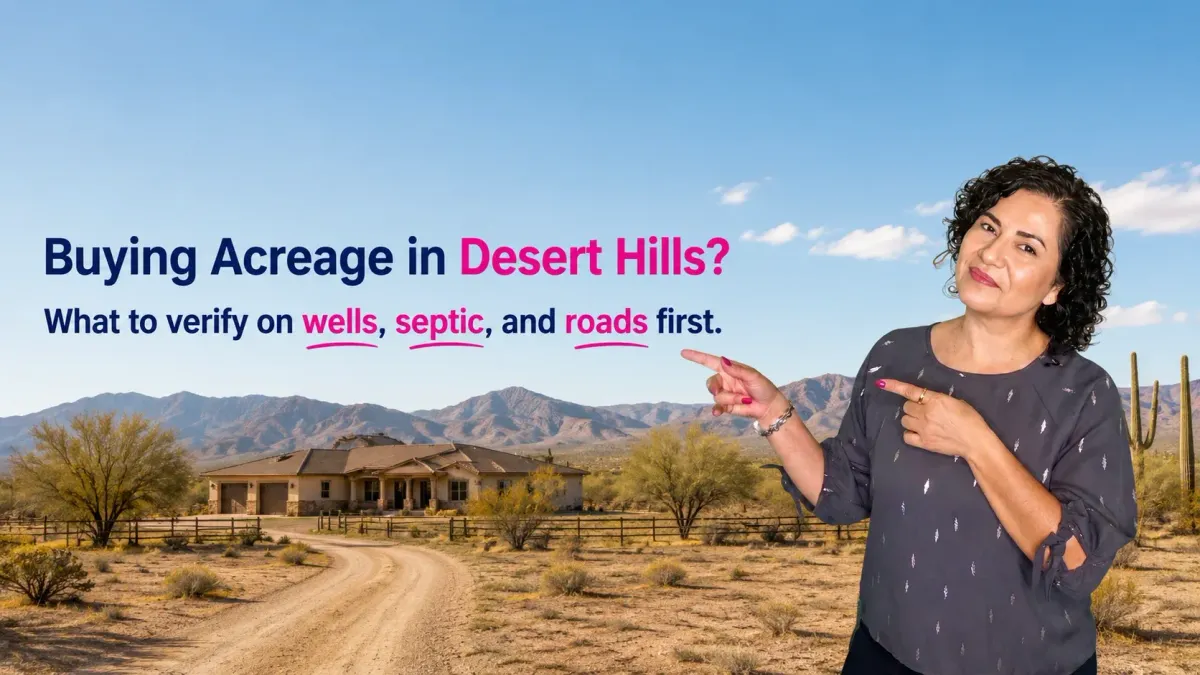
What do I need to check before buying acreage in Desert Hills, AZ?
Water, septic, and road access are the three make-or-break items. Most Desert Hills properties sit in unincorporated Maricopa County with no city water or sewer, so you're dealing with a private or shared well — or hauled water — an on-site septic system, and often a private dirt road you help maintain. Confirm each one in writing during your inspection period, because these are exactly the things that quietly cost rural buyers money after closing.
There's a lot to love about Desert Hills: large lots, mountain views, room for horses, dark skies, no HOA, and quick I-17 access to North Phoenix amenities. But the infrastructure under a rural acreage property is nothing like a city subdivision, and buyers coming from a tidy master-planned neighborhood are often surprised by how much they're responsible for out here. This is usually where I slow buyers down, because the appeal is real but so are the obligations, and the gap between them is where people get hurt. Let me walk you through the diligence that protects you, so the land you fall in love with doesn't come with surprises you didn't price in.
Water: Private Well, Shared Well, or Hauled
Water is the first and biggest question on any Desert Hills parcel, because there's no municipal water line to connect to. In unincorporated Maricopa County you'll generally see one of three arrangements, and each carries different homework. A private well serves only your property — you own it and you maintain it, and you'll want to verify its depth, output, age, equipment condition, and that it's properly registered with the state. A shared well serves a handful of homes under a recorded well-share agreement — here, what matters is the agreement itself: how many shares exist, who pays for repairs and electricity, who manages it, and what happens if the well needs a costly fix. Hauled water means no well at all; you buy water by the delivery and store it in a tank, which works but adds an ongoing cost and logistics most buyers haven't budgeted for.
What I watch for here is buyers treating "has water" as a yes/no box when the details are the whole story. Get the well-share agreement in hand and read it, confirm registration and recent service history on a private well, and understand the real cost and reliability of whichever setup you're inheriting. Arizona's well permitting and registration process runs through the Arizona Department of Water Resources, and a well-share agreement is a legal document worth having your own eyes — and ideally a professional's — on before you remove contingencies. If you're coming from out of state and can't be here in person, our guide to buying from a distance and protecting yourself in the contract applies doubly to rural water diligence.
Septic: You're On Your Own Wastewater
With no city sewer, Desert Hills homes run on an on-site septic system, and Arizona has a specific process tied to selling one. Before closing, the seller is required to provide the buyer a completed septic Report of Inspection, and after the sale the buyer files a Notice of Transfer of ownership with the county — the framework is laid out by Maricopa County's onsite wastewater program. That inspection is your window into the system's condition, so don't treat it as a formality; a failing or undersized septic system is an expensive surprise to discover after you own it.
Beyond the required transfer inspection, pay attention to the system's age, type, and capacity for the home you intend to have. A standard soil-based system behaves differently than an alternative engineered system, and a system sized for a small older home may not support a larger build or addition. If a lot has been split, setbacks can also come into play. The point is to know exactly what's in the ground and whether it fits your plans before you commit, the same way you'd scrutinize any major system on a resale property. Our breakdown of what happens after your offer is accepted walks through how inspection findings move the transaction along.
— Paul, Surprise, AZ
Roads and Access: Who Maintains the Dirt
Out here, the road to your home may not belong to the county. Many Desert Hills parcels are reached by private easements — often a recorded strip a few feet wide running along property lines — and those private roads are maintained by the people who use them, not by Maricopa County. That means grading, dust control, washboarding, and washout repairs after a monsoon are a shared neighbor responsibility, sometimes informal and sometimes governed by a road maintenance agreement. Some properties front paved public roads; many sit at the end of dirt. The difference affects your daily drive, your vehicles, and your costs.
Two things are worth nailing down before you buy. First, confirm you have legal, recorded access to the property — a parcel's access easement should be documented, not assumed, because landlocked or poorly-documented access is a genuine and costly problem out here. Second, understand the maintenance reality: who keeps the road passable, whether there's an agreement and a cost-share, and how the road holds up in heavy rain. A beautiful lot at the end of a road no one maintains is a different purchase than it first appears.
Zoning, Deed Restrictions, and Utilities
A few more rural realities round out the diligence. Unincorporated Maricopa County uses rural zoning designations that govern how many homes a parcel can hold and what you can do with it — and "no HOA" does not mean "no rules," because individual parcels can still carry recorded deed restrictions on things like home size, building type, or animals. So confirm both the zoning and any deed restrictions for the specific parcel, especially if horses or outbuildings are part of your plan; horse privileges are common in Desert Hills, but they aren't universal.
Utilities deserve a look too. Electric service is typically available through the local provider, but on some lots the line isn't at the property and extending service can be a real expense — verify where power actually is, not just that it's "close." Many homes use propane for cooking and heat rather than natural gas, and desert drainage and floodplain status near washes are worth checking, since the high desert can move a lot of water fast when it does rain. None of this is a reason to avoid Desert Hills; it's simply the homework that turns a dream lot into a sound purchase. If you're weighing a property that needs work, our move-in-ready versus fixer-upper checklist is a useful companion for sizing up condition.
— ReyAna K, Peoria, AZ
How to Run Diligence on a Rural Parcel
The good news is that Arizona's standard purchase process gives you the room to do this homework. The AAR contract's inspection period — generally ten days — is your window to investigate everything above, and on an acreage property you'll want to use every bit of it. That usually means going beyond a standard home inspection to add specialized ones: a well inspection and water test if there's a well, a careful review of the septic Report of Inspection, a look at the recorded access easement and any well-share or road agreements, and a survey if lot lines or splits are unclear. At this stage, I help clients narrow their focus to the documents and inspections that actually carry the risk, rather than getting lost in the romance of the views.
The throughline is simple: get everything in writing and verify it within your contingency window, because once you remove contingencies, these issues become yours. A well-run rural purchase isn't harder, it's just different — it rewards diligence and punishes assumptions. Before you write an offer, it's worth reading how to structure an offer that protects you after inspections so your contingencies actually do their job on a property like this.
Frequently Asked Questions
Do Desert Hills homes have city water and sewer?
Generally no. Most Desert Hills properties are in unincorporated Maricopa County and rely on a private or shared well, or hauled water, plus an on-site septic system rather than a municipal sewer connection.
What is a shared well, and what should I check?
A shared well serves several homes under a recorded well-share agreement. Review how many shares exist, who manages it, how repair and electricity costs are split, and the well's condition before removing your contingencies.
Who maintains the dirt roads in Desert Hills?
Many properties are reached by private easements maintained by the owners who use them, not by the county. Confirm you have recorded legal access and understand who keeps the road passable and how costs are shared.
Does Arizona require a septic inspection when buying?
In Maricopa County, the seller must provide the buyer a completed septic Report of Inspection before closing, and the buyer files a Notice of Transfer of ownership afterward. Use that inspection to assess the system's condition.
Can I keep horses on a Desert Hills property?
Often yes — horse privileges are common in the area — but it isn't universal. Confirm the parcel's zoning and any recorded deed restrictions before assuming horses or outbuildings are allowed.
The Bottom Line
Desert Hills offers something the city can't — space, quiet, views, and room for horses without an HOA looking over your shoulder. The trade is that you take on infrastructure a subdivision handles for you, and water, septic, and road access are where that trade gets real. None of it should scare you off; it should simply slow you down enough to verify. Use your inspection period fully, get the well-share, septic, easement, and zoning details in writing, and lean on specialized inspections where the risk lives. Do that, and the acreage you fell for becomes a confident purchase instead of a costly education — exactly the way rural buying is supposed to go.
About the Author
Kasandra Chavez is a real estate advisor serving the West Valley and North Valley of Greater Phoenix, Arizona, recognized among the top 5% of real estate professionals in the Greater Phoenix area. She works with buyers and sellers to build a strategy aligned with their lifestyle and long-term goals, providing clear decision-making support at each step. Her focus is on helping clients navigate complex purchases and local due diligence with confidence.
Kasandra Chavez | Chavez Dream Home Team | chavezdreamhometeam.com