
View Lot Premium or Finish Upgrades at Skymark and Ridgecrest?
At Skymark and Ridgecrest in Northpointe at Vistancia, should your budget go to a view lot premium or design-center finishes? The resale math says spend on what you can't change later.
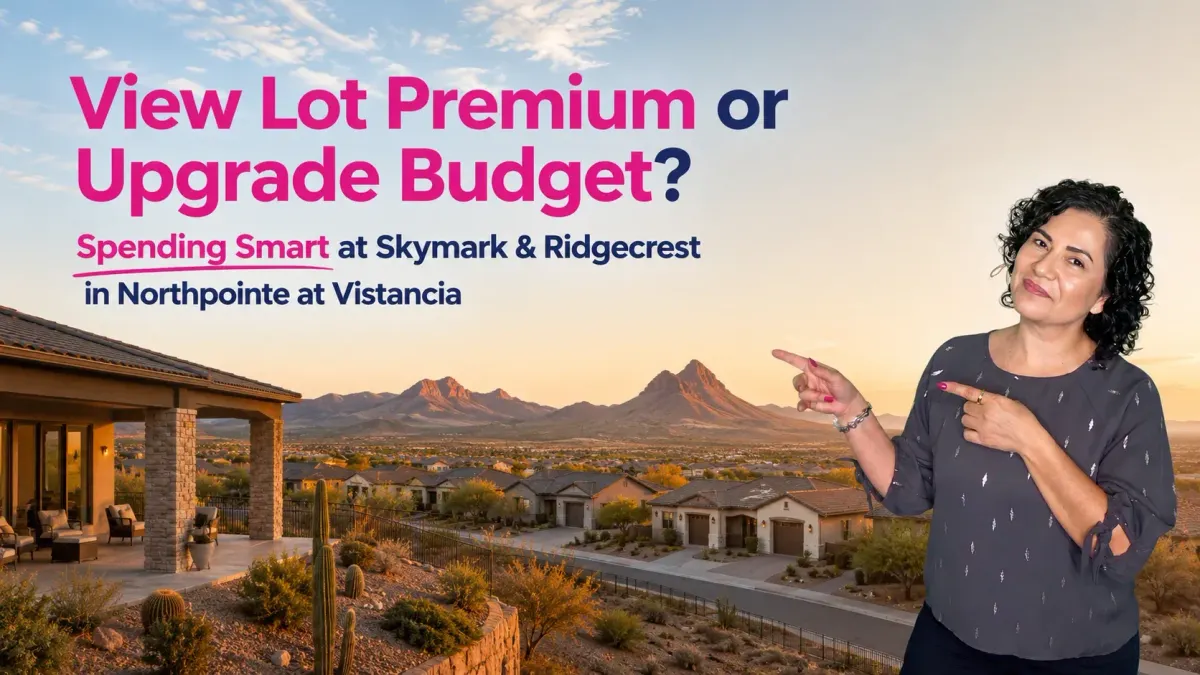
With Skymark and Ridgecrest opening new phases in Northpointe at Vistancia, is it smarter to pay a premium for a view lot now or choose a more basic lot and plan to upgrade finishes within the same builder community?
In most cases, put the dollars toward the lot—because a lot is permanent and finishes are replaceable. A view premium buys something no future owner can add and no neighbor can replicate, while most cosmetic upgrades can be done after closing, often for less than design-center pricing. The refined rule: spend on what you can't change later (the homesite and structural options), stay disciplined on what you can (cosmetic finishes)—as long as the premium doesn't push you past the enclave's realistic price ceiling.
This is the question that separates buyers who are still shopping from buyers who are about to sign, and the fact that you're asking it means you've already done the hard part: you've picked your community. Now Shea's two Northpointe offerings put the dilemma in front of you in its purest form. Skymark's collections release homesites perched in some of the most elevated terrain in the Vistancia master plan, and Ridgecrest's phases climb the Sonoran foothills with the kind of sightlines that sell the 55+ lifestyle in a single photo. The sales office will happily take your money for either answer—a premium homesite or a loaded design-center sheet—so the discipline has to come from you. Here's the framework I use with buyers standing exactly where you are, and why the lot usually wins.
What a Lot Premium Actually Buys
A lot premium purchases three things, and all of them are permanent. First, scarcity: in any release, the view lots, the elevated positions, and the no-neighbor-behind homesites are a fixed, small fraction of the map, and once they're gone, they're gone for that enclave's lifetime. Second, daily experience: you collect the view every morning for as long as you own the home, which is a return paid in something other than dollars but is no less real. Third—and this is the resale mechanism—differentiation that survives time. Years from now, when your home is a resale competing against similar floor plans on interior streets, the lot is the line item a buyer can't get anywhere else and an appraiser can't ignore. Finishes date; granite gives way to quartz gives way to whatever comes next. A mountain sightline doesn't go out of style. In master-planned communities, well-chosen premium homesites have historically defended their pricing better in soft markets precisely because they can't be reproduced by the builder's next release. That's the honest case for paying up. It comes with one structural caution I'll flag now and return to: a premium only works if the total price still fits inside what the enclave's resale market will realistically support.
What Finish Upgrades Actually Buy
Design-center spending is a different kind of purchase, and it splits into two categories that deserve opposite treatment. Structural and behind-the-walls options—extended garages, additional bedrooms or baths, taller ceilings, multi-slide door openings, plumbing and electrical rough-ins, insulation and window packages—are effectively part of the lot decision: they're impossible or brutally expensive to add later, so if they matter to how you'll live, buy them at build time without guilt. Cosmetic finishes are the opposite story. Flooring, backsplashes, lighting, hardware, countertop tiers, and window treatments can all be done after closing, frequently at better pricing than the builder's design center, on your own schedule, and to taste you'll have refined by actually living in the home. There's also a quieter issue: upgrade-heavy homes can appraise below their contract price because appraisers weight comparable sales, not your design sheet—which means heavy cosmetic spending may effectively be cash you don't get back at resale. None of this makes the design center a villain; it makes it a menu to order from selectively. Before you sit down there, know the contract terms around deposits and changes—my guides to North Peoria new construction contract protections and comparing builder contracts, incentives, and warranties cover what to verify before any upgrade dollars become non-refundable.
— Donna R, Peoria, AZ
The Skymark and Ridgecrest Specifics That Change the Math
Generic advice only goes so far, and two community-specific facts should shape your decision here. First, at Skymark, Shea's plan calls for every homesite to back to open space. Read that again before paying a large view premium: when even the "basic" lots offer privacy and an open backdrop, the marginal difference between a standard homesite and a premium one narrows to the quality of the specific sightline—elevation, orientation, which mountain face you see—rather than view versus no view. That makes lot-by-lot evaluation more important and blanket premiums less automatically worth it. Second, Ridgecrest is a 55+ boutique community of around 400 homesites, which changes the ownership math in two directions at once. Buyers there often intend long tenures—sometimes a final home—which means the daily-enjoyment return on a view compounds over many years, strengthening the case for the premium. At the same time, certain "upgrades" in a 55+ home aren't cosmetic at all: single-level living refinements, wider doorways, zero-threshold showers, and task lighting are aging-in-place infrastructure, and several of them are structural decisions best made at build time. New phases at both communities mean lot selection is currently at its best—and that window narrows with every release, while the design center's menu will look identical next year.
The Rule I Give Buyers: Spend on What You Can't Change
This is usually where I slow buyers down, because the sales environment is engineered to make both spends feel equally urgent. They're not. Rank your dollars in this order: first, the homesite—if a specific lot genuinely fits how you live and what you'll want at resale, secure it, because it's the one decision with no second chance. Second, structural options—the bedroom count, garage depth, ceiling height, and rough-ins that future-you can't retrofit. Third, and only with what's left, cosmetic finishes—and even then, favor the ones that are disruptive to redo (flooring) over the ones that are a weekend project (hardware, lighting, paint). The discipline has a boundary, though: a view premium that pushes your total past the top of the enclave's realistic resale range, or that strains your loan qualification, has crossed from investment into indulgence—the most expensive home on the street historically has the hardest resale path. Ground your total budget first in what it costs to buy a home in Peoria, set your ceiling, and then let the lot-first hierarchy allocate within it. A basic-lot home with tasteful post-close finishes is a fine outcome. A premium-lot home with builder-grade carpet you replace in year three is usually a better one.
How to Evaluate a Specific View Lot Before You Pay for It
Whichever way you lean, never buy a premium from a lot map alone. Stand on the actual dirt at the time of day you'll use the backyard, and check the sun orientation—a west-facing "view patio" in Arizona is a very different asset in July than the rendering suggests. Ask the sales team what's planned on every piece of land in your sightline: future phases, roads, trail corridors, and community facilities can all change a view, and in a community still building out—Northpointe is planned for roughly 3,200 homes at completion—"open space today" and "preserved open space forever" are different answers, so ask which one your view is. Verify the grading plan for pads behind and beside you, since a two-story neighbor on a higher pad rewrites a sightline. Compare the premium against what the same dollars buy elsewhere in the release. And once you're under contract, protect the investment with the same rigor as any new build—independent inspections and a thorough final walkthrough before closing. At this stage, I help clients narrow their focus to two or three specific homesites and price the premium against each lot's verifiable, permanent attributes—not against the feeling the model home tour was designed to produce.
— Eli R, Buckeye, AZ
Frequently Asked Questions
Do view lot premiums hold their value at resale?
Well-chosen premium homesites generally defend value better than cosmetic upgrades because they're scarce and can't be replicated by later construction. The premium still needs to keep the total price within the enclave's realistic resale range to pay off.
Do Skymark homesites at Northpointe at Vistancia have views?
Skymark's plan calls for every homesite to back to open space, so even standard lots offer privacy and an open backdrop. Premium lots differ in elevation, orientation, and specific sightlines, which is why evaluating the individual homesite matters more than the premium label.
Is Ridgecrest at Northpointe age-restricted?
Yes. Ridgecrest is a Trilogy Boutique Community by Shea Homes, the 55+ offering within Northpointe at Vistancia, planned at a boutique scale of roughly 400 homesites with its own resident club and amenity hub.
Are builder design-center upgrades worth the cost?
Structural options that can't be added later are usually worth buying at build time. Cosmetic finishes often cost more through the design center than after closing and rarely return dollar-for-dollar at resale, so be selective.
Can a view at Northpointe change as new phases are built?
It can. Northpointe is planned for roughly 3,200 homes at completion, so confirm whether the land in a lot's sightline is permanently preserved open space or designated for future development, and review grading plans for nearby pads before paying a premium.
The Bottom Line
When you're locked into a community you love, the question isn't whether to spend—it's where the dollars do permanent work. The lot is forever; the finishes are a phase. Pay for the homesite and the structural choices you can't revisit, walk the specific lot and verify what its view will look like after build-out, and let the cosmetic upgrades wait for your own contractors and your own timeline. The buyers who regret their decision five years in are almost never the ones who bought the right lot with builder-grade counters. They're the ones admiring upgraded backsplashes through a window that looks at a block wall.
About the Author
Kasandra Chavez is a real estate advisor serving the West Valley of Greater Phoenix, Arizona, recognized among the top 5% of real estate professionals in the Greater Phoenix area. She works with buyers and sellers to build strategy around their lifestyle and goals, providing clear decision-making support at every stage. Her approach centers on process control and steady market navigation, so clients always know what comes next.
Kasandra Chavez | Chavez Dream Home Team | chavezdreamhometeam.com