
Sun City or Sun City West: Which Should You Buy In?
The real differences between Sun City and Sun City West aren't the amenities — they're the fee structure, the housing stock, and how each community is governed.
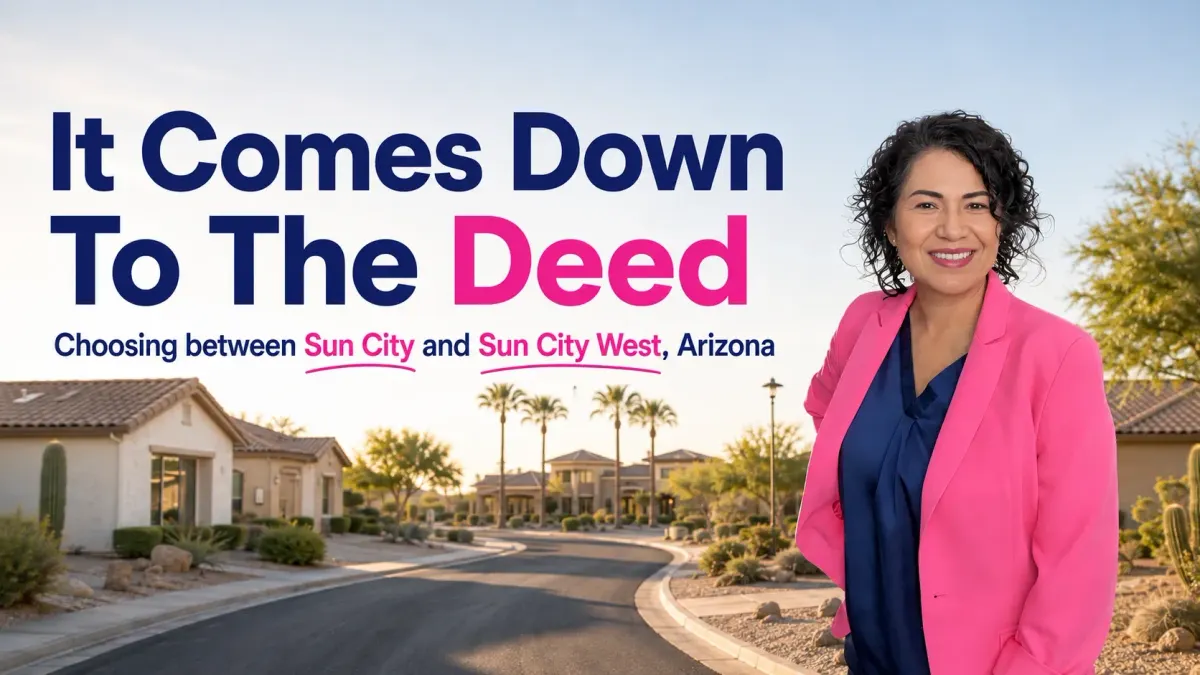
Sun City or Sun City West — which one should I actually buy in?
The honest answer depends on two things almost nobody leads with: how many people will be on the deed, and how much updating you want to do. Sun City West assesses its recreation fee per person on the deed, while the original Sun City assesses per property — so a couple generally pays more annually in Sun City West. Sun City's housing stock is roughly two decades older, which usually means a lower purchase price and more renovation ahead of you.
Most comparisons of these two communities read like brochure copy. Both have golf. Both have recreation centers. Both are age-restricted, both sit in unincorporated Maricopa County northwest of Phoenix, and both were built by Del Webb. All true, and none of it helps you choose.
The differences that change your monthly budget and your first year are structural, and they're rarely explained well. This is usually where I slow buyers down, because retirees often choose on a weekend of touring and don't discover the fee mechanics until after closing.
How Do Recreation Fees Differ Between Sun City and Sun City West?
This is the single biggest financial difference, and it turns on a structural detail. Sun City West's recreation fee is assessed per person on the deed, paid to the Recreation Centers of Sun City West. The original Sun City assesses its annual property assessment per property, paid to the Recreation Centers of Sun City, regardless of how many names are on the title.
The practical consequence: for a single buyer, annual cost lands in similar territory. For a couple both on the deed, Sun City West's per-person structure produces a higher combined figure. That difference compounds over a twenty-year retirement, and it never appears in a listing.
What One-Time Fees Do You Pay at Closing in Sun City or Sun City West?
Separate fees from the annual assessment, and buyers routinely conflate the two. Both communities collect one-time fees at closing — preservation, capital improvement, and transfer fees — funding long-term upkeep of the recreation facilities. They are separate from the annual assessment, due at close of escrow, and in a slower market negotiable between buyer and seller. The Recreation Centers of Sun City publishes its current fee schedule covering all of them.
One thing worth raising directly with the recreation organization: these one-time fees attach to a change in ownership, and the governing language turns on whether the original payer still holds a majority interest in the property. If you are selling one home and buying another inside the same community, ask whether any credit or reimbursement applies to your situation. Nobody checks this for you, and it is not applied automatically. More on the fee picture in my guide to Sun City recreation fees and asset preservation.
Why Are Property Taxes Lower in Sun City and Sun City West?
Because most of both communities sits outside the surrounding school district. As Sun City West's own fees and taxes page puts it, local school taxes are often a major part of a property tax bill, and most of Sun City West was removed years ago from the surrounding school district. That absence is the main reason tax bills in both communities run well below comparable Phoenix-area homes. Both communities are also unincorporated, so there's no municipal property tax or city sales tax layer, and Maricopa County provides services.
Two cautions. First, the school-tax exclusion covers most but not necessarily all parcels — not a blanket guarantee for every address, so confirm it on the specific property rather than assuming. Second, unincorporated status means county-level services rather than a city's, and the two communities are served by different fire providers. Neither is a drawback, but both are worth understanding before you assume the arrangement matches what you're used to.
— Eli R, Buckeye, AZ
Housing Stock: What You're Actually Buying in Each Community
Sun City homes are roughly two decades older, and that gap drives most of what you'll experience as a buyer. Sun City was developed beginning in 1960; Sun City West sales ran from the late 1970s into the late 1990s. Sun City generally offers lower purchase prices and more original systems, while Sun City West offers newer construction, larger floor plans, and more attached garages.
The trade is straightforward once you see it. A lower Sun City purchase price often comes with a renovation budget attached — original electrical panels, aging sewer lines, and dated kitchens are common in that era. If you're comfortable managing a remodel, that's equity to build. If you want to unpack and start playing pickleball, Sun City West's newer stock will feel easier. My guide to what inspectors find on 1960s and 1970s Sun City homes covers what to expect on the older end.
Governance and HOAs: What Surprises Buyers Most
Neither community works the way buyers expect. Most homes in Sun City and Sun City West are not in a traditional homeowners association. The recreation organizations are separate nonprofits, not municipal departments and not HOAs — they own and operate the facilities and levy the annual fee, and membership comes with the deed.
Sun City West contains smaller HOAs covering condos, duplexes, patio homes, and some single-family homes, typically where the association maintains front landscaping. Those carry their own dues on top of the recreation fee. Separate homeowners associations exist in Sun City as well and may add their own charges.
When I'm helping a buyer compare specific homes across these two communities, five things determine which one actually fits:
- Number of people on the deed: This single fact changes the annual recreation cost between the two communities, and it's decided before you ever tour a home.
- Whether the property sits in a sub-HOA: A Sun City West patio home or duplex may carry association dues in addition to the recreation fee, which changes the monthly math.
- Golf and bowling participation: Neither is covered by the annual recreation fee in either community, so a frequent golfer should price that separately before comparing.
- Renovation appetite: The older Sun City stock rewards buyers willing to update and penalizes those who aren't.
- Recreation center proximity: Both communities have multiple centers, and the one nearest your home shapes daily routine more than the total count does.
Which Community Fits Which Buyer?
Sun City suits a buyer prioritizing the lowest entry price and the widest amenity footprint, who is comfortable with an older home and possibly a remodel. It's the original Del Webb community with the longest-established club and activity culture, and the per-property fee structure is friendlier to couples.
Sun City West suits a buyer who wants newer construction, larger floor plans, and less immediate renovation, and will pay a somewhat higher combined annual recreation cost for it — particularly a single buyer, for whom the per-person structure barely matters. For adjacent comparisons, I've looked at whether PebbleCreek is worth the premium over Sun City West and at how to read the CC&Rs and age restrictions when buying in Sun City West.
Frequently Asked Questions
Is the recreation fee cheaper in Sun City or Sun City West?
It depends on the deed. Sun City West charges per person on the deed while Sun City charges per property, so a couple generally pays more annually in Sun City West, while costs for a single owner are more comparable.
Do Sun City and Sun City West pay school taxes?
Most of both communities was removed from the surrounding school district years ago, which is why property tax bills run well below comparable Phoenix-area homes. Confirm the exclusion on the specific parcel rather than assuming.
Do Sun City and Sun City West have HOAs?
Most homes in both do not have a traditional HOA. The recreation organizations are separate nonprofits, not HOAs. Sun City West does contain smaller HOAs covering condos, duplexes, patio homes, and some single-family homes.
Which community has newer homes?
Sun City West. Sun City was developed beginning in 1960, while Sun City West sales ran from the late 1970s into the late 1990s, so its homes are generally newer with larger floor plans.
Is golf included in the recreation fee?
No. Golf and bowling are billed separately in both communities. A frequent golfer should price an annual card or per-round fees separately, since those costs can exceed the annual recreation fee itself.
Can I get the one-time fee reimbursed if I sell and buy again in the same community?
Ask the recreation organization directly. These fees attach to a change in ownership and the governing language turns on majority ownership interest, so whether a credit applies depends on your situation. It is not applied automatically.
Are both communities age-restricted?
Yes. Both Sun City and Sun City West are age-restricted communities, and each has its own occupancy requirements recorded in its governing documents that a buyer should review before writing an offer.
The Bottom Line
Skip the amenity comparison — both communities have more golf, pools, and clubs than most people use. Decide on the two things that actually differ: how many names go on the deed, and how much house work you want to take on.
If you're a couple watching recurring costs and you don't mind updating an older home, the original Sun City's per-property fee structure and lower entry prices work in your favor. If you want newer construction and less immediate renovation, or you're buying alone and the per-person structure barely registers, Sun City West is likely the better fit. Either way, get the specific parcel's tax status and any sub-HOA obligation confirmed in writing before you write the offer.
I'm Kasandra Chavez, REALTOR® and Team Lead of the Chavez Dream Home Team with Real Broker, serving the West and Northwest Valley of Greater Phoenix, Arizona, and recognized among the top 5% of real estate professionals in the Greater Phoenix area. If you're weighing Sun City against Sun City West, I'm happy to price out the real annual cost for your specific situation before you tour, so you're comparing the two on numbers rather than impressions.
Have Questions About West Valley Real Estate?
Kasandra Chavez provides free, no-obligation consultations for buyers, sellers, and investors.
Schedule a Consultation