
Is It a Smart Time to Buy in Surprise AZ in 2026
Surprise prices have softened and days on market are up. Here's what that combination actually means for buyers in 2026 — and what waiting really costs.
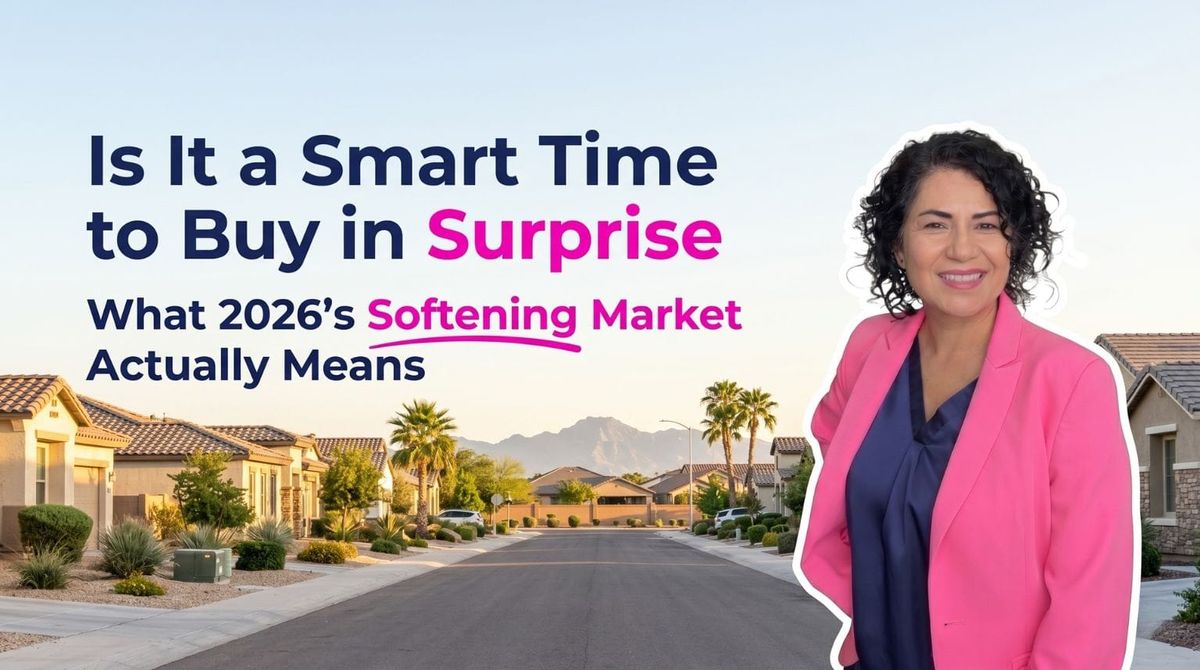
Is it a smart time to buy in Surprise with prices softening slightly but days on market rising in 2026?
For most buyers who are financially ready and planning to own for five years or more, yes — Surprise in 2026 is one of the more buyer-friendly windows the West Valley has offered in years. Prices have eased modestly, days on market have stretched into balanced-to-buyer-favored territory, and seller concessions are back on the table. The math doesn't reward waiting indefinitely for a lower rate or a lower price, because neither of those is guaranteed and the cost of being out of the market while you wait is real.
If you've been watching Surprise from the sidelines, the question you're really asking isn't whether the market will keep softening. It's whether you should act on the softening that has already happened, or hold out for more. Here's what I see playing out with buyers I'm working with right now: the ones who are ready and decisive are getting outcomes — price reductions, closing-cost help, sometimes both — that simply weren't available eighteen months ago. The ones who keep waiting are mostly waiting for a market that already exists, just with different language attached to it.
What softening actually looks like in Surprise right now
Surprise has been flagged by multiple market trackers as one of the West Valley cities that has shifted meaningfully toward buyers in 2026, alongside Buckeye, Goodyear, and Maricopa. The drivers are well-understood: years of aggressive new construction in the corridor have lifted inventory, demand has normalized off the 2021–2022 peak, and rates settling into the mid-6% range have kept some would-be buyers on the sidelines. That combination produces exactly what you're seeing — longer days on market, more price reductions during the marketing period, and sale-to-list ratios sitting below 100%.
That's not a crash, and it's not headed to one according to current forecasts. It's a normalization. What it means for a buyer is that the urgency narrative of the last few years — write fast, waive contingencies, overpay for fear of missing out — has been replaced by a market where careful buyers can actually be careful. You can take a second tour. You can ask for an inspection contingency and expect it to be honored. You can negotiate.
Why "wait for a better deal" usually doesn't math out
The instinct to wait is rational, and I never push back on it without showing the numbers. But here is what waiting actually looks like in practice. If you wait six months for prices to drop another 2%, you save a small amount on the home — but only if you're still confident enough to buy then. Most buyers who wait six months end up waiting another six. Meanwhile, you're paying rent or staying put in a home that no longer fits, and you're sitting out whatever appreciation does occur. If rates drop while you wait, competition increases and the leverage you have right now disappears.
The honest framing is this: in a softening market, buyers who close today get the price reduction and the negotiation leverage. Buyers who close in a recovering market sometimes get a slightly lower price but lose the leverage. The combined value of price plus leverage tends to be highest in exactly the window Surprise is in right now. What I watch for here isn't whether prices might soften further — they might — but whether the total transaction cost is likely to be better six or twelve months out. For a buyer planning to own five-plus years, the answer is usually no, and a refinance is almost always available later if rates drop materially.
— Gloria B, Buckeye, AZ
Where the real leverage shows up in a Surprise offer right now
In a balanced-to-buyer-favored market, leverage isn't only about price. It shows up in four places, and a buyer who recognizes all four usually walks away with a meaningfully better deal than a buyer who only fixates on the headline number.
The first is the inspection period. With the AAR 10-day inspection window honored across Arizona contracts, sellers are more willing to negotiate repair requests in writing rather than risk a cancellation. The second is closing-cost contributions. Seller credits toward buyer closing costs have come back as a standard ask, especially on listings that have been on the market beyond the median DOM. The third is appraisal flexibility. With list prices occasionally outrunning comps, sellers are sometimes willing to renegotiate to appraised value rather than restart the marketing process. And the fourth — the most overlooked — is timeline. Buyers asking for 35 to 45 days to close, or for a rent-back to bridge a current home sale, are getting accommodations that were unthinkable two years ago.
At this stage, I help buyers narrow their focus to which of these four matter most for their specific situation. A first-time buyer with limited cash to close cares most about credits. A move-up buyer juggling a current home cares most about timeline. A relocation buyer cares most about contingency protection. The leverage is there — the question is which lever to pull. For move-up buyers who need to sell a current home to fund the next, understanding how contingent offers and rent-backs actually work in the West Valley is often the difference between getting an accepted offer and watching the right home go to someone else.
What this means for first-time buyers specifically
First-time buyers carry a particular kind of stress in a market like this one. They're balancing affordability questions against rate uncertainty against the basic fear of buying the wrong home. The current Surprise environment is genuinely better for first-time buyers than the last three years have been — but only if they're prepared. Preparation means a pre-approval that reflects current rates, a clear sense of total monthly cost including taxes and insurance, and a realistic shortlist of neighborhoods rather than the entire city.
The mistake I see first-time buyers make is treating Surprise as one market. It isn't. Northern Surprise near Loop 303 behaves differently from the older, more established central core. New-construction-heavy zones with active builder incentives behave differently from resale-dominated subdivisions. Pricing leverage, inspection norms, and contingency expectations all shift by sub-market. Buyers comparing Surprise to other West Valley options should also look at how communities like PebbleCreek and Sun City West differ on total cost of ownership — the lesson on amenity premiums and HOA structure applies to younger master-planned communities too.
— Dustin T, Glendale, AZ
When waiting actually does make sense
I don't tell every buyer to act now. There are three scenarios where waiting is genuinely smarter than buying, and a good advisor names them clearly. First, if you don't have stable employment or your income is in transition. The current rate environment punishes thin margins, and a slightly lower price next year doesn't fix an unstable underwriting picture. Second, if you're not planning to stay in the home at least three to five years. Transaction costs alone — agent compensation, title fees, inspections, moving — typically run 6–10% of the home value across both buying and selling, and a short hold period rarely recovers that in appreciation. Third, if your down payment isn't yet built up and stretching to the minimum would leave you cash-poor on a property that needs anything from immediate repairs to landscaping.
For buyers facing any of those, the smart move is to use the next six to twelve months to fix the underlying issue, not to gamble on market direction. The market will still be here. The conditions may shift, but they won't shift dramatically enough in a year to make the difference between "ready" and "not ready."
Frequently asked questions
Are Surprise sellers actually accepting offers below asking price in 2026? Yes, more often than they have in years. With many homes priced above what comps support, well-positioned offers below list are being accepted, especially on listings past the median days-on-market threshold.
Should I wait for mortgage rates to drop before buying in Surprise? For most buyers, no. Waiting often means trading current leverage for future competition. A refinance is available later if rates drop materially, but you can't refinance a home you didn't buy.
How long are Surprise homes sitting on the market right now? Reporting sources vary, but the directional trend is clear: Surprise days on market have stretched into the balanced-to-buyer-favored range, longer than the seller-leaning era of 2021–2022.
What kind of seller concessions are realistic to ask for in Surprise right now? Closing-cost credits, repair credits, and rate-buydown contributions are all back on the table, particularly on listings that have been active beyond the typical marketing window.
Are builders still offering incentives in Surprise corridors? Yes. West Valley builder incentives have remained more generous through 2026 than during the surge years, including closing-cost help and rate buydowns, though specific packages change frequently and should be confirmed directly.
The bottom line
Surprise in 2026 is a market where careful buyers can be careful, and that's a meaningful change from the last few years. The combination of softening prices, longer days on market, and renewed seller flexibility creates a window where being prepared and decisive matters more than waiting for perfect conditions that may never arrive. If you're financially ready and planning to own for five years or more, the math usually favors buying now and refinancing later — not waiting for a future that may already be priced in.
Kasandra Chavez is a real estate advisor serving the West Valley of Greater Phoenix, Arizona, recognized among the top 5% of real estate professionals in the Greater Phoenix area. She partners with buyers and sellers to develop strategies aligned with their lifestyle, financial goals, and timeline — helping them make confident, well-informed decisions. Her process keeps the focus on managing decisions, not chasing the market.