
Should You Trade Up Your Peoria Home to Be Near the Innovation Core?
High-wage jobs are landing along Peoria's Loop 303 corridor. Here's how to decide whether to cash out your central Peoria home and trade up closer to the Innovation Core.
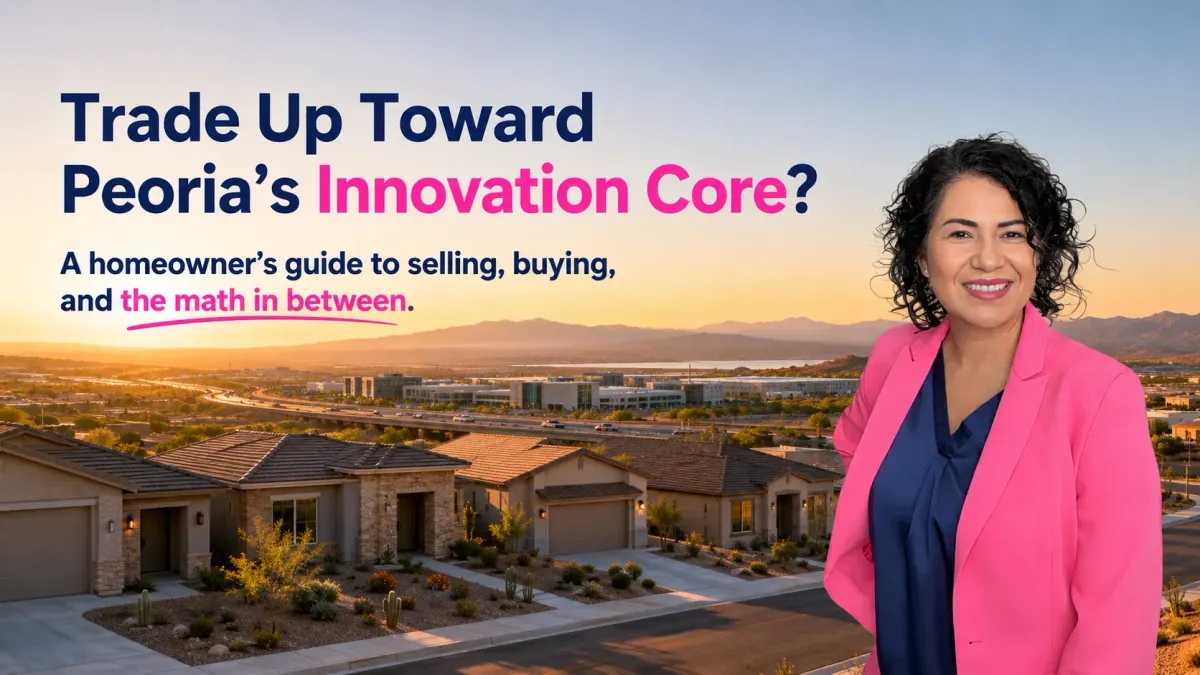
Should I sell my central Peoria home and trade up to live closer to the Innovation Core?
Maybe — if your central Peoria home has built real equity and a shorter trip to the new Loop 303 job corridor genuinely fits your life, trading up can be a smart move. But this is a coordinated sell-and-buy that hinges on more than excitement about new jobs: you're often trading a lower locked-in interest rate for a newer home and a different monthly payment, so the math has to work, not just the story. The good news is that the Innovation Core is a long-term build, so you have time to plan the move carefully rather than chase it.
If you've owned in central Peoria for a while, you've likely watched your equity climb and wondered whether now's the time to cash some of it out and move into something newer and closer to where the jobs are heading. It's a reasonable instinct — high-wage employers are committing to the northern Loop 303 corridor, and that kind of news tends to pull buyers north. But a trade-up is one of the trickiest moves in real estate, because you're a seller and a buyer at the same time, and the two sides have to line up. This is exactly where I slow clients down and run the actual numbers before anyone falls in love with a new floor plan. Let's break down what's really happening with the Innovation Core, why central Peoria owners are looking north, and how to tell whether the move makes sense for you.
What the Peoria Innovation Core Actually Is
First, let's clear up what's being built, because "innovation core" can sound like vague marketing. The Peoria Innovation Core is a roughly 7,000-acre, city-led development zone along the Loop 303 corridor, stretching from Lone Mountain Parkway up toward State Route 74. Peoria partnered with the Arizona State Land Department to lead the master planning, with the explicit goal of bringing employment closer to where residents already live — a meaningful shift for a city long known as a high-quality place to live but short on large local employers.
The important part for homeowners is what kind of jobs these are. The anchor project is Amkor Technology's advanced semiconductor packaging and testing campus near Lake Pleasant Parkway and Loop 303 — not a warehouse district, but high-wage advanced manufacturing tied to the region's chip boom and supporting major tech names. City officials estimate the campus will eventually bring around 3,000 jobs at an average salary near $100,000, with the first phase expected to open toward the end of the decade. One clarification worth making, since it gets muddled: Amkor's campus sits inside the Innovation Core, having moved from a smaller earlier site to this larger one — you can see the details on the City of Peoria's Amkor project page. High-wage jobs of that scale are the kind of demand driver that can reshape where people want to live.
Why Central Peoria Homeowners Are Eyeing the Move
If you bought in central Peoria years ago, two things are probably true: you have a comfortable amount of equity, and your neighborhood sits a fair distance from the new northern job corridor. That combination is exactly what makes a trade-up tempting. Cashing in appreciation to move into a newer home — often with the layouts, energy efficiency, and amenities that older stock can't match — and landing closer to where the high-wage jobs are heading is a genuinely appealing package.
What I watch for here is whether the motivation is lifestyle, commute, investment, or all three, because that changes the right answer. If someone in your household is likely to work along the Loop 303 corridor, shaving your daily drive has real day-to-day value. If you're partly betting on appreciation as the job base grows, that's a longer-horizon play. And if it's mostly about wanting a newer home, that's valid too — it just means the new-construction trade-offs matter more than the location story. Naming the real "why" up front keeps the rest of the decision honest.
The Real Math: Equity, Rate, and Payment
Here's the part that excitement tends to skip. A trade-up isn't just "sell high, buy nice" — it's a full reset of your housing costs. If you locked in a low interest rate years ago, moving likely means taking on today's rate on a newer, possibly pricier home, which can change your monthly payment meaningfully even when you're rolling a healthy chunk of equity into the purchase. You also carry costs on both sides of the deal: selling expenses on the old home and closing costs on the new one.
This is usually where I slow sellers down and put it on paper. The right question isn't "how much is my home worth?" — it's "what does my whole picture look like after the dust settles?" That means weighing your equity against the new payment, the rate change, and the costs of doing two transactions. It helps to get clear-eyed about what it costs to buy in Peoria right now before you assume the equity covers everything. When the numbers genuinely work, a trade-up can be a great wealth and lifestyle move. When they don't, it's far better to know that before you list.
— La Maja, Avondale, AZ
Coordinating the Sell-and-Buy Without Getting Stuck
The logistics are where trade-ups live or die. The core question is order: do you sell first and risk needing somewhere to land, or buy first and risk carrying two homes? Neither is automatically right. Selling first gives you certainty about your budget and a strong, non-contingent offer on the new home; buying first lets you move once, but it leans on bridge financing or a contingency that sellers may resist. The market conditions and your own finances decide which path is safer, and this is the heart of coordinating a sale and a purchase at the same time.
New construction adds a wrinkle worth planning for. If you're buying a brand-new home closer to the corridor, the build timeline rarely matches your sale neatly — you might sell months before the new home is ready, or face a delay that strands your equity. Tools like rent-backs, careful contingency language, and realistic timelines keep you from owning two homes or none. And because builder contracts protect the builder first, it's smart to understand how to protect yourself in a North Peoria new-construction contract before you sign. Sequencing it well is often the difference between a smooth move and a stressful one, which is why timing your sale so the two sides line up deserves real attention.
— ReyAna K, Peoria, AZ
Should You Move Now or Wait?
Here's the reassuring reality: you don't have to rush. The Innovation Core is a multi-year build, with Amkor's first phase opening toward the end of the decade and the broader corridor filling in over many years after that. That means the job-driven demand it creates will unfold gradually, not overnight — there's no single deadline you're racing against.
At this stage, I help clients narrow their focus to two honest questions: does the move fit your life in the next year or two, and does the math work today? If both are yes, buying ahead of the demand curve can be a sound long-term play, and you get to enjoy the newer home and shorter commute while the corridor matures. If either is shaky — the payment stretches you, or the timing isn't right — waiting costs you very little, because this story is just getting started. Either way, the smart move is to decide on your numbers and your life, not on the buzz around a groundbreaking.
Frequently Asked Questions
What is the Peoria Innovation Core?
It's a roughly 7,000-acre, city-led development zone along the Loop 303 corridor in north Peoria, from Lone Mountain Parkway toward State Route 74. Peoria is leading the master planning to bring high-wage employers closer to residents, with Amkor's semiconductor campus as the first major project.
Is Amkor in Five North or the Innovation Core?
Amkor's advanced semiconductor campus is in the Peoria Innovation Core, near Lake Pleasant Parkway and Loop 303. It moved from a smaller earlier site to a larger site within the Innovation Core, where it is now expanding further.
Should I sell my Peoria home now to move closer to the jobs?
Only if the equity, the new payment, and the location genuinely work for you. Because the Innovation Core is a long-term build with Amkor's first phase years out, there's time to plan the move carefully rather than rush into it.
Will the Innovation Core raise nearby home values?
High-wage job growth historically supports housing demand over time, which can be a long-term positive for nearby values. That said, it's an appreciation thesis, not a guarantee, and value always depends on location, condition, and broader market conditions.
Should I sell first or buy first when trading up?
It depends on your finances and the market. Selling first gives budget certainty and a stronger offer; buying first means one move but leans on bridge financing or a contingency. Contingencies and rent-backs help you avoid owning two homes or none.
The Bottom Line
A wave of high-wage jobs heading to Peoria's Loop 303 corridor is a genuine reason to think about trading up — but it's a reason to plan, not to rush. If your central Peoria equity is strong, the new payment pencils out, and a home closer to the Innovation Core fits the life you actually live, a coordinated sell-and-buy can be a powerful move both financially and day to day. If the math is tight or the timing is off, the beauty of the Innovation Core is that it's a long game, so waiting costs you almost nothing. Run your real numbers, get the sequencing right, and let the decision rest on your situation rather than the headlines.
About the Author
Kasandra Chavez is a real estate advisor serving the West Valley of Greater Phoenix, Arizona, and is recognized among the top 5% of real estate professionals in the Greater Phoenix area. She specializes in sell-and-buy coordination, relocation, and new-construction navigation, working with clients to build a strategy aligned with their lifestyle and long-term goals. Her focus is helping homeowners run the real numbers behind a move so the decision is grounded in clarity, not hype.