Should I Wait for Interest Rates to Drop Before Buying in Arizona?
A data-driven look at whether waiting for lower interest rates makes sense for Arizona homebuyers in 2026 — and what to focus on instead.
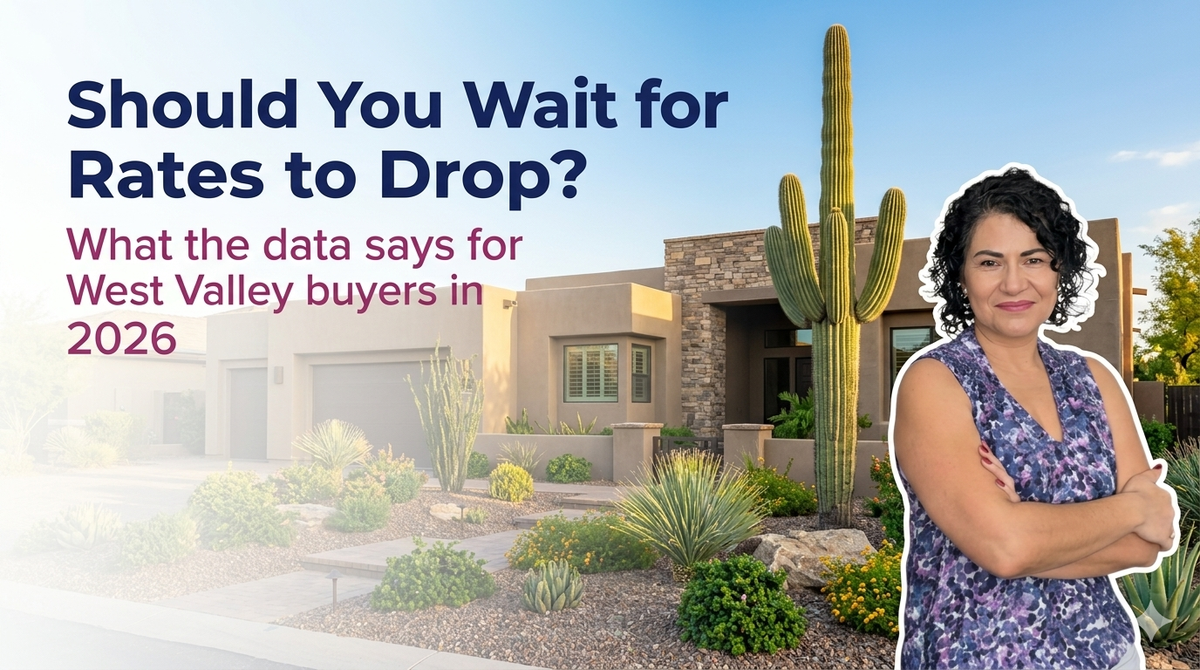
Should I Wait for Interest Rates to Drop Before Buying in Arizona?
Should I wait for interest rates to drop further before buying in AZ?
Not necessarily. As of March 2026, 30-year fixed mortgage rates are hovering around 6%, already down significantly from 6.65% a year ago. The data suggests rates are unlikely to fall dramatically this year, and waiting often means facing higher home prices and more competition when other buyers make the same calculation — which means the savings you hoped for on your rate may be offset by what you end up paying for the home itself.
The Fear Underneath This Question
Buyers don't want to make a bad financial decision. That is the real fear underneath most timing questions — not the interest rate itself, but the worry that you will look back in a year or two and wish you had waited, or wish you had acted sooner. When you are making the largest purchase of your life, every fraction of a percentage point feels enormous, and the pressure to time it perfectly can keep you stuck in a cycle of watching and waiting while the market moves around you.
Here's what I'm seeing with clients right now: the buyers who are making confident decisions are the ones who stopped focusing on where rates might go and started focusing on what their actual numbers look like today. The West Valley market is giving buyers more room to negotiate than it has in years, and that leverage has real financial value that does not show up in a rate comparison alone. The question is not whether rates will drop — it is whether today's conditions are strong enough for your specific situation. If you are also weighing whether renting or buying makes more financial sense right now, the math may surprise you.
What the Numbers Tell Us About Rates Right Now
According to Freddie Mac's Primary Mortgage Market Survey, the average 30-year fixed mortgage rate was 6.11% as of March 12, 2026. That is up slightly from 6.00% the prior week, but the bigger picture matters more: a year ago, that same rate averaged 6.65%. The Federal Reserve has cut its benchmark rate by 175 basis points since September 2024, bringing the federal funds rate to a range of 3.50% to 3.75%.
What this means for you is that borrowing costs have already improved significantly. Most economists, including analysts at Wells Fargo and Bankrate, expect the 30-year fixed rate to stay in the low-to-mid 6% range throughout much of 2026. Deloitte's global economics team projects the Fed may leave rates unchanged until December 2026, with the federal funds rate reaching its neutral level around mid-2027. The practical impact of this is that if you are waiting for rates to dip into the 4% or 5% range, the data does not support that expectation in the foreseeable future.
• Greater Phoenix Cromford Market Index: 82.9 (below 100 = shifting toward buyers)
• Greater Phoenix Supply Index: 104.0 (inventory slightly above balanced levels)
• Greater Phoenix median sales price: approximately $450,000–$500,000 (February 2026)
• Average days on market: approximately 71 days (Q1 2026)
Source: The Cromford Report — data shared per Cromford Associates LLC subscriber policy
The 3% and 4% rates that many buyers remember from 2020 and 2021 were a historic anomaly driven by emergency pandemic-era monetary policy. In my experience, framing today's rates against that period creates unrealistic expectations. A more useful comparison is the 30-year average, which sits closer to 7%. At 6%, you are borrowing below the long-term norm.
The Real Cost of Waiting for the "Perfect" Rate
This is usually where I slow buyers down, because the math on waiting is rarely as simple as it seems. The assumption behind waiting is that your future rate savings will outweigh what you pay in the meantime. But that calculation ignores three things that are working against you while you wait.
First, home prices in the Greater Phoenix area have appreciated significantly over the past five years. According to ARMLS data, the median sales price in Greater Phoenix has risen from approximately $340,000 in early 2021 to the $450,000–$500,000 range today. Even if prices flatten — and there is no guarantee they will — you are still building no equity and paying rent during the months you spend waiting. That rent payment builds someone else's wealth, not yours.
Second, when rates do drop, competition increases. Every buyer who has been sitting on the sidelines will enter the market at the same time, which drives up demand, pushes prices higher, and reduces your negotiating power. According to the National Association of REALTORS, existing-home sales increased 1.7% in February 2026 as buyers responded to the current rate environment — and that activity will only accelerate if rates move lower. The buyers who act before a rate drop often get better purchase terms than those who rush in after one.
Third, you can refinance a rate, but you cannot renegotiate your purchase price. If you buy today at 6% and rates eventually move to 5.5%, you refinance and your payment drops. But if you wait and prices increase by $20,000 or $30,000, that added cost stays with you for the life of the loan regardless of where rates go.
— Gloria B, Buckeye, AZ
How to Think About Your Monthly Payment — Not Just the Rate
Buyers often focus on the rate. I focus on the total monthly payment and the long-term value of the asset. The interest rate is one piece of a larger picture that includes your purchase price, property taxes, homeowner's insurance, HOA dues if applicable, and any private mortgage insurance. A slightly higher rate on a well-priced home in a community that fits your lifestyle can result in a lower total monthly cost than a lower rate on a home that stretches your budget. If you are working through how to assess what you can truly afford in the West Valley, the total payment picture is where to start.
Here is the trade-off most buyers do not consider: in the West Valley, HOA fees in planned communities like those in Peoria, Surprise, and Goodyear typically range from $50 to $250 per month depending on the community amenities. If you are weighing HOA versus non-HOA communities in the West Valley, that monthly difference can be just as significant as a rate change. Property taxes in Maricopa County are generally lower than the national average, which helps offset rate costs for Arizona buyers compared to many other states.
What I watch for here is the total housing cost relative to income and lifestyle. If your monthly payment — including taxes, insurance, and HOA — allows you to live comfortably, save for emergencies, and still enjoy your day-to-day life from that home, then the rate is a number you can work with and refine later through refinancing. This likely is not your forever home — it is a stepping stone that builds equity and positions you for the next one. The strategic approach here would be to lock in today's price and today's terms, then refinance when the opportunity comes.
What the West Valley Market Looks Like for Buyers Right Now
The data shows a market that is moving in your favor as a buyer. According to the Cromford Report, the Greater Phoenix Cromford Market Index sits at 82.9 as of March 12, 2026. A balanced market reads as 100, which means the current reading indicates conditions are shifting toward buyers. The Supply Index at 104.0 tells us that inventory is slightly above balanced levels — more homes to choose from and less pressure to make snap decisions.
The contract ratio — the number of homes under contract divided by active listings — is one of the most telling indicators of real-time demand. When the contract ratio is lower, it means fewer buyers are competing for each listing, which gives you more room to negotiate on price, closing costs, and terms like post-possession timelines. In my experience, this kind of leverage can save buyers thousands of dollars that do not show up in a rate comparison. For buyers concerned about navigating appraisal gaps or low down payment options, a buyer-favorable market also means more flexibility from sellers.
Arizona added 67,394 new residents in the most recent census data, averaging 185 people per day moving to the state. That population growth supports long-term home values, but right now the supply side has caught up enough to give current buyers breathing room. Sales are up 12.33% year over year, which means the market is active — buyers are transacting — but inventory levels are keeping the pace manageable.
So, the bottom line is that the West Valley market in spring 2026 offers a combination of improved rates, increased inventory, and buyer-friendly conditions that may not last once rates do eventually drop further and more buyers flood back in.
— Paul, Surprise, AZ
When Waiting Might Actually Make Sense
Waiting for perfect market conditions is its own kind of risk. But there are situations where pausing is the right call — and they have nothing to do with interest rates.
If you are carrying high-interest consumer debt, if your employment situation is unstable, or if you have not saved enough for a down payment and closing costs, then waiting is not about the market — it is about your readiness. The same applies if you are going through a major life transition like a divorce, a job relocation that has not been finalized, or a family change that will shift your housing needs in the next six to twelve months.
There are no bad markets — there are bad purchases. The difference is preparation and information. The right time to buy is when your finances, your timeline, and your personal situation align — not when a headline tells you rates moved a quarter point in one direction.
Frequently Asked Questions
Will mortgage rates drop below 5% in Arizona in 2026?
Based on current forecasts from Freddie Mac, Wells Fargo, and Bankrate, the 30-year fixed rate is expected to stay in the low-to-mid 6% range throughout 2026. Economists do not anticipate a return to 4% or 5% rates in the foreseeable future without a significant economic disruption.
Should I buy now and plan to refinance later?
This is a strategy that many West Valley buyers are using successfully right now. You lock in today's purchase price while inventory and negotiating conditions are favorable, then refinance if and when rates improve. The key is to ensure your current monthly payment is comfortable, not stretched.
How much does a 1% rate difference actually affect my monthly payment?
On a $450,000 home with 5% down, the difference between a 6% rate and a 5% rate is approximately $280 per month. That is meaningful, but it is also the kind of number that can be offset by negotiating seller concessions, a lower purchase price, or lender credits — all of which are more available in a buyer-friendly market like the one the West Valley is experiencing right now.
Is it a buyer's or seller's market in the West Valley right now?
According to the Cromford Report as of March 2026, the Greater Phoenix Cromford Market Index is 82.9 — anything below 100 indicates conditions are tilting in favor of buyers. The Supply Index at 104.0 confirms that inventory is above balanced levels, giving buyers more selection and negotiating room.
What Matters More Than the Rate
The rate is a number on a page. What actually shapes your experience as a homeowner is whether the home fits your life, whether the monthly payment lets you live comfortably, and whether you have a plan for what comes next. The buyers who feel the most confident are not the ones who timed the market perfectly — they are the ones who made an informed decision with clear eyes and a strategy behind it.
If this home is a stepping stone that builds equity and positions you for the next chapter, then the question shifts from "when is the perfect time?" to "does this work for me right now?" That is a much more answerable question, and one that leads to better outcomes.
About the Author
Kasandra Chavez is a real estate advisor serving the West Valley of Greater Phoenix, Arizona, recognized among the top 5% of real estate professionals in the Greater Phoenix area. She works with buyers and sellers to develop strategy aligned with their lifestyle and long-term goals, providing the education and decision-making support needed at every stage of the transaction. Her approach centers on process control, market clarity, and making sure her clients never feel rushed into a decision they are not ready for.