Should I Sell My Rental Property Now or Keep It as the Phoenix Market Matures?
Trying to decide whether to sell your rental property now or hold it as the Phoenix market shifts? Here's how to think through the timing, the numbers, and the factors that actually matter.
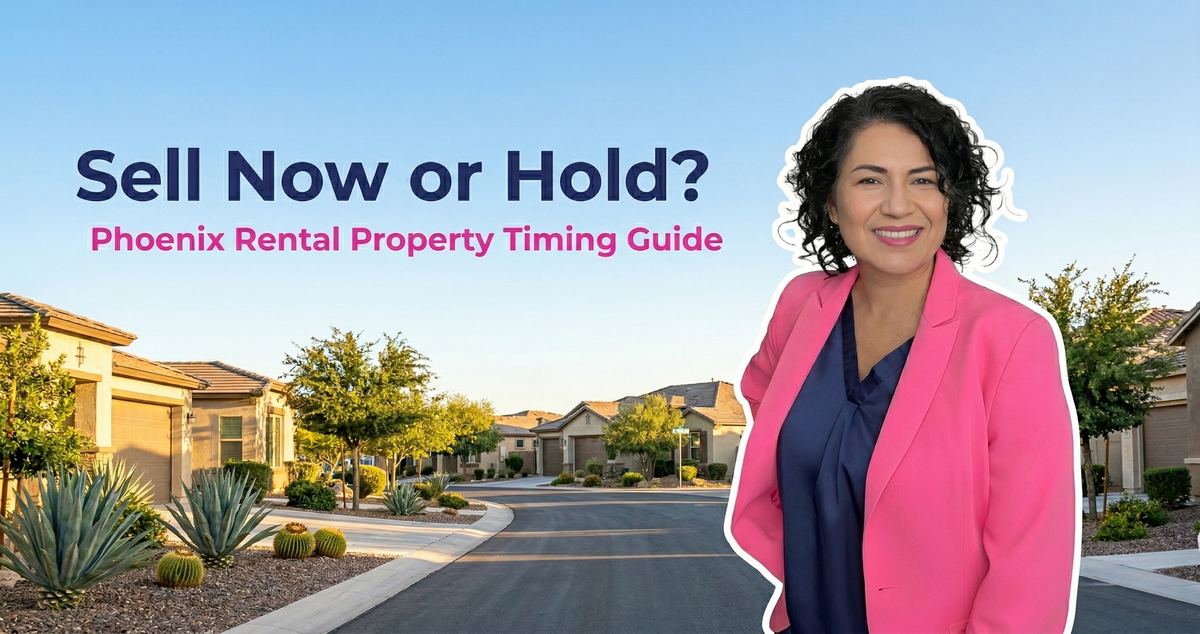
Should I sell my rental property now or keep it as the Phoenix market matures?
Whether to sell now or hold depends on three things working together: your property's current net return, your personal financial position, and where Phoenix-area demand is actually heading. For most landlords in the West Valley, the answer isn't obvious — and the cost of guessing wrong in either direction is real.
What's Actually Happening in the Phoenix Rental Market Right Now
Phoenix has been one of the most-watched rental markets in the country for the past several years, and that attention hasn't faded. The West Valley — Peoria, Surprise, Goodyear, Avondale, Buckeye — continues to absorb significant population growth driven by job relocation, Sun Belt migration, and major employer expansion. That growth is still happening, but the pace has moderated from its pandemic-era peak.
What that means for you as a landlord is more nuance than a simple "hold" or "sell" signal. Metro Phoenix's rental vacancy rate climbed to 8.4% in 2025, up from 7.9% the prior year, according to AZ Big Media — a meaningful shift that gives tenants more negotiating power and puts pressure on landlords to compete on price or amenities. Competition from new construction has softened some of the rent appreciation landlords counted on through 2020–2023.
If your rent hasn't kept pace with your operating costs, or if your equity position has grown significantly, the math may look very different today than it did three years ago. This is usually where I slow investors down. Before you make a move either direction, you need to know your actual numbers — not what the market is doing broadly, but what your specific property is doing for you right now. That starts with your cap rate, your equity, and your next best use of both.
How to Read Your Property's Real Return
A lot of landlords think about their rental property in terms of monthly cash flow, but cash flow alone doesn't tell you whether holding or selling is the stronger move. The number you actually need is your current cap rate — your net operating income divided by the property's current market value. If that number has compressed significantly since you purchased, your property may be working harder on paper (as equity) than it is in your bank account each month.
Here's what to look at: If your Phoenix-area rental is generating a 4–5% cap rate on today's value, and you could redeploy that equity into something generating 6–7%, you're leaving return on the table by holding. On the other hand, if your rent has risen alongside the market, you purchased before the run-up, and your operating costs are under control, your yield might still be strong relative to your original investment — even if it looks modest compared to current market value.
Depreciation, maintenance reserves, and vacancy cost assumptions all factor in here. A property that looks like it's performing may be eroding your return in ways that don't show up on a simple cash flow spreadsheet. You can find additional context on how metro Phoenix single-family home activity shaped up through 2025 in AZ Big Media's year-end recap — useful for benchmarking your property's position against broader market trends.
— Michael R, Avondale, AZ
The Tax Considerations That Change the Calculation
This is the piece that surprises most Phoenix landlords: the tax implications of selling a rental property are materially different from selling a primary residence, and they can significantly affect which decision actually puts more money in your pocket.
When you sell a rental property, you're looking at two separate tax events. The first is capital gains on your appreciation — if you've owned the property for more than a year, you'll likely qualify for long-term capital gains rates rather than ordinary income rates. The second is depreciation recapture, which taxes you on the depreciation deductions you've taken over the years at a flat 25% rate. That recapture amount can be substantial if you've owned the property for a long time.
Before making any decision to sell, a conversation with a CPA who understands real estate is not optional — it's step one. The IRS guidance on like-kind exchanges explains in plain terms how a 1031 exchange can allow you to defer those taxes by reinvesting proceeds into another qualifying investment property. Your CPA can help you determine whether that path makes sense given your current tax position and goals. [VERIFY - Arizona Accuracy: confirm state-level capital gains treatment with a licensed AZ CPA before publishing]
The 1031 exchange path is worth understanding even if you're leaning toward cashing out. If your goal is to get out of active landlord responsibilities but you want to preserve wealth-building through real estate, a 1031 exchange into a different property type or a different market could give you both.
What Phoenix-Area Market Conditions Actually Tell You About Timing
Phoenix is not one market — it's dozens of micro-markets that behave differently depending on price point, submarket, and property type. Goodyear and Buckeye are absorbing new construction at a different pace than Peoria and Surprise. A single-family rental in a master-planned community in Surprise competes with new-build rentals differently than a 1970s ranch-style home in Glendale.
What matters to your timing decision is how your specific property type competes in its specific zip code — and what buyer demand actually looks like there right now. According to Phoenix REALTORS® data reported by AZ Big Media, Surprise saw closed sales up 7.4% in 2025, and Goodyear posted an even stronger 27.5% increase — signals that buyer demand in parts of the West Valley remains active. But Avondale's closed sales dropped 5.7% in the same period, a reminder that "the Phoenix market" can tell you very different stories depending on where your property sits.
Investor-owned single-family rentals in the West Valley are still attractive to both individual buyers and smaller investors, particularly at price points where conventional financing makes sense. Your pricing strategy needs to reflect current inventory levels and how long homes in your zip code are sitting. Earnest money in Phoenix transactions is typically in the 0.5–1% range, and closing is handled through a title company under the Arizona Association of Realtors contract. Inspection periods run 10 days, and the full process from accepted offer to close runs approximately 30 days. For a broader view of where to explore selling or buying in the West Valley, you can browse more West Valley market insights at blog.chavezdreamhometeam.com.
The Landlord-Fatigue Factor — When the Decision Isn't Purely Financial
Not every reason to sell a rental property shows up in a spreadsheet. Landlord fatigue is real, and in conversations with clients making this decision, it comes up more often than people expect. Managing a tenant relationship, handling maintenance calls, tracking rent collection, and staying current on Arizona landlord-tenant law is a genuine time and energy cost — especially if you're managing the property yourself.
At this stage, I help clients separate two questions that often get tangled together: "Is this a good investment?" and "Is this the right investment for me right now?" A property can be a perfectly sound financial asset and still not be the right fit for where you are in your life. If you're approaching retirement, if your income has changed, if you're managing a health situation, or if you're simply ready to simplify — those are legitimate factors that belong in the decision.
The flip side is also true: if you have low debt on the property, stable tenants, and a long investment horizon, the Phoenix market's fundamental growth drivers haven't reversed. Maricopa County remained one of the fastest-growing counties in the country in 2024, adding more than 57,000 new residents according to the U.S. Census Bureau's Vintage 2024 Population Estimates — a signal that underlying housing demand isn't going away. Holding through a slower appreciation period is a reasonable strategy if your cash flow still makes sense and you're not overextended.
— La Maja, Avondale, AZ
Frequently Asked Questions
Is now a good time to sell a rental property in Phoenix? It depends on your equity position, your cap rate on current market value, and your personal financial goals. Phoenix-area demand remains solid, but the answer varies significantly by submarket and property type. A current market analysis for your specific property is the starting point.
What taxes will I owe when I sell a rental property in the Phoenix area? You may owe capital gains tax on appreciation and depreciation recapture tax at a flat 25% rate on deductions previously taken. The total tax impact depends on your income, how long you've owned the property, and your overall tax position. Speak with a CPA before making this decision. [VERIFY - Arizona Accuracy: confirm AZ state income tax treatment of gains with a licensed AZ CPA]
What is a 1031 exchange and should I consider it? A 1031 exchange lets you defer capital gains and depreciation recapture taxes by reinvesting the proceeds from your rental property sale into another qualifying investment property. It requires strict timelines — 45 days to identify a replacement property and 180 days to close — and coordination with a qualified intermediary. Whether it makes sense depends on your goals and what you'd exchange into.
How long does it take to sell a rental property in Phoenix once I decide? From accepted offer to close, the process runs approximately 30 days under the Arizona Association of Realtors purchase contract. Preparation time before listing — tenant coordination, repairs, staging decisions — varies and should be factored into your timeline.
Do I need to disclose rental history or tenant issues when selling? In Arizona, sellers are required to complete a Seller's Property Disclosure Statement (SPDS). Known material issues with the property must be disclosed. The SPDS is designed to protect all parties from future disputes, not to hurt the sale — your real estate advisor can walk you through what applies before you list.
What to Hold Onto When the Decision Gets Hard
Whether you sell or hold, what you're really protecting is your financial position over the next 5–10 years — not just the next 90 days. The Phoenix market is not collapsing, and it's not about to explode again the way it did in 2021. What's more likely is a sustained period of moderate growth, stable demand, and continued population inflow. How your rental performs in that environment depends on your specific numbers, not the headlines.
The right decision is the one that aligns with where your equity, your tax position, your time, and your long-term goals intersect. If you've been putting off running those numbers clearly, that's where the conversation starts.
About the Author
Kasandra Chavez is a real estate advisor serving the West Valley of Greater Phoenix, Arizona, recognized among the top 5% of real estate professionals in the Greater Phoenix area. She works with buyers and sellers to build strategy aligned with their lifestyle and goals, providing the decision-making support that makes complex transactions manageable. Kasandra specializes in guiding clients through investment property decisions, market timing, and the full selling process from preparation through close.
More Helpful Real Estate Videos from Kasandra
Stay confident in your real estate journey with Kasandra’s latest Arizona tips and insights.