How Much Are Seller Closing Costs in Arizona for 2026?
A clear breakdown of what Arizona sellers actually pay at closing in 2026 — from title fees and commissions to prorated taxes and concessions.
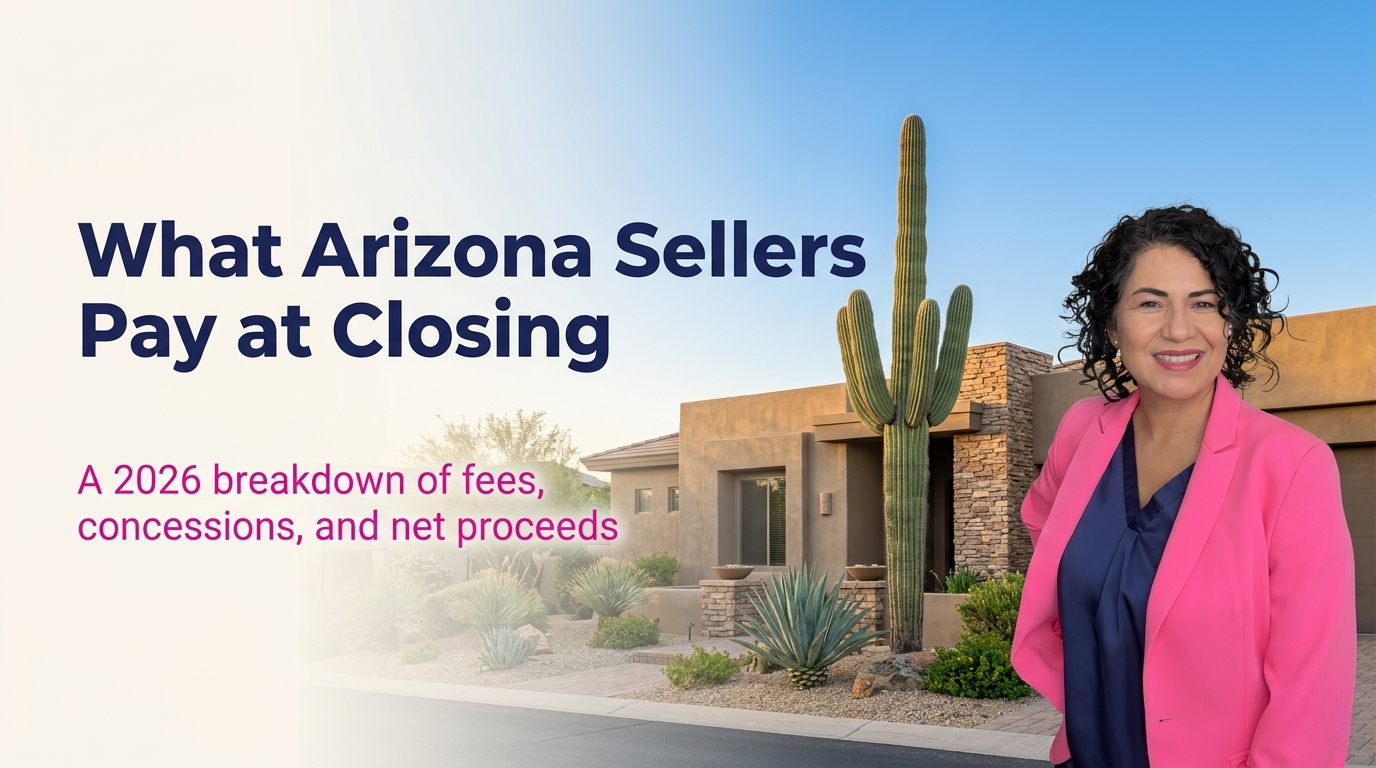
How Much Are Seller Closing Costs in Arizona for 2026?
You're selling your home in Arizona — but what does closing actually cost? Seller closing costs typically run 6-10% of your home's sale price and include title insurance, escrow fees, real estate commission, HOA transfer fees, prorated property taxes, and any seller-paid concessions to the buyer. Understanding these costs now helps you plan realistically for what you'll walk away with.
Introduction
There's a moment in every seller's journey when the numbers shift from theoretical to real. You've accepted an offer, and suddenly you're looking at a closing statement — a densely packed document showing exactly what gets deducted before you see your money. For many sellers, that first glance at the deductions is a jolt. Title fees, commission, concessions, prorated taxes — the line items add up fast, and many of my clients tell me they wish they'd known the breakdown earlier.
This is usually where I slow sellers down. Arizona closing costs aren't hidden or arbitrary. They're predictable, documented, and — when you understand them — manageable. The market has shifted dramatically since 2021. Seller-paid concessions have risen from about 15% of closings to over 50% today, which means your negotiation strategy at the closing table matters more than ever.
In this guide, I'll walk you through every cost Arizona sellers typically face, explain what's changed in 2026 following the NAR settlement, and show you how your net sheet is calculated. By the end, you'll know exactly what to expect when you close.
What's Included in Arizona Seller Closing Costs
Arizona seller closing costs fall into several categories, and each has a purpose and a price.
Real Estate Commission
Your listing agent's commission and the buyer's agent's commission are typically the largest closing costs. Historically, these were paid from the seller's proceeds — usually 5-6% total, split between listing and buyer's agent. However, following the 2024 NAR settlement changes, buyer agent compensation is no longer displayed on the MLS. This has created more negotiation flexibility. As of August 2024, sellers decide what to offer buyer's agents, and buyer and buyer's agent must now have written agreements disclosing compensation. This shift has put more strategic control in your hands, but it also requires clarity upfront.
Title Insurance and Title Search
Arizona title companies (not attorneys — that's an important distinction in Arizona) handle closings and charge for a title search ($75–$200) and a title insurance policy. Sellers typically pay for the owner's title policy, which ranges from $1,400 to $4,000 depending on the home's age and purchase price. This insurance protects the buyer against future title claims.
Escrow and Closing Fees
Arizona escrow fees are filed with the state and are generally split 50/50 between buyer and seller unless the parties agree otherwise. For a home in the $300,000–$500,000 range, expect $1,150–$1,250 in escrow fees. Closing or settlement fees from the title company typically run $150–$300.
Prorated Property Taxes and HOA Fees
Arizona property taxes are paid in arrears (meaning you pay for the previous year in the current year). At closing, taxes are prorated. If you've prepaid taxes or if the buyer is taking over mid-month, adjustments happen at the closing table. Similarly, HOA fees (if applicable) are prorated to the closing date. These aren't always large, but they're almost always present.
Recording Fees
The county recorder charges a small fee (typically $10–$50) to record the deed transfer.
Wire Fees and Miscellaneous Charges
Title companies charge wire fees (usually $15–$30) to send your proceeds to your bank. Document preparation, courier fees, and notary fees may add another $50–$150.
Real Estate Commissions in 2026: Post-NAR Settlement Landscape
The NAR settlement fundamentally changed commission transparency. Here's what that means for you as a seller.
Before August 2024, the MLS allowed sellers to offer buyer agent commission — typically 2.5–3% of the sale price. Both parties could see the offer upfront. This is no longer the case. Now, sellers can offer buyer agent compensation, but it must be negotiated outside the MLS. The buyer and their agent negotiate compensation directly in their written buyer agreement.
From a strategic standpoint, this matters. Many West Valley sellers still offer buyer agent compensation — often 2–2.5% — to keep their listing competitive. Markets with less inventory or higher-priced homes may see less competition for buyer commission offers. Your listing agent will help you position your offer strategically based on local market conditions.
The key takeaway: Your listing agent's commission is still a line item at closing, but the buyer's agent commission is now part of a conversation you control. If you want to offer nothing to the buyer's agent, you can — but that may reduce buyer interest. If you offer 2.5%, that comes out of your proceeds at closing.
Seller Concessions: What the Cromford Data Shows
Here's what surprised many Arizona sellers in 2025 and continues into 2026: concession rates are at historic highs.
— Michael R, Avondale
A seller concession is money the seller agrees to pay toward the buyer's closing costs or repairs. This might be a credit for a home inspection issue, a loan discount point, or general closing cost assistance. In late 2021, only about 15% of Arizona closings included seller-paid concessions. Today, that number is 50.5% — and in some West Valley communities, it's even higher.
Why the jump? Buyer financing has tightened. Interest rates are higher. Buyers need more help at the closing table, and sellers in competitive markets are offering it to close deals. It's a negotiation point, and it directly impacts your bottom line.
• 50.5% of Arizona closings included seller-paid concessions (February 2026)
• Up from ~15% in late 2021 — a dramatic market shift toward buyer-favorable terms
• Concession rates vary by city and price point — West Valley communities trending higher
Source: The Cromford Report — data shared per Cromford Associates LLC subscriber policy
What I watch for here is the timing of concessions. Some sellers offer concessions upfront to attract more offers. Others negotiate them at the contract stage, after an inspection. The strategy depends on your market position and timeline. In a slower market, offering 2–3% in concessions can move inventory faster. In a strong market, you may negotiate less.
Your net sheet calculation — which I'll explain next — shows concessions as a deduction. The more concessions you offer, the less you walk away with.
— La Maja, Avondale
How Your Net Sheet Is Calculated
This is the moment sellers often slow down, pen in hand, wanting to understand every line. The net sheet is your roadmap to closing proceeds.
Your closing statement starts with the sale price. From there, every cost and credit is deducted or applied in order:
- Sale Price: $500,000
- Less: Listing Agent Commission (e.g., 2.5%): -$12,500
- Less: Buyer Agent Commission (e.g., 2%): -$10,000
- Less: Title Insurance Policy: -$3,000
- Less: Escrow and Closing Fees: -$1,200
- Less: Prorated Property Taxes (if applicable): -$850
- Less: HOA Fees and Transfer Fees: -$250
- Less: Seller Concessions (e.g., 3%): -$15,000
- Less: Recording Fees, Wire Fees, Miscellaneous: -$350
- Equals: Net Proceeds to Seller: ~$457,850
This is simplified, but it's the shape of the calculation. The order matters less than completeness — every cost is itemized on your closing statement.
Here's what I'm seeing with clients: many sellers expect to walk away with 90% of their sale price. The reality is closer to 85–88% after all costs, especially if you're offering buyer concessions. Planning for 8–10% in total costs keeps expectations grounded and prevents surprises at the closing table.
What Surprises Most Sellers at Closing
Over years of closings, I've noticed patterns in what catches sellers off guard.
Prorated Taxes
Arizona property taxes are paid in arrears. If you close mid-month and have prepaid taxes, you may receive a credit. If the buyer is closing late in the year and taxes for that year haven't been fully paid, you might owe more. This number can be significant on a $400,000+ home.
HOA Estoppel and Transfer Fees
If your home is in an HOA community, the HOA issues an estoppel letter detailing any outstanding assessments, special fees, or future obligations. You're responsible for any unpaid assessments through closing. Additionally, HOA transfer fees (typically $50–$300) come out of proceeds.
Wire Fees and Last-Minute Charges
Small fees seem minor individually — $15 for a wire, $25 for a notary, $35 for document prep — but they add up. Some sellers are shocked by the accumulation of what feels like nickeling-and-diming.
Concessions Affecting Your Timeline
If you've offered buyer concessions and they're substantial, understand that those funds come directly from your proceeds. A 3% concession on a $500,000 sale is $15,000. It's important, real money.
Title Issues Discovered at Closing
Occasionally, a title search uncovers a lien, a boundary dispute, or an old easement that must be resolved before closing. These resolutions cost money. It's rare, but it happens, and it's always a surprise.
FAQ
Q: Can I negotiate my closing costs with the title company?
Some title companies offer discounts for specific buyers — first responders, investors, repeat clients. Ask your agent to inquire. Escrow fees are filed with the state, but negotiation room exists on title policy rates and ancillary charges.
Q: Who typically pays for the buyer's home warranty?
Conventionally, sellers offer a one-year home warranty to buyers (typically $400–$600) as a closing cost item. This is negotiable and often used as a concession or bargaining point.
Q: Does Arizona require an attorney at closing?
No. Arizona title companies handle closings, and an attorney is not required by law. Your title company's escrow officer conducts the closing and prepares all documents.
Q: What if I'm selling "as-is" — do I still pay closing costs?
Yes. Selling as-is means you're not making repairs, but closing costs are separate. You still pay commission, title, escrow, and all standard fees. As-is selling may reduce your negotiating leverage, which could increase seller concessions.
Q: How do I minimize closing costs?
Work with an agent who understands the current market and pricing strategy. Aggressive pricing that generates multiple offers gives you leverage to minimize concessions. Additionally, securing pre-approval from buyers (or being willing to work with FHA buyers who cost you less in concessions) can reduce what you ultimately offer.
Closing
Selling a home is a life transition, not just a transaction. Understanding your closing costs is part of that transition — it's the moment where your equity becomes real proceeds, and where clarity replaces surprise. Arizona's market has shifted. Concessions are now standard, buyer agent compensation is negotiable, and strategic pricing matters more than ever.
The best approach is to start with a clear picture of what you'll actually take home. That's where a net sheet comes in. Before you list, sit down with your agent and calculate it. Know your numbers. Know what success looks like. And know that unexpected costs — while rare — are discoverable and manageable when you have accurate information.
When you're ready to sell, your agent's job is to guide you through each step with clarity and to protect your bottom line at the closing table.
About the Author
Kasandra Chavez is a REALTOR® and team lead at Chavez Dream Home Team in Arizona's West Valley. Recognized among the top 5% of real estate professionals in the Greater Phoenix area, she specializes in helping sellers navigate pricing strategy, negotiations, and closing logistics across Peoria, Surprise, Glendale, Avondale, Goodyear, Buckeye, and Anthem. Kasandra brings a calm, strategic approach to home sales, focusing on protecting her clients' interests and delivering clarity at every stage. She's a member of the Arizona Regional MLS and stays current with market trends, NAR settlement changes, and closing cost dynamics affecting West Valley homeowners. When she's not closing deals, she's learning about her clients' life stories and how their home sale fits into their next chapter.