
Should I Sell My Peoria Home Now or Wait for the Vistancia Commercial Expansion?
Weighing whether to sell your Peoria home now or wait for the Vistancia commercial expansion? Here is how to think about timing, market data, and your financial goals.
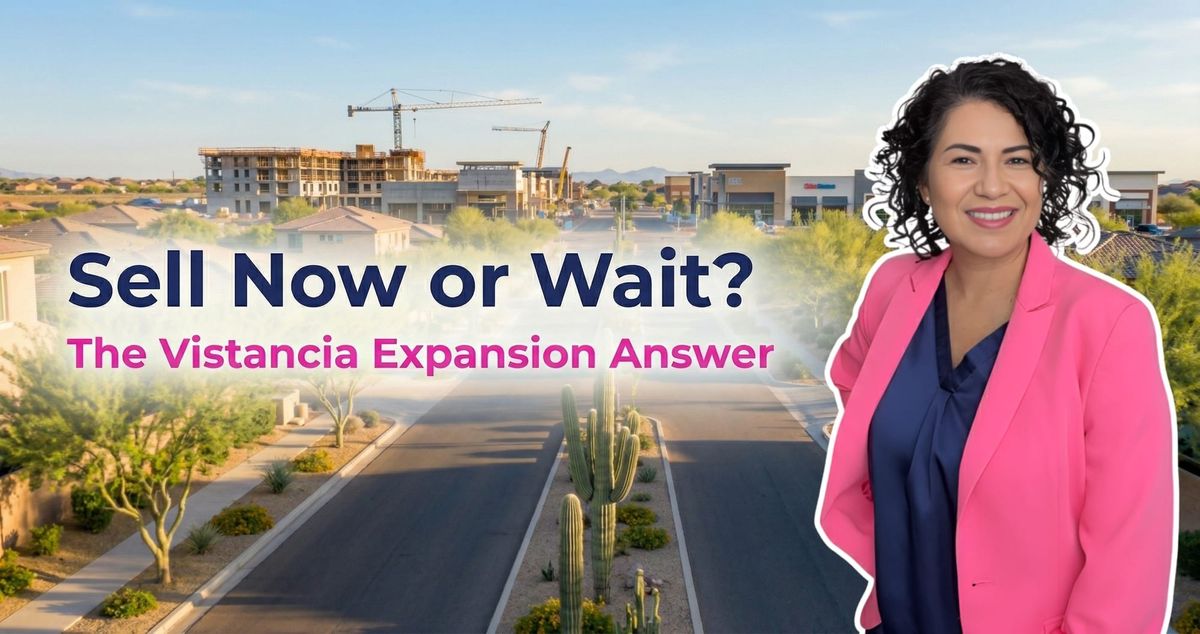
The answer depends on your timeline, your financial position, and how long you can realistically afford to wait. The Vistancia commercial expansion — particularly the Five North mixed-use development — is projected to bring meaningful retail, dining, and employment growth to northwest Peoria, with the first phases delivering in 2026 and 2027. However, the full impact on nearby home values may not materialize for three to five years. If your life is asking you to move in the next 12 to 18 months, waiting for a speculative value increase rarely makes financial sense when you factor in carrying costs, opportunity cost, and the risk that the market shifts against you in the meantime.
The Fear Behind the Timing Question
The hardest part of a timing question is not the data. It is the feeling that you might be making the wrong call — that if you sell now, you will look back in three years and wish you had waited. That fear is real, and it is one of the most common conversations I have with sellers in Peoria right now.
But here is the other side of that coin. Waiting for perfect market conditions is its own kind of risk. While you hold, your carrying costs continue — mortgage, insurance, property taxes, maintenance. The market can shift. Interest rates can move. And the personal reasons that prompted you to think about selling in the first place do not pause while the market catches up. Whether you are outgrowing your space, preparing for a job change, or ready to move closer to family, the cost of putting your life on hold has a number attached to it, even if it does not show up on a spreadsheet.
The commercial expansion at Vistancia is real and significant. But the question is not whether it will have an impact — it is whether that impact will arrive in time for your timeline and in a magnitude that justifies the wait. Let's look at the data and then walk through a framework for making this decision with clarity.
What the Vistancia Commercial Expansion Actually Includes
The centerpiece of the expansion is Five North at Vistancia, a 320-acre mixed-use development within the 7,100-acre Vistancia master-planned community. Five North is planned to include a main street retail and restaurant district, hospitality venues, office spaces, healthcare facilities, a K-12 charter school campus, and approximately 1,500 luxury residential units. It is positioned as the lifestyle and economic hub of northwest Peoria.
In addition, the Vistancia Commerce Park at Five North — a 239,700-square-foot speculative industrial park developed by the Barclay Group — is expected to begin construction in the second quarter of 2026, with delivery anticipated by mid-2027. This project is designed to serve advanced manufacturing, logistics, and supplier companies drawn to the area by economic catalysts including the TSMC semiconductor campus and Amkor Technology's $7 billion advanced packaging facility.
The broader Peoria Innovation Core spans nearly 7,000 acres along Loop 303 and Lake Pleasant Parkway and represents one of the largest remaining development opportunities in Greater Phoenix. According to the City of Peoria, this landmark agreement with the Arizona State Land Department is expected to generate up to $1.5 billion for Arizona's public education system while delivering thousands of new jobs and amenities for residents. This is not a single project — it is a multi-decade development framework that will unfold over the next 10 to 20 years.
What this means for you as a homeowner near Vistancia is that the development pipeline is substantial and real — but the timeline is measured in years, not months. The first retail and dining options at Five North may open in 2026, but the kind of neighborhood-level transformation that meaningfully moves home values requires sustained build-out and occupancy, which is a longer arc.
How Commercial Development Typically Affects Nearby Home Values
Research on the relationship between commercial development and residential property values tells a consistent story: the impact is real, but it is uneven and gradual. Studies from the Urban Land Institute and peer-reviewed urban planning research have found that proximity to well-planned mixed-use commercial development can boost nearby home values, with the strongest positive effects observed at approximately a half-mile from the commercial core and diminishing with distance.
The type of development matters significantly. Mixed-use projects with walkable retail, dining, and community amenities — which is exactly what Five North is designed to be — tend to produce the most consistent positive impact on surrounding residential values. Large industrial or big-box developments, by contrast, can create negative externalities like traffic and noise that offset the economic benefits.
Here is the trade-off specific to Peoria and Vistancia. The development plan is well-designed and aligns with the type of commercial investment that research shows benefits homeowners. But the appreciation curve from commercial development is not a sudden jump — it is a gradual climb that typically starts when the commercial space is occupied and businesses are operating, not when construction begins. For Five North, that means the most meaningful value impact is likely two to four years away, with the full effect potentially five years or more out.
— Kathy T, Peoria, AZ
The Cost of Waiting: What You Risk by Holding
This is usually where I slow sellers down — not to push them toward selling, but to make sure the decision to wait is grounded in numbers rather than hope. Waiting has real costs, and they compound in ways that are easy to underestimate.
The first cost is carrying. Every month you hold the home, you are paying your mortgage, property taxes, homeowner's insurance, HOA dues if applicable, and maintenance. For a home in Peoria valued near $480,000, those costs can easily total $3,000 to $4,000 per month depending on your mortgage terms. Over 24 months of waiting, that is $72,000 to $96,000 in carrying costs — money that comes directly out of the appreciation you are hoping the commercial expansion delivers.
The second cost is opportunity. If you are planning to buy your next home, the market you are buying into is also moving. Prices in your target market may rise while you wait. Interest rates may shift. The home you could afford today may be out of reach in two years, especially if you are moving to a market with stronger demand than Peoria. If you are weighing a move to another West Valley city while you wait, it is worth comparing how Peoria stacks up against Phoenix on commute times, school quality, and long-term lifestyle fit — factors that affect what you can realistically afford in your next home.
The third cost is market risk. According to Zillow data, the average Peoria home value is currently around $480,000, reflecting a 5.2% year-over-year decline. While longer-term forecasts suggest modest appreciation of 2–4% annually for Arizona, the near-term trajectory is not guaranteed. If the broader market softens further before the Vistancia expansion delivers its value boost, you could find yourself waiting for appreciation that arrives on a lower baseline.
The bottom line is this: the commercial expansion needs to add more than your cumulative carrying costs, opportunity costs, and market risk to justify the wait. For most sellers, that is a high bar.
What the Peoria Market Looks Like Right Now
Let's look at the numbers. As of early 2026, the Peoria housing market is showing signs of a more balanced environment. According to Redfin's Peoria market data, homes are selling at a median price around $535,000, with days on market averaging 87 days. The market is not as competitive as it was in 2021 and 2022, but it is also not distressed — sales volume is actually increasing, with more transactions closing year-over-year.
What I watch for here is the contract ratio — the number of homes under contract divided by active listings. The contract ratio tells us what demand looks like relative to supply today, and it is the first indicator of a market shift. In Peoria, the ratio suggests a balanced-to-slightly-soft market, which means sellers who price strategically and prepare their home well are still getting strong offers, while overpriced listings are sitting.
Your competition matters as much as your comps. Comps tell us what a home will likely appraise for. Your competition — the other active listings in your price range, neighborhood, and condition level — determines how quickly it sells. If you are in Vistancia or adjacent neighborhoods, your competition includes new construction from builders like Shea Homes and Brightland Homes, which are actively delivering new inventory into the market. An agent who just wants to list your home is different from an agent who wants to sell it — and in a market like this, that distinction matters more than usual.
— Amanda A, Anthem, AZ
Making the Decision: A Framework for Timing Your Sale
The strategic approach here would be to separate the emotional pull of "what if" from the financial reality of your specific situation. There are three scenarios worth working through.
If your life needs you to move within 12 months — for a job, for family, for space — the math almost always favors selling now. The carrying costs of holding for speculative appreciation, combined with the risk that the market does not cooperate in the short term, make waiting a losing proposition for most sellers on a near-term timeline. You can still capture the value your home has built over the past several years and position yourself well for the next purchase.
If you have the financial flexibility to hold for two to three years and no urgent reason to move, waiting becomes more defensible — but only if you are genuinely comfortable with the risks. The Vistancia expansion should begin delivering lifestyle amenities by late 2027, and if the broader Peoria market stabilizes or appreciates modestly in the interim, you may see a meaningful bump. But you need to be realistic that the bump may be 3–8% over that period, not a dramatic overnight shift.
If you are somewhere in between — wanting to move but not on a hard deadline — the most valuable thing you can do is run the numbers now. A conservative net sheet that models both scenarios — selling today versus selling in 18 to 24 months — gives you a concrete comparison rather than a guessing game. Factor in your carrying costs, the likely appreciation range, your target market's trajectory, and the lifestyle cost of staying in a home that no longer fits your needs. If the timing aligns with also buying your next home, understanding how contingent offers and rent-back strategies work can give you more flexibility to sell and move without feeling rushed into a bad purchase.
In my experience, sellers who make this decision based on their own financial picture and life circumstances — rather than trying to time the market — end up in a stronger position. There are no bad markets. There are bad purchases. The difference is preparation and information.
Frequently Asked Questions About Selling in Peoria Near Vistancia
Will the Vistancia commercial expansion increase my home's value?
Research suggests that well-planned mixed-use commercial developments like Five North at Vistancia can positively impact nearby home values over time. The strongest effects typically appear when commercial spaces are occupied and operating — not during construction — which means the most meaningful impact is likely two to four years away.
How much could my Peoria home appreciate if I wait for the Vistancia build-out?
Estimates vary, but based on historical patterns for similar mixed-use developments in growing metros, homes within a half-mile to one mile of completed commercial cores can see a 3–8% premium over comparable homes farther away. This effect builds gradually as the commercial area reaches full occupancy.
What are the carrying costs of waiting to sell my Peoria home?
For a Peoria home valued near $480,000, monthly carrying costs typically range from $3,000 to $4,000 including mortgage, property taxes, insurance, HOA, and maintenance. Over 24 months, that totals $72,000 to $96,000 — an amount that must be offset by any appreciation gain to justify the wait.
Is the Peoria housing market expected to go up or down in 2026?
Current data shows Peoria home values have softened slightly year-over-year, with modest declines of around 1–5% depending on the source. Arizona-wide forecasts project 2–4% annual appreciation over the next few years, suggesting a stabilizing market rather than dramatic swings in either direction.
When is the Five North at Vistancia development expected to open?
The first elements of Five North are beginning to deliver in 2025 and 2026, including the American Leadership Academy campus and Mountainside Fitness. Retail and dining components are expected to follow, with the Vistancia Commerce Park industrial space projected for mid-2027 delivery.
The Bottom Line
The Vistancia commercial expansion is a real and significant investment in Peoria's future. But your home sale is not an investment thesis — it is a personal financial decision that affects where you live, how you live, and what comes next for your family. What truly matters is not whether the expansion will create value. It likely will. The question is whether that timeline aligns with yours, and whether the projected gains outweigh the very real costs of waiting.
Running the numbers before you decide — not after — gives you the clarity to move forward with confidence. Whether you sell now and capture the equity you have built, or hold strategically with a clear financial plan, the right decision is the one grounded in your reality, not the market's potential.
About the Author
Kasandra Chavez is a real estate advisor serving the West Valley of Greater Phoenix, Arizona, recognized among the top 5% of real estate professionals in the Greater Phoenix area. She works with buyers and sellers to develop strategies aligned with their lifestyle and goals, helping clients navigate market timing decisions with data-driven confidence. Kasandra's approach centers on preparation, transparent communication, and protecting her clients' financial interests throughout the process.