
Renting vs. Selling Your Sun City West Home: HOA Restrictions, Local Rules, and Tax Issues to Understand First
Thinking about renting out a Sun City West home instead of selling? Here’s how local rules, HOA restrictions, and tax considerations affect the decision before you become a landlord.
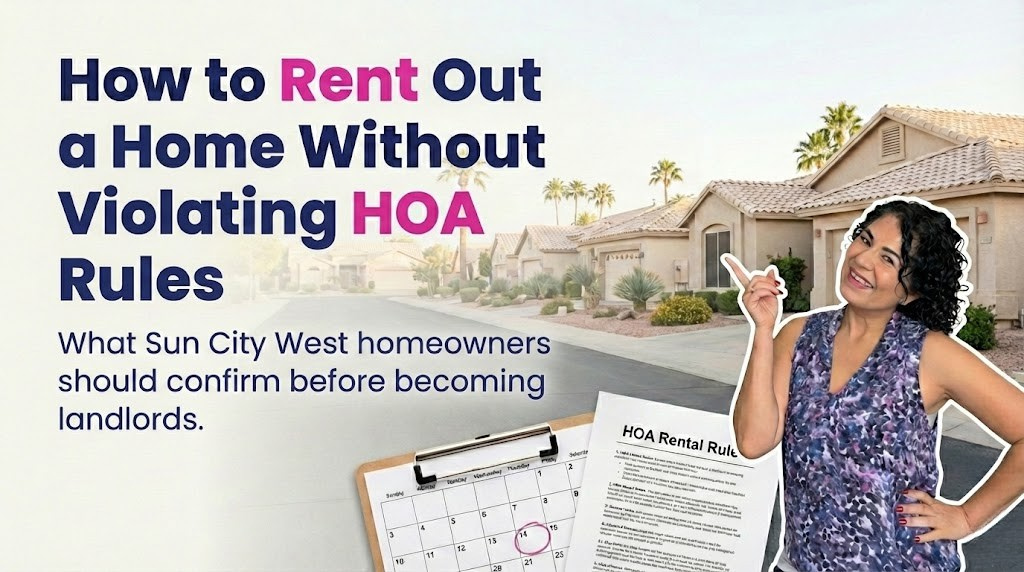
We're thinking of renting out our current Sun City West home instead of selling—what local rules, HOA restrictions, and tax issues should we understand before deciding to become landlords?
Sun City West has specific rental restrictions that many homeowners don't discover until they've already committed to a plan. The community caps rental properties at 20% of total homes, enforces strict age requirements for tenants, and requires HOA approval before any lease begins. Beyond HOA rules, Arizona landlord-tenant law creates obligations around security deposits, habitability standards, and eviction procedures that differ significantly from simply owning a home. Tax treatment also shifts—rental income becomes reportable, depreciation enters the equation, and your eventual sale may trigger different capital gains calculations than a primary residence sale would.
Why Sun City West Rental Decisions Require a Different Approach
Most homeowners considering a rental conversion are weighing two straightforward options: keep the income stream or take the sale proceeds. In Sun City West, that calculation has additional layers that can change the outcome entirely.
This is where I help clients slow down and map out the restrictions before running the numbers. The rental cap, age requirements, and approval process mean your timeline isn't entirely in your control. Understanding these constraints early prevents the frustration of building a plan around assumptions that don't hold.
Sun City West is governed by the Recreation Centers of Sun City West (RCSCW), and their rental policies exist to preserve the community's character as an active adult destination. These aren't suggestions—they're enforced conditions that can block a rental arrangement entirely.
Understanding Sun City West's HOA Rental Restrictions
The 20% rental cap means that if your neighborhood has already reached its limit, you may not be able to rent at all until another owner converts their rental back to owner-occupied status. This creates a waitlist situation in some areas.
Even when a rental slot is available, the HOA requires that at least one tenant be 55 years of age or older, and no permanent residents under 19 are permitted. This significantly narrows your tenant pool compared to unrestricted communities in Surprise, Peoria, or other West Valley cities offering diverse housing options.
The approval process itself involves submitting a rental application to the HOA, providing tenant information, and waiting for authorization before any lease begins. This is where I watch for timing complications—if you're counting on rental income by a certain date, the approval timeline needs to factor into your planning. You can review the official Sun City West CC&Rs to understand the full scope of community requirements.
Lease terms also face restrictions. Many age-restricted communities in Arizona require minimum lease durations (often six months or longer) and prohibit short-term or vacation rentals entirely. This eliminates Airbnb or VRBO strategies that might work elsewhere in the Phoenix area.
— Michael R, Avondale, AZ
Arizona Landlord Requirements You'll Need to Meet
Becoming a landlord in Arizona creates legal obligations that go beyond collecting rent. The Arizona Residential Landlord and Tenant Act governs security deposits, maintenance responsibilities, lease requirements, and eviction procedures.
Security deposits are capped at one and a half months' rent, and you must return them within 14 business days of lease termination, minus documented deductions. Habitability standards require you to maintain structural integrity, plumbing, heating, and electrical systems—costs that come out of your rental income.
This is usually where I help clients think through the management question. Will you self-manage from a distance, or hire a property management company? Professional management typically runs 8-10% of monthly rent, which affects your cash flow calculations. For out-of-state owners or those who've relocated within Arizona, management fees become a practical necessity rather than a luxury.
Arizona also requires landlords to provide specific disclosures about property conditions, and lease agreements must comply with state requirements. Non-compliance can create liability exposure that offsets the financial benefits of rental income.
Tax Implications of Converting to a Rental Property
The tax treatment of rental property differs substantially from your primary residence, and these differences matter both during ownership and at sale.
Rental income is reportable on Schedule E of your federal return. You can deduct mortgage interest, property taxes, insurance, HOA fees, repairs, and management costs against that income. Depreciation—spreading the cost of your home (excluding land) over 27.5 years—creates additional deductions that reduce taxable rental income.
What I watch for here is the eventual sale scenario. When you sell a primary residence, you may exclude up to $250,000 in capital gains ($500,000 for married couples filing jointly) under IRC Section 121. However, once you convert to a rental, you begin accumulating depreciation that must be "recaptured" at sale—taxed at up to 25% regardless of your ordinary income rate.
The exclusion rules also become more complex. If you've lived in the home two of the last five years, you may still qualify for a partial exclusion, but the calculation changes based on how long the property served as a rental versus a primary residence.
— La Maja, Avondale, AZ
When Selling May Be the Clearer Path
Not every situation favors holding property as a rental. If the HOA rental cap blocks your ability to lease, if your tenant pool is too narrow to generate reliable income, or if the tax implications of depreciation recapture outweigh the rental benefits, selling may produce a better outcome.
This is where I help clients compare actual numbers rather than assumptions. What would your net rental income be after HOA fees, management costs, maintenance reserves, and vacancy allowances? How does that compare to investing your sale proceeds differently? What does your timeline look like—are you planning to sell eventually anyway, and if so, does the depreciation recapture math favor selling now while you still qualify for the primary residence exclusion?
Sun City West homes in good condition continue to attract buyers, particularly those seeking the community's amenities and active adult lifestyle. A well-prepared sale in the current market may deliver the liquidity and simplicity that a rental arrangement cannot.
Frequently Asked Questions
Can I rent my Sun City West home on Airbnb or VRBO?
No. Sun City West prohibits short-term and vacation rentals. Minimum lease terms typically apply, and all rentals require HOA approval with at least one tenant aged 55 or older.
What happens if Sun City West's rental cap is already reached?
You may be placed on a waiting list until another rental property converts back to owner-occupied status. This timeline is unpredictable and can delay your plans indefinitely.
How does converting to a rental affect my capital gains exclusion?
Once you convert, the two-out-of-five-year residency rule begins to erode. If you sell after renting for several years, you may lose part or all of the $250,000/$500,000 exclusion, and depreciation recapture taxes will apply.
Do I need a property manager for a Sun City West rental?
It depends on your proximity and availability. Arizona landlord law requires timely responses to maintenance issues and legal compliance with lease terms. Many owners find professional management worth the 8-10% fee for the oversight and liability protection it provides.
What disclosures are required for Arizona rental properties?
Arizona requires disclosure of known material defects, lead-based paint information for pre-1978 homes, and documentation of the property's condition at lease signing. Non-compliance can create legal liability.
Moving Forward With Clarity
The rent-versus-sell decision in Sun City West isn't simply a financial calculation—it's a question of constraints, timelines, and what you're actually able to execute given the community's rules. Understanding the HOA restrictions, Arizona landlord obligations, and tax implications before committing protects you from building a plan that can't move forward.
The goal isn't to eliminate all complexity. It's to know which complexities you're choosing and why they make sense for your situation.
About the Author
Kasandra Chavez is a real estate advisor serving the West Valley of Greater Phoenix, Arizona, recognized among the top 5% of real estate professionals in the Greater Phoenix area. She works with buyers and sellers navigating complex decisions, helping them align real estate strategy with lifestyle goals and family priorities. Her approach emphasizes clarity, structure, and informed decision-making throughout the process.