
What Are the Pros and Cons of Selling My Arizona House by Owner Instead of Using a Full-Service Agent?
Thinking about selling your Arizona home by owner? Here's what you need to know about pricing, marketing, negotiation, and legal protection before deciding between FSBO and full-service representation.
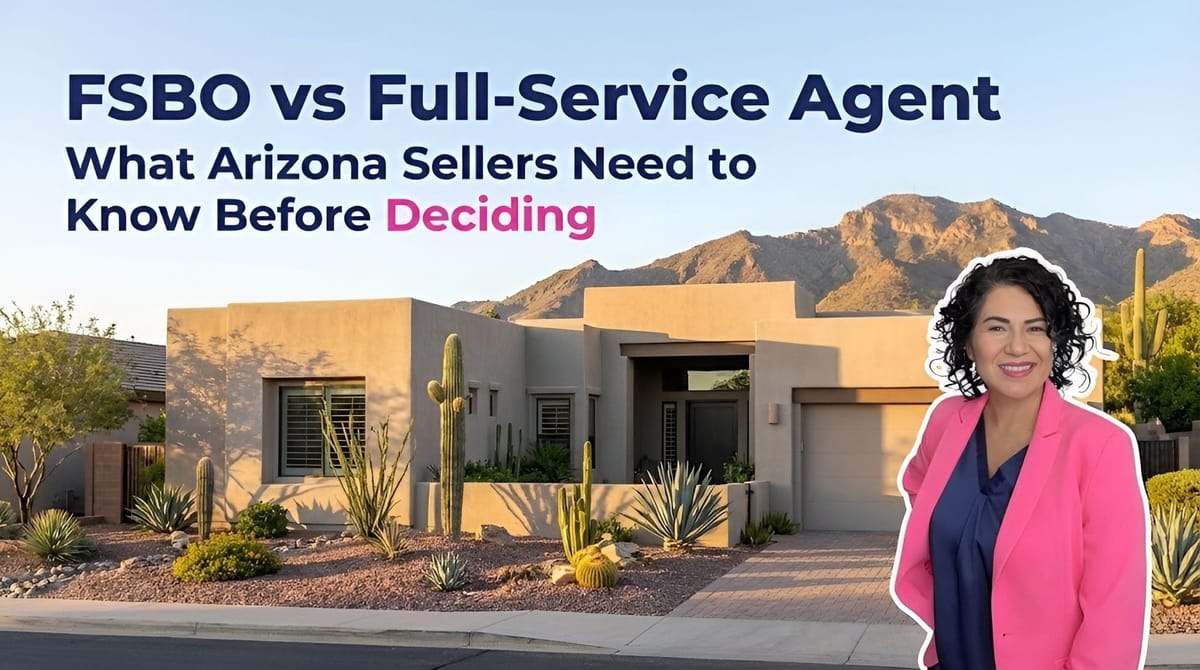
What are the pros and cons of selling my Arizona house by owner instead of using a full-service agent?
Selling by owner can save you commission costs and give you direct control over showings and negotiations, but you'll handle pricing analysis, marketing, buyer qualification, contract preparation, and legal compliance yourself. Using a full-service agent means paying commission but gaining market expertise, professional negotiation, MLS exposure, legal protection, and coordinated transaction management from listing to close.
The decision usually comes down to whether you have the time, market knowledge, and risk tolerance to manage a complex transaction on your own, or whether professional support will protect your timeline and net proceeds more effectively.
Most sellers who consider FSBO underestimate how much pricing accuracy, buyer reach, and contract protection matter in the West Valley market. This is usually where I slow sellers down and walk through what each approach actually requires, because the upfront cost difference can look appealing until you see what's at stake during negotiation or appraisal.
What You Actually Control When You Sell by Owner
When you sell FSBO, you're responsible for pricing strategy, staging decisions, photography, listing descriptions, and showing coordination. You also screen buyers, respond to offers, negotiate terms, and manage deadlines through closing.
The appeal is direct control. You set the price, choose how to present the home, and decide which offers to pursue. If you have real estate experience or a strong understanding of your local market, this can work in your favor.
The challenge is that control also means accountability. If your pricing is off by even five percent in either direction, you risk leaving money on the table or sitting on the market too long. If your listing photos don't compete with professionally marketed homes, buyer interest drops. If you misread contract language or miss a deadline, you could face legal exposure or lose the deal entirely.
This is where I help clients assess capacity honestly. Selling by owner isn't just about willingness to do the work—it's about having the bandwidth and expertise to do it correctly under pressure.
The Financial Trade-Off: Commission Savings vs. Market Reach
The most common reason sellers explore FSBO is commission savings. A typical full-service agent charges five to six percent of the sale price, split between the listing agent and buyer's agent. On a $450,000 home in Peoria or Surprise, that's $22,500 to $27,000.
Selling by owner eliminates the listing agent commission, potentially saving you two and a half to three percent. But in most cases, you'll still offer compensation to the buyer's agent to attract represented buyers, which means you're saving roughly half the total commission, not all of it.
The trade-off is exposure. Homes listed on the MLS reach more buyers, get more showings, and statistically sell faster and for higher prices than FSBO listings. According to the National Association of Realtors' 2025 Profile of Home Buyers and Sellers, FSBO homes sold for a median of $360,000 compared to $425,000 for agent-assisted sales—an 18% gap in favor of agent-listed homes. Even after commission, the net proceeds often favor professionally marketed homes.
In the West Valley, where inventory moves quickly in certain price ranges and neighborhoods, timing and visibility matter. A home that sits for three extra weeks because it wasn't promoted effectively can cost more in carrying costs and price reductions than the commission you saved.
— Ankita C, Gilbert, AZ
What Happens During Negotiation and Appraisal
Pricing and marketing are just the beginning. Once an offer comes in, you're managing negotiation, inspection responses, appraisal coordination, and contract amendments. This is where inexperience becomes costly.
Buyers and their agents know when a seller isn't represented. They may submit lower offers, request more concessions, or structure terms that favor their position. Without a clear understanding of comparable sales, market conditions, and contract leverage, it's easy to accept less favorable terms or walk away from a deal that could have been salvaged.
Appraisal is another critical moment. If the appraisal comes in below the contract price, you'll need to renegotiate. How you handle that conversation—whether you lower the price, ask the buyer to cover the gap, or meet somewhere in the middle—determines whether the deal closes and at what net value to you.
This is where I watch for stress to show up if expectations aren't clear. Sellers who were confident during pricing often feel overwhelmed once multiple parties are involved and deadlines are stacking up. Having someone manage that coordination and protect your position during high-pressure moments is what full-service representation is designed to do.
Legal and Disclosure Requirements in Arizona
Arizona requires specific disclosures about property condition, HOA rules, and known defects. You're also responsible for ensuring the contract complies with state regulations and that all addendums are properly executed.
The Arizona Association of Realtors' Seller's Property Disclosure Statement (SPDS) is designed to help sellers make legally required disclosures about material facts affecting the property. This includes everything from structural issues and past repairs to environmental conditions and HOA assessments. If you miss a required disclosure or fail to include necessary contract language, you could face legal claims from the buyer after closing.
Even unintentional mistakes—like not disclosing a prior roof repair or failing to provide HOA documents on time—can create liability. Arizona law requires sellers to disclose all material facts that could impact a buyer's decision or the property's value, and these disclosure obligations survive closing.
Full-service agents carry errors and omissions insurance and have transaction coordinators who track every form, deadline, and signature. When you sell by owner, that protection disappears. You're personally responsible for ensuring everything is done correctly and on time.
For sellers with straightforward transactions and strong organizational skills, this may be manageable. For those juggling multiple responsibilities or unfamiliar with Arizona real estate law, the risk increases significantly.
— Michael R, Avondale, AZ
When FSBO Makes Sense and When It Doesn't
FSBO can work well when you're selling to a known buyer—like a family member, tenant, or neighbor—and price has already been agreed upon. In these cases, you're essentially formalizing a private transaction, and professional marketing isn't necessary. According to NAR data, 38% of FSBO sellers sold to someone they already knew.
It can also make sense if you have significant real estate experience, access to comparable sales data, and the time to manage every aspect of the transaction yourself. Some investors and industry professionals sell their own properties successfully because they already have the systems and knowledge in place.
FSBO becomes riskier when you're selling in a competitive market, need to reach the widest possible buyer pool, or lack experience with contract negotiation and legal compliance. It's also harder to execute if you're selling while relocating, managing a job transition, or dealing with time-sensitive financial needs.
What I help sellers evaluate is whether the potential savings justify the workload, risk, and opportunity cost. If selling by owner means pricing uncertainty, limited buyer reach, or legal exposure, the commission starts to look like protection rather than expense.
What Full-Service Representation Actually Provides
When you hire a full-service agent, you're paying for market analysis, professional photography, MLS access, buyer outreach, showing coordination, offer negotiation, contract management, and transaction oversight from listing to close.
You're also paying for accountability. If something goes wrong, your agent is responsible for fixing it. If a deadline is missed, a form is incomplete, or a negotiation stalls, they manage the solution. That layer of protection matters most when transactions get complicated, which they often do.
Beyond logistics, representation provides strategic positioning. Experienced agents know how to price competitively without undervaluing, how to respond to lowball offers without losing leverage, and how to structure terms that protect your interests during inspection and appraisal.
In the West Valley, where buyer demand fluctuates by season and neighborhood, having someone who tracks those patterns and adjusts strategy accordingly can mean the difference between a quick, clean sale and a drawn-out process with multiple price reductions.
How to Decide What's Right for Your Situation
Start by assessing your capacity honestly. Do you have time to respond to buyer inquiries, schedule showings, and manage paperwork during business hours? Can you price the home accurately using comparable sales data and market trends? Are you comfortable negotiating with experienced buyer agents who do this professionally?
Next, consider your timeline and financial priorities. If you need to close quickly to coordinate with another purchase or job relocation, professional marketing and transaction management may be worth the cost. If you're flexible on timing and confident in your ability to handle the process, FSBO may be viable.
Finally, evaluate your risk tolerance. Are you prepared to handle legal claims if something goes wrong? Can you absorb the cost of extended carrying expenses if the home doesn't sell quickly? Do you have a backup plan if negotiations fall apart?
The goal isn't to choose the cheapest option—it's to choose the approach that protects your net proceeds and timeline most effectively. That calculation looks different for every seller, depending on experience, resources, and what's at stake.
Frequently Asked Questions
Can I list my home on the MLS without using a full-service agent?
Some flat-fee MLS services allow you to list your home without full representation, giving you broader exposure while retaining control over showings and negotiation. Costs typically range from $100 to $500 for basic MLS access, with additional fees for services like professional photography or contract support. You'll still need to handle contracts, disclosures, and closing coordination yourself, but you gain access to the buyer pool that searches the MLS. This middle-ground option works for sellers who want visibility without paying full commission.
How do I price my home accurately if I sell by owner?
You'll need access to recent comparable sales in your neighborhood, an understanding of current market conditions, and the ability to adjust for your home's unique features and condition. Some sellers use online valuation tools, but these often lack the nuance required for accurate pricing. Overpricing costs you time and buyer interest, while underpricing leaves money on the table. Professional appraisals can provide a baseline, but they don't account for marketing strategy or buyer perception.
What happens if a buyer's agent brings me an offer and I'm selling FSBO?
You'll negotiate directly with the buyer's agent, who represents their client's interests. They may push for concessions, price reductions, or favorable terms because they know you're not represented. Having a real estate attorney review the contract before signing can provide some protection, but you're still managing the negotiation and transaction coordination yourself. Many FSBO sellers underestimate how much leverage shifts when the buyer has professional representation and they don't.
Are there legal risks to selling by owner in Arizona?
Yes. Arizona requires specific disclosures about property condition, HOA regulations, and known defects through the Seller's Property Disclosure Statement (SPDS). If you miss a required disclosure or fail to include necessary contract language, you could face legal claims from the buyer after closing. You're also responsible for ensuring that all documents are executed correctly and that deadlines are met. Without professional oversight, these risks increase significantly, especially if you're unfamiliar with Arizona real estate law.
How long does it typically take to sell a home by owner in the West Valley?
FSBO homes generally take longer to sell than professionally marketed listings because they reach fewer buyers and often lack the pricing accuracy and presentation quality that attract serious offers. In active West Valley neighborhoods like Peoria and Surprise, agent-listed homes may sell within two to four weeks, while FSBO listings can sit for several months. Extended time on market often leads to price reductions, which can offset the commission savings you were aiming for.
Final Considerations Before You Decide
Selling by owner can save you money if you have the time, market knowledge, and risk tolerance to manage a complex transaction independently. Full-service representation costs more upfront but provides market expertise, legal protection, negotiation support, and coordinated transaction management that can protect your net proceeds and timeline.
The right choice depends on your experience, capacity, and what's at stake. If pricing accuracy, buyer reach, and contract protection matter more than commission savings, professional representation makes sense. If you're confident in your ability to handle every aspect of the sale and willing to accept the associated risks, FSBO may be viable.
What matters most is choosing the approach that aligns with your priorities and protects your outcome, not just the option that looks cheapest on paper.
About the Author
Kasandra Chavez is a real estate advisor serving the West Valley of Greater Phoenix, Arizona, recognized among the top 5% of real estate professionals in the Greater Phoenix area. She helps West Valley buyers and sellers navigate complex transactions with clarity and strategy aligned with their lifestyle and family needs. Her approach emphasizes decision-making support and process control throughout every stage of the real estate transaction.