Are Property Taxes Higher in New Construction West Valley Communities?
New construction communities in the West Valley often carry higher property taxes due to Community Facilities Districts. Here's what buyers need to know about CFDs, tax rates, and the real cost of buying new in Arizona.
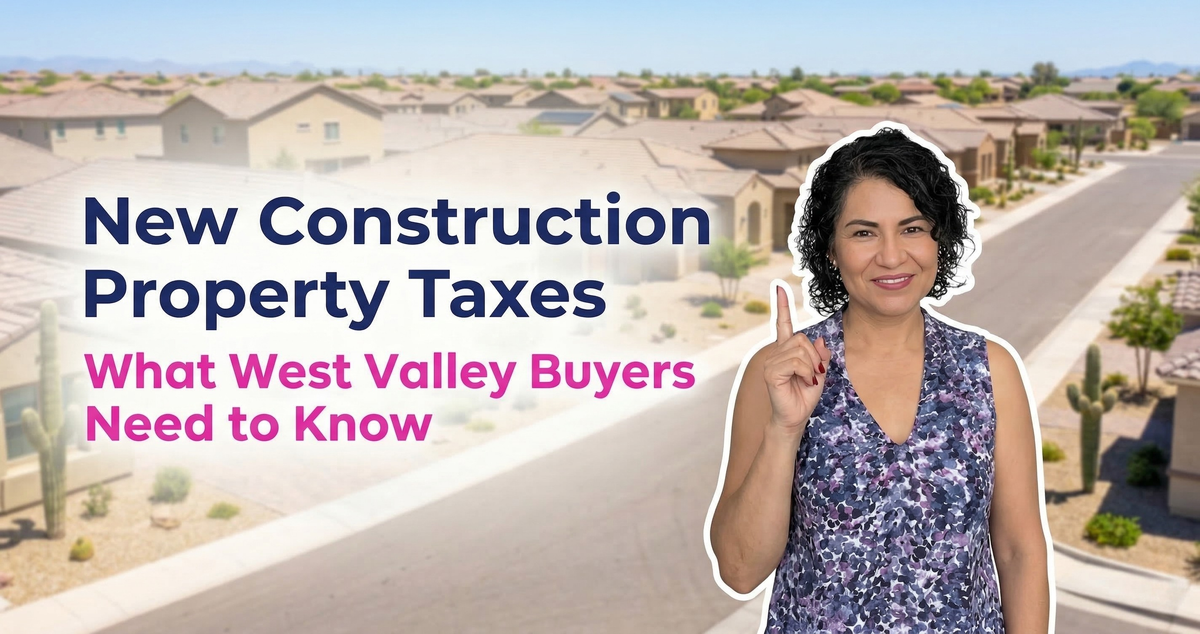
Are property taxes higher in new construction West Valley communities?
In many cases, yes. New construction communities across the West Valley frequently carry additional property tax assessments through Community Facilities Districts — known as CFDs — that older, established neighborhoods typically do not have. These CFD taxes can add $500 to $2,000 or more per year to your property tax bill on top of standard county, city, and school district taxes. The difference comes down to how the infrastructure in your community was financed, and understanding this before you buy can prevent a costly surprise in your first tax bill.
The Budget Number That Catches Buyers Off Guard
If you've been comparing new builds to resale homes in the West Valley, you've probably noticed something that doesn't quite add up. The listing price looks competitive. The builder incentives are attractive. But when you run the real monthly payment — including taxes — the number feels higher than expected. That gap between what you thought you'd pay and what the tax bill actually shows is one of the most common sources of stress for new construction buyers in communities like Goodyear, Buckeye, Surprise, and Peoria.
The concern underneath this question is usually financial: you want to make a smart purchase, and you need to know whether the total cost of ownership in a new community is genuinely competitive — or whether hidden assessments are eating into your monthly budget. This is exactly the kind of detail that matters before you sign a builder contract, and it's one of the first things I walk buyers through when we're comparing new builds to resale homes in the West Valley.
How Arizona Property Taxes Work — and Why New Construction Is Different
Arizona homeowners pay some of the lowest property taxes in the country. According to SmartAsset's Arizona property tax data, the statewide average effective property tax rate is approximately 0.55%, compared to a national average closer to 1.03%. Maricopa County — which covers the entire West Valley — averages roughly 0.47% with a median annual tax bill around $1,965.
But those are averages. The actual rate on your specific property depends on a stack of overlapping taxing authorities: the county, your city, your school district, any fire districts, the community college district, and — here's where new construction diverges — any special taxing districts tied to your community.
Arizona uses a two-tiered property tax system. Your Limited Property Value, or LPV, determines your primary taxes (which fund schools, cities, and the county). Your Full Cash Value, or FCV, determines secondary taxes (which fund voter-approved bonds and overrides). For residential properties, the assessment ratio is 10% — meaning a home with an LPV of $400,000 has an assessed value of $40,000, and your tax rate is applied per $100 of that assessed value.
In established neighborhoods, these layers are predictable. In new construction communities, there's often one more layer that changes the math significantly.
What Are Community Facilities Districts — and How Do They Affect Your Tax Bill?
A Community Facilities District, or CFD, is a special taxing district created under Arizona Revised Statutes Title 48 to finance the construction and maintenance of public infrastructure in master-planned communities. Roads, water systems, sewer lines, drainage, parks, and traffic signals — the infrastructure that makes a new community livable — are expensive to build. Developers typically work with the city to create a CFD early in the development process, and the district issues bonds to pay for that infrastructure upfront.
Here's where it affects you as a buyer: those bonds are repaid through additional property tax assessments levied on homeowners within the district. The CFD tax appears as a separate line item under the "Special District" section of your Maricopa County property tax statement. It's not optional, and it doesn't go away when you sell — it stays with the property.
What I watch for here is the total tax picture, not just the base rate. A home in a CFD community might have an effective tax rate of 0.8% to 1.2% when you combine the standard taxes with the CFD assessment — compared to 0.4% to 0.6% in an older neighborhood without a CFD. On a $450,000 home, that difference can mean $1,500 to $2,500 more per year in property taxes.
The tax limit for CFD bond repayment is capped at $3.00 per $100 of limited property value under Arizona law. CFD rates vary by year depending on the levy needed to cover debt service and operations, and they typically run for 20 to 30 years until the bonds are retired.
— Donna R, Peoria, AZ
Where CFDs Are Most Common in the West Valley
CFDs are concentrated in the fast-growing master-planned communities where most new construction is happening. In my experience, buyers are most often surprised by CFD taxes in these areas:
Goodyear has 10 active CFDs and 8 Special Assessment areas. Communities like Estrella Mountain Ranch, Palm Valley, Centerra, and Canyon Trails all operate within CFD boundaries. Goodyear also uses Special Assessment Lien Bonds in some communities — these are separate from the CFD ad valorem tax and follow a 25-year repayment schedule. Importantly, prepaying a special assessment does not remove your property from the CFD — you'll still pay the ad valorem portion.
Buckeye has multiple CFDs covering its rapidly expanding communities. The Sundance CFD, Festival Ranch CFD, and Tartesso CFD are among the most active. Buckeye's growth rate means new CFDs continue to be formed as developers bring additional master-planned communities online. If you're weighing whether to buy in Buckeye before further development, the CFD structure is one of the key factors to evaluate.
Surprise and Peoria also have CFDs, though generally fewer than Goodyear and Buckeye. Older sections of these cities — particularly areas built in the 1990s and early 2000s — often fall outside CFD boundaries entirely, which is one reason their effective tax rates tend to be lower. When you're comparing HOA and non-HOA communities in Surprise and the West Valley, layering the CFD question on top gives you a more complete picture of recurring costs.
Not every new construction home is in a CFD. Some builders develop in areas where infrastructure was already funded by previous assessments or city capital improvement budgets. This is why pulling the actual tax record — not relying on the builder's estimate — is a critical step before you make an offer.
How to Calculate Your Real Property Tax Before You Buy
The data shows that the single most reliable way to understand your tax obligation is to look at the actual tax record for a comparable property in the same community — not the builder's projected estimate. Here's the practical approach:
Step 1: Get the APN (Assessor's Parcel Number) for any completed home in the same subdivision. Your agent can pull this from the MLS listing or the Maricopa County Assessor's records.
Step 2: Look up that APN on the Maricopa County Treasurer's website. The tax statement breaks down every taxing authority — county, city, school, fire, community college, and any CFDs or special assessments. This is where you'll see the CFD line items that don't show up in a simple tax rate estimate.
Step 3: Compare the total tax bill as a percentage of the home's market value. If the combined rate is above 0.7% to 0.8%, a CFD or special assessment is likely involved. If it's below 0.5%, you're probably looking at a community without additional district taxes.
Step 4: Ask your agent to request the CFD disclosure from the builder. Arizona law requires disclosure of CFD participation, and the document outlines the bond amounts, anticipated assessments, and the district's boundaries. If you're reviewing builder contracts and incentives in Goodyear, this disclosure should be part of your due diligence package.
What this means for you is straightforward: two homes at the same price in two different West Valley communities can have significantly different total monthly payments. A $450,000 home in an older Peoria neighborhood might carry $1,800 per year in property taxes. The same-priced home in a new Goodyear CFD community might carry $3,200 to $4,000. That's a difference of $115 to $185 per month — money that directly affects your affordability calculation.
— Gloria B, Buckeye, AZ
What Higher Taxes Mean for Your Long-Term Investment
Here's the trade-off. The CFD taxes fund real infrastructure — the roads you drive on, the parks your kids play in, the water and sewer systems your home depends on. These are not wasted dollars. In many cases, the infrastructure funded by CFDs contributes to property value appreciation over time as the community matures, amenities are completed, and surrounding commercial development fills in.
The practical question isn't whether CFD taxes are good or bad — it's whether the total cost of ownership fits your budget and your timeline. If this is a stepping stone home you plan to hold for three to five years, the CFD taxes reduce your monthly cash flow compared to a resale home at the same price point. If you're planning to stay ten or more years, the newer systems, builder warranties, lower maintenance costs, and community appreciation may offset the higher tax bill.
The strategic approach here would be to run the real numbers — not just the purchase price, but the full monthly payment including taxes, HOA, insurance, and any CFD or special assessments. That's the number that determines whether a home works for your family's budget, and it's the number that should drive your decision.
FAQ
Do all new construction homes in the West Valley have CFD taxes?
No. Some new builds are in areas where infrastructure was previously funded. Always check the actual tax record and ask for the CFD disclosure before making an offer.
How much do CFD taxes typically add to a West Valley property tax bill?
CFD assessments vary by community and year, but typically add $500 to $2,000+ annually on top of standard property taxes. The exact amount depends on the bond obligations and your home's assessed value.
Will CFD taxes ever go away?
CFD bonds typically run 20 to 30 years. Once the bonds are fully retired, the debt service portion of the assessment ends. However, operations and maintenance assessments may continue for ongoing infrastructure upkeep.
Can I negotiate CFD taxes with the builder?
No. CFD taxes are levied by the district and collected through Maricopa County — they are not set by the builder. However, some builders offer incentives or credits that can offset the higher tax burden indirectly.
How do I find out if a specific property is in a CFD?
Look up the property's APN on the Maricopa County Treasurer's website. The tax statement will show any CFD or special district assessments. You can also check the city's CFD interactive maps — Buckeye and Goodyear both provide these online.
The Bottom Line
Property taxes in new construction West Valley communities are often higher than in established neighborhoods — not because the base tax rates are different, but because CFDs and special assessments add layers that fund the infrastructure you rely on. The difference is real and measurable, and it belongs in your monthly budget calculation from day one. Understanding where those dollars go and how long the assessments last puts you in a stronger position to decide whether a new build is the right fit for your financial picture and your family's next chapter.
About the Author
Kasandra Chavez is a REALTOR® and Team Lead with the Chavez Dream Home Team at Real Broker, serving the West Valley of Greater Phoenix, Arizona, and recognized among the top 5% of real estate professionals in the Greater Phoenix area. She helps buyers and sellers navigate complex real estate decisions with strategy aligned to their lifestyle, goals, and financial picture. Her approach prioritizes education and preparation — ensuring every client understands the full cost of ownership before making one of the biggest financial decisions of their life.