Avondale vs. Goodyear Property Taxes for New Builds: What West Valley Buyers Need to Know
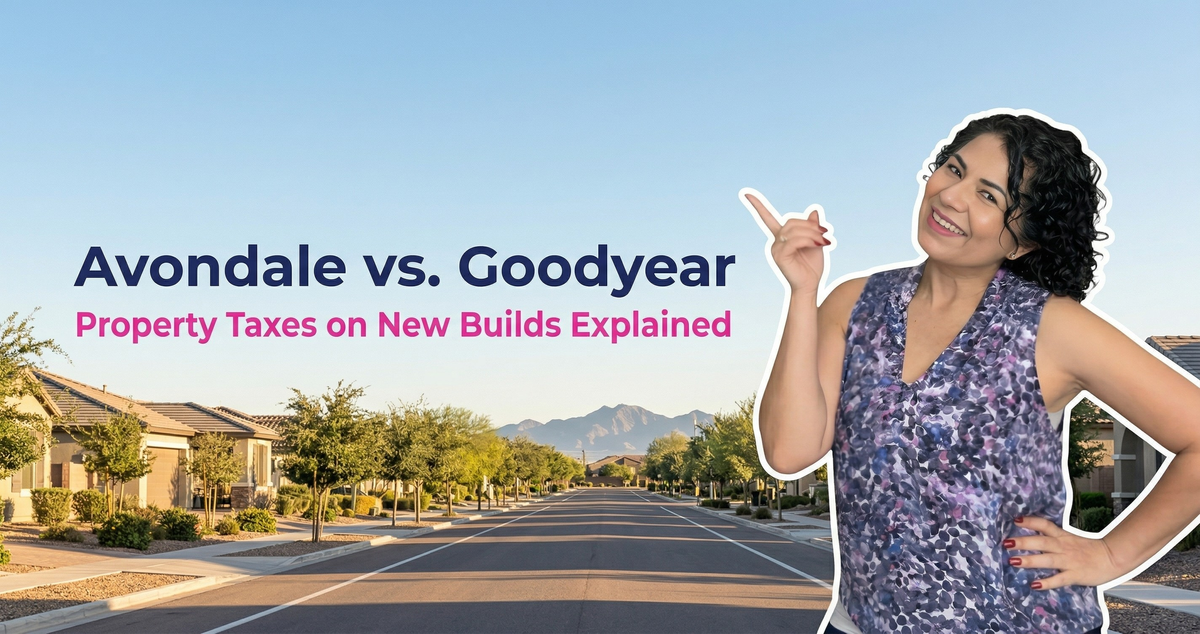
Avondale and Goodyear share a border and a builder base, but their property tax bills don't always match. Here's what new build buyers need to know before they decide.
What are the property tax differences between Avondale and Goodyear for new builds?
Both cities sit in Maricopa County and follow the same Arizona assessment framework — 10% of your home's Limited Property Value (LPV), applied against a combined rate that includes state, county, city, and school district layers. The meaningful difference comes down to which school districts and special taxing districts apply to your specific parcel. Goodyear's median effective property tax rate currently runs around 0.67% of market value, while Avondale comes in slightly lower at approximately 0.60% — and because new builds start with a first-year "Rule B" assessment that sets the baseline for the life of your ownership, getting clear on the numbers before you sign matters more than most buyers expect.
Why Property Taxes Feel Confusing on New Builds — And Why That's Normal
If you've been shopping new construction in the West Valley, you've probably gotten a property tax estimate from the builder's sales rep. Those numbers are almost always based on the land value only — because the house hasn't been assessed yet. Once your home is completed and added to the county assessor's rolls, the full assessed value comes in, and your actual tax bill can look noticeably different from what you were told at the sales table.
This is usually where I slow buyers down before they commit to a community. Understanding how your first assessment is calculated — and what you can do about it — is one of the most financially significant pieces of the new build process.
In Arizona, new construction triggers what's called a "Rule B" valuation. It's the county assessor's method for establishing the Limited Property Value (LPV) on a brand-new property that has no prior-year value to reference. According to the Arizona State Board of Equalization, the Rule B calculation sets the LPV based on the relationship between Full Cash Value and Limited Property Value of comparable properties in the same legal classification and area. The LPV they set in that first year becomes the baseline your future taxes grow from — capped at no more than 5% annually. That initial number carries weight for as long as you own the home.
How Arizona Calculates Property Taxes — The Mechanics That Apply to Both Cities
Before comparing Avondale and Goodyear side by side, it helps to understand the underlying framework, because it's the same in both cities.
Maricopa County uses a two-tiered system. First, the assessor establishes your home's Full Cash Value (FCV) — an estimate of market value. From there, the Limited Property Value (LPV) is derived. By Arizona statute, the LPV can increase no more than 5% per year, which is one reason Arizona property taxes tend to be relatively stable even in rising markets.
Your assessed value is then calculated by multiplying the LPV by the residential assessment ratio, which is 10% statewide. So on a $400,000 home with an LPV of $400,000, your assessed value would be $40,000. That $40,000 is what your combined tax rate is applied to.
The combined rate is where city lines start to matter. It includes: the state levy, Maricopa County's portion, the city's share (which is a small slice — roughly 11% of your total bill in both Avondale and Goodyear), and the school district and special district taxes, which are typically the largest component of your bill. School districts don't follow city boundaries perfectly, which is why two homes a few blocks apart can have meaningfully different tax rates.
Avondale vs. Goodyear: Where the Numbers Diverge
Both cities share the same county-level taxes and the same state framework. The divergence comes at the school district and special district level.
In Goodyear, the median effective property tax rate is approximately 0.67% of market value, with median annual bills ranging from around $1,954 in the 85338 zip code up to $3,082 in the 85395 zip code — a meaningful spread that reflects how much the school district assigned to your parcel can influence your total bill. Litchfield Elementary, Agua Fria Union High School District, and Liberty Elementary are among the districts active in Goodyear, and they each carry different levy rates.
In Avondale, the median effective rate sits closer to 0.60%, with median annual bills running from approximately $1,611 in the 85323 zip code to $1,822 in the 85392 zip code. Avondale has its own school district boundaries that don't always align with what buyers expect when shopping by zip code.
For a new build specifically, one additional factor applies in both cities: your first-year tax bill may still reflect only the land value if your home closed before the assessor added the completed structure to the rolls. Many new build buyers are surprised when their second-year bill is significantly higher. I walk my clients through this timeline specifically so the adjustment doesn't catch them off guard.
— Donna R, Peoria, AZ
The School District Variable: The Detail That Moves the Number Most
When buyers ask me to compare Avondale and Goodyear on taxes, the honest answer is: your specific parcel matters more than the city name. Two homes in the same city can carry meaningfully different combined rates depending on which school district boundaries they fall within — and new build communities sometimes straddle those boundaries.
At this stage, I help clients narrow their focus to the actual parcel-level tax rate rather than city-level averages. The Maricopa County Assessor's online lookup tool allows you to search any address or parcel and see the full breakdown of which taxing jurisdictions apply and at what rate. For a new build where the home isn't fully on the rolls yet, the most reliable approach is to look up comparable completed homes in the same community or on the same street and use those as your working estimate.
Arizona also provides a meaningful benefit to owner-occupied homes: the Homeowner Rebate of up to $600 annually applied against school taxes. Per the Maricopa County Assessor's Office, this rebate appears automatically on tax bills for properties classified as a primary residence (Legal Class 3) — you do not need to file a separate application, though you must ensure your home is correctly classified as your primary residence with the assessor. It is only available on your primary residence. For a new build buyer planning to live in the home, this rebate can provide real relief and should be factored into your budget.
It's also worth knowing that Arizona's primary property tax rate for all districts combined is capped at 1% of a property's LPV for owner-occupied homes. If the combined rate would otherwise exceed that, the school district portion is reduced and the state covers the difference. This cap is one reason West Valley property taxes remain comparatively stable despite the region's rapid growth.
What Closing Looks Like and When Taxes Are Due
In Arizona, closings are handled by title companies — not attorneys. Your title company will calculate any property tax prorations at the time of closing, meaning you and the seller will divide responsibility for the current tax year based on your close date.
Arizona property taxes are paid in two installments: the first is due October 1 (delinquent after November 1) and the second is due March 1 (delinquent after May 1). Most buyers with a mortgage won't deal with these directly — your lender typically collects an escrow portion with each payment and pays the bill on your behalf. That said, in your first year in a new build, it's worth confirming with your lender what estimated tax amount they're using for impounds, because estimates based on land-only value will result in an escrow shortfall when the full assessed value comes in.
— Paul, Surprise, AZ
Frequently Asked Questions
Are property taxes the same in Avondale and Goodyear since they're both in Maricopa County?
Not exactly. Both cities follow the same Arizona framework and share county-level taxes, but school district and special district boundaries — which make up the largest portion of your bill — vary by parcel, not just by city. Goodyear's median effective rate is approximately 0.67% of market value; Avondale's is closer to 0.60%, though individual parcels can fall outside these medians.
Why is the property tax estimate from the builder's sales team so much lower than my actual first bill?
Builder estimates at the time of purchase are typically based on land value only, because the completed home hasn't yet been assessed by the county. Once construction is added to the rolls, you receive a supplemental notice establishing the full assessed value. This is normal and expected — it's not an error — but it can catch buyers off guard if no one explains it in advance.
What is the Rule B valuation and why does it matter for new builds in Arizona?
When a new home is assessed for the first time, the county uses a "Rule B" ratio to establish the Limited Property Value (LPV) — the baseline all future tax calculations grow from. Because the LPV can only increase 5% annually, the value set in year one stays relevant for the entire ownership period. Arizona law gives you the right to appeal this initial assessment, and the window to do so is narrow.
Do I automatically get the Homeowner Rebate on a new build in Arizona?
Yes — for primary residences classified as Legal Class 3, the Homeowner Rebate of up to $600 annually toward school district taxes is applied automatically on your tax bill. What matters is that your home is correctly classified as your primary residence with the county assessor. This rebate is not available on investment properties or secondary homes.
How do HOA fees interact with property taxes in Avondale and Goodyear?
HOA dues and property taxes are separate obligations. Many newer communities in both cities carry HOAs, and it's important to know both costs as part of your total monthly housing picture. Some communities also have special district assessments layered on top of standard property taxes, so pulling the full tax detail for a specific parcel — not just the city median — is the most accurate approach.
What Matters When You're Making This Decision
The tax difference between Avondale and Goodyear on a new build is real but not dramatic at the city level. What moves the number is the school district and special district layer that applies to your specific address. Two homes a few blocks apart — one just inside Avondale, one just inside Goodyear — can carry meaningfully different bills depending on where the district boundaries fall.
The most important step is pulling the parcel-level tax breakdown before you commit to a community, understanding how your first-year assessment will be calculated, and confirming your lender's escrow estimate reflects a realistic tax figure. These are the details that protect your budget and prevent the surprises that tend to surface after closing. If you're also navigating a simultaneous sale and purchase in the West Valley, the same principle applies — structure matters more than optimism, and getting the contract details right in Goodyear is as important as understanding the tax picture.
About the Author
Kasandra Chavez is a real estate advisor serving the West Valley of Greater Phoenix, Arizona, recognized among the top 5% of real estate professionals in the Greater Phoenix area. She works with West Valley buyers and sellers to align their real estate strategy with their lifestyle, budget, and long-term goals, guiding confident decisions through every stage of the process. Kasandra specializes in managing the details that determine financial outcomes — from first assessments on new builds to the contingencies and timelines that protect her clients from exposure.
More Helpful Real Estate Videos from Kasandra
Stay confident in your real estate journey with Kasandra’s latest Arizona tips and insights.