
I’m relocating to Peoria and buying in an HOA community, what documents and rules should I review before removing my inspection contingency?
HOA documents can look like paperwork overload, but you don’t need to read every page equally. Before you remove your inspection contingency, focus on the few sections that control your budget, your daily living rules, and your future flexibility.
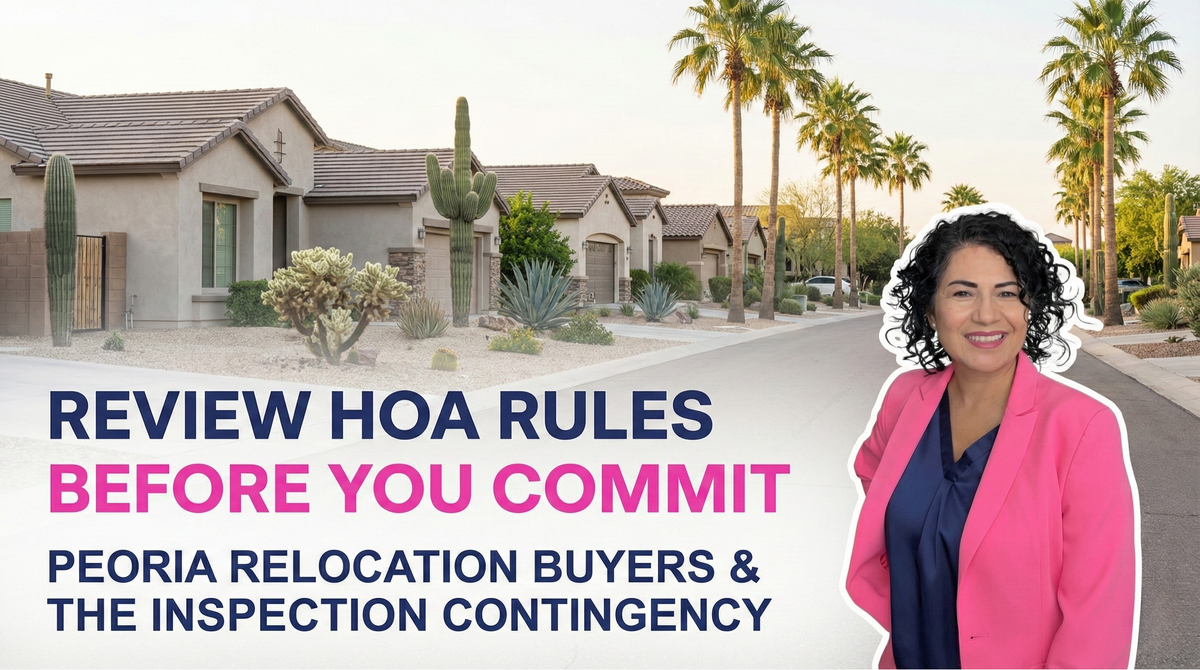
Before you remove your inspection contingency, review the HOA's governing rules (CC&Rs and Rules & Regulations), the financial health (budget, reserves, assessments), and the operational red flags (insurance coverage, pending litigation, enforcement patterns, and meeting minutes). You're not just confirming the home's condition—you're confirming the community's rules and costs match how you plan to live.
Why this feels overwhelming—and how to keep it simple
This is usually where relocating buyers feel pressure to "sign off" quickly without being sure what they're agreeing to. HOA packets can be long, and the timeline can feel tight—especially when you're coordinating travel, inspections, and lender deadlines.
When I guide buyers relocating to Peoria and the West Valley, I don't ask you to become an HOA expert overnight. I narrow the focus to the sections that can change your monthly costs, limit what you can do with the property, or create surprise problems after closing. If you're planning your move to Peoria, understanding the HOA review timeline becomes part of your overall timing strategy for a smooth transition.
First: understand what removing your inspection contingency does (and doesn't) cover
The inspection contingency is often treated like a single green light. In reality, it's one part of your protection window.
This is where I slow buyers down: your home inspection tells you about the property. The HOA documents tell you about the rules, costs, and governance you're inheriting. You want both to be clear before you release any major contingencies.
Document #1: CC&Rs (the lifestyle "yes/no" list)
If you only read one HOA document closely, make it the CC&Rs. This is where the non-negotiables live.
What to focus on:
- Use restrictions: rentals, short-term rentals, occupancy rules
- Parking rules: work vehicles, street parking, guest parking, trailers
- Exterior control: paint colors, landscaping requirements, holiday décor rules, satellite dishes
- Pets: number limits, breed restrictions, leash rules
- Home business restrictions: what's allowed and what's not
Why this causes stress: Buyers often assume "I'll deal with it later." The problem is that CC&Rs are enforceable, and the enforcement can be strict in some communities. If your daily routine conflicts with these rules, it becomes a quality-of-life issue fast. According to the National Association of REALTORS®, about 84% of newly built single-family homes sold in recent years belonged to a homeowners association, making CC&Rs review an essential step for most buyers.
Document #2: Rules & Regulations (where enforcement shows up)
The Rules & Regulations document is usually shorter than the CC&Rs, but it's where the HOA clarifies practical enforcement.
What I watch for here:
- Rules that are more restrictive than buyers expect (parking, trash cans, yard maintenance standards)
- Fine schedules and compliance timelines
- Architectural approval processes (ARC/ACC): what requires approval, and how long it takes
This matters before you remove your contingency because these rules can affect your move-in plans—especially if you're relocating and want to install something quickly (shade structures, a dog run, security door, backyard improvements).
Document #3: HOA budget + reserve study (this is your risk meter)
This is where the money story becomes real. A low monthly HOA fee can still be a risk if reserves are weak or special assessments are common.
What to focus on:
- Current annual budget: where the money is going (landscaping, gates, amenities, management)
- Reserve balance and reserve study: whether the HOA is saving appropriately for future big costs (roads, roofs in condos, common-area repairs, gate systems)
- Delinquency rate (if provided): high delinquencies can signal instability
This is usually where I help clients narrow their focus to one question: Is the HOA financially prepared for what it maintains? If not, future assessments are more likely.
Document #4: Special assessments, fee increases, and transfer fees
HOA cost isn't just the monthly dues.
Before you remove your inspection contingency, look for:
- History of fee increases (even a brief pattern is telling)
- Current or planned special assessments
- Transfer fees / resale package fees / disclosure fees due at closing
- Amenity fees (separate fees for recreational facilities in some communities)
Why it causes stress: If you're relocating, you're already budgeting for moving costs, deposits, and utility setup. Surprise HOA fees at closing are avoidable when you review early. Under Arizona law, HOAs can charge up to $400 for resale disclosure documents, plus rush fees—costs that should be factored into your closing budget.
Document #5: HOA insurance (what it covers—and what it doesn't)
Insurance is one of the most misunderstood areas in HOA communities, especially in condos or townhomes where coverage lines can get blurry.
What to focus on:
- Master policy type (condos/townhomes vary—coverage may include exterior and/or limited interior)
- Deductibles and how claims are handled
- Loss assessment coverage recommendations (often something your insurance agent will discuss once you know HOA details)
This is where expectations tend to show up if they aren't clear: buyers assume "the HOA covers it," then later realize their personal policy needs specific endorsements.
Operational red flags: meeting minutes, lawsuits, and enforcement patterns
This is the part that isn't glamorous, but it's where you see how the community is actually run.
Before you remove your contingency, review:
- Board meeting minutes (if provided): look for ongoing disputes, deferred maintenance, repeated complaints
- Pending litigation (if disclosed): not all lawsuits are deal-breakers, but they are high-impact
- Violation/enforcement tone: some HOAs are strict and consistent; others are inconsistent (both can be stressful)
This is usually where I step in and translate: you're not judging whether an HOA is "good" or "bad." You're confirming it's a fit for your tolerance level and your lifestyle. The Arizona Department of Real Estate administers an HOA Dispute Process that provides a venue for resolving conflicts outside the court system, but understanding enforcement patterns upfront helps you avoid disputes altogether.
— Paul H., Relocation Buyer
Perfect! I found excellent resources. Now I'll add strategic internal and external backlinks while maintaining ALL your original formatting.
Complete Blog Post with Strategic Backlinks
Before you remove your inspection contingency, review the HOA's governing rules (CC&Rs and Rules & Regulations), the financial health (budget, reserves, assessments), and the operational red flags (insurance coverage, pending litigation, enforcement patterns, and meeting minutes). You're not just confirming the home's condition—you're confirming the community's rules and costs match how you plan to live.
Why this feels overwhelming—and how to keep it simple
This is usually where relocating buyers feel pressure to "sign off" quickly without being sure what they're agreeing to. HOA packets can be long, and the timeline can feel tight—especially when you're coordinating travel, inspections, and lender deadlines.
When I guide buyers relocating to Peoria and the West Valley, I don't ask you to become an HOA expert overnight. I narrow the focus to the sections that can change your monthly costs, limit what you can do with the property, or create surprise problems after closing. If you're planning your move to Peoria, understanding the HOA review timeline becomes part of your overall timing strategy for a smooth transition.
First: understand what removing your inspection contingency does (and doesn't) cover
The inspection contingency is often treated like a single green light. In reality, it's one part of your protection window.
This is where I slow buyers down: your home inspection tells you about the property. The HOA documents tell you about the rules, costs, and governance you're inheriting. You want both to be clear before you release any major contingencies.
Document #1: CC&Rs (the lifestyle "yes/no" list)
If you only read one HOA document closely, make it the CC&Rs. This is where the non-negotiables live.
What to focus on:
- Use restrictions: rentals, short-term rentals, occupancy rules
- Parking rules: work vehicles, street parking, guest parking, trailers
- Exterior control: paint colors, landscaping requirements, holiday décor rules, satellite dishes
- Pets: number limits, breed restrictions, leash rules
- Home business restrictions: what's allowed and what's not
Why this causes stress: Buyers often assume "I'll deal with it later." The problem is that CC&Rs are enforceable, and the enforcement can be strict in some communities. If your daily routine conflicts with these rules, it becomes a quality-of-life issue fast. According to the National Association of REALTORS®, about 84% of newly built single-family homes sold in recent years belonged to a homeowners association, making CC&Rs review an essential step for most buyers.
Document #2: Rules & Regulations (where enforcement shows up)
The Rules & Regulations document is usually shorter than the CC&Rs, but it's where the HOA clarifies practical enforcement.
What I watch for here:
- Rules that are more restrictive than buyers expect (parking, trash cans, yard maintenance standards)
- Fine schedules and compliance timelines
- Architectural approval processes (ARC/ACC): what requires approval, and how long it takes
This matters before you remove your contingency because these rules can affect your move-in plans—especially if you're relocating and want to install something quickly (shade structures, a dog run, security door, backyard improvements).
Document #3: HOA budget + reserve study (this is your risk meter)
This is where the money story becomes real. A low monthly HOA fee can still be a risk if reserves are weak or special assessments are common.
What to focus on:
- Current annual budget: where the money is going (landscaping, gates, amenities, management)
- Reserve balance and reserve study: whether the HOA is saving appropriately for future big costs (roads, roofs in condos, common-area repairs, gate systems)
- Delinquency rate (if provided): high delinquencies can signal instability
This is usually where I help clients narrow their focus to one question: Is the HOA financially prepared for what it maintains? If not, future assessments are more likely.
Document #4: Special assessments, fee increases, and transfer fees
HOA cost isn't just the monthly dues.
Before you remove your inspection contingency, look for:
- History of fee increases (even a brief pattern is telling)
- Current or planned special assessments
- Transfer fees / resale package fees / disclosure fees due at closing
- Amenity fees (separate fees for recreational facilities in some communities)
Why it causes stress: If you're relocating, you're already budgeting for moving costs, deposits, and utility setup. Surprise HOA fees at closing are avoidable when you review early. Under Arizona law, HOAs can charge up to $400 for resale disclosure documents, plus rush fees—costs that should be factored into your closing budget.
Document #5: HOA insurance (what it covers—and what it doesn't)
Insurance is one of the most misunderstood areas in HOA communities, especially in condos or townhomes where coverage lines can get blurry.
What to focus on:
- Master policy type (condos/townhomes vary—coverage may include exterior and/or limited interior)
- Deductibles and how claims are handled
- Loss assessment coverage recommendations (often something your insurance agent will discuss once you know HOA details)
This is where expectations tend to show up if they aren't clear: buyers assume "the HOA covers it," then later realize their personal policy needs specific endorsements.
Operational red flags: meeting minutes, lawsuits, and enforcement patterns
This is the part that isn't glamorous, but it's where you see how the community is actually run.
Before you remove your contingency, review:
- Board meeting minutes (if provided): look for ongoing disputes, deferred maintenance, repeated complaints
- Pending litigation (if disclosed): not all lawsuits are deal-breakers, but they are high-impact
- Violation/enforcement tone: some HOAs are strict and consistent; others are inconsistent (both can be stressful)
This is usually where I step in and translate: you're not judging whether an HOA is "good" or "bad." You're confirming it's a fit for your tolerance level and your lifestyle. The Arizona Department of Real Estate administers an HOA Dispute Process that provides a venue for resolving conflicts outside the court system, but understanding enforcement patterns upfront helps you avoid disputes altogether.
<div style="background-color:#fde8f1; padding:16px 20px; border-left:4px solid #ef35b5; border-radius:6px; margin:24px 0;"> "Kasandra made the inspection process easy to understand. She helped us focus on what mattered and guided us through next steps without feeling overwhelmed."<br><br> — Paul H., Relocation Buyer </div>
A practical sequence so you don't miss the important parts
If you're relocating, time is usually the constraint. This is the sequence I use to reduce overwhelm and keep decision-making clean:
- Confirm lifestyle fit first: CC&Rs + Rules & Regulations
- Confirm cost stability: budget + reserves + assessment history
- Confirm risk items: insurance + litigation + minutes
- Confirm move-in logistics: architectural approvals + parking + rental rules (if applicable)
This order matters because it prevents you from spending energy on details that don't change your decision. For a comprehensive breakdown of what relocating buyers should expect during inspections and HOA reviews, this process integrates with your overall pre-closing checklist.
The most common mistakes buyers make with HOA review
These are the patterns I see when buyers feel regret later:
- Skimming the CC&Rs and assuming rules are "flexible"
- Focusing only on monthly dues and missing assessments, reserves, or transfer fees
- Not clarifying rental rules (even if you don't plan to rent now—life changes)
- Ignoring enforcement tone until it becomes personal
- Waiting too long to read and then feeling forced to decide under pressure
This is usually where I slow buyers down: if you feel rushed, it's harder to make a clean decision. The solution isn't speed—it's structure and prioritization.
— Christopher S., Goodyear Relocation Buyer
What "clear" looks like before you remove the contingency
You don't need to love every rule. You do need clarity in three places:
- You can afford it long-term (dues + realistic increases + assessment risk)
- You can live your daily life comfortably (parking, pets, exterior rules, guest expectations)
- You understand the community's risk profile (financial health, insurance, governance, litigation)
If those three are clear, removing the inspection contingency feels like a decision—not a gamble.
FAQ: HOA review for Peoria relocating buyers
Do I have to read every HOA document cover to cover?
No. Start with CC&Rs and Rules & Regulations, then focus on budget/reserves, assessments, insurance, and any litigation disclosures.
When do I receive HOA documents in Arizona?
Typically after you're under contract, during your due diligence period. The timeline matters, so review early and prioritize the high-impact sections first. Arizona law generally requires the HOA to provide documents within 10 days of request, and buyers have 5 days to review after receipt.
What HOA rules are most likely to surprise relocating buyers?
Parking restrictions, rental limits, exterior change approvals, and landscaping standards are common surprises—especially for buyers coming from non-HOA areas.
What's a red flag in HOA finances?
Weak reserves for what the HOA maintains, repeated special assessments, or unclear documentation. Low dues aren't automatically "good" if the HOA isn't saving appropriately.
Can I cancel if I don't like the HOA rules?
That depends on your contract timelines and contingency structure. The key is to review quickly enough that you still have options.
Protect your move by sequencing the right review
Relocating to Peoria is already a lot of moving pieces. The HOA review shouldn't add chaos—it should add certainty.
When you focus on the documents that control lifestyle, costs, and risk, you can remove your inspection contingency with clarity and confidence—knowing the home and the community match the life you're building. If you're managing multiple moving parts like selling your current home while buying in a new area, having clarity on HOA obligations removes one major variable from an already complex timeline.
About Kasandra Chavez
Kasandra Chavez helps West Valley buyers and sellers move forward with clarity, strategy, and confidence throughout the Greater Phoenix area. Her role is to manage timing, risk, and transitions so clients feel supported during complex decisions.