New Build vs. Resale Home in the West Valley: Which Is the Better Buy?
Comparing new construction to resale homes across Goodyear, Buckeye, and Surprise — from builder contracts to long-term value.
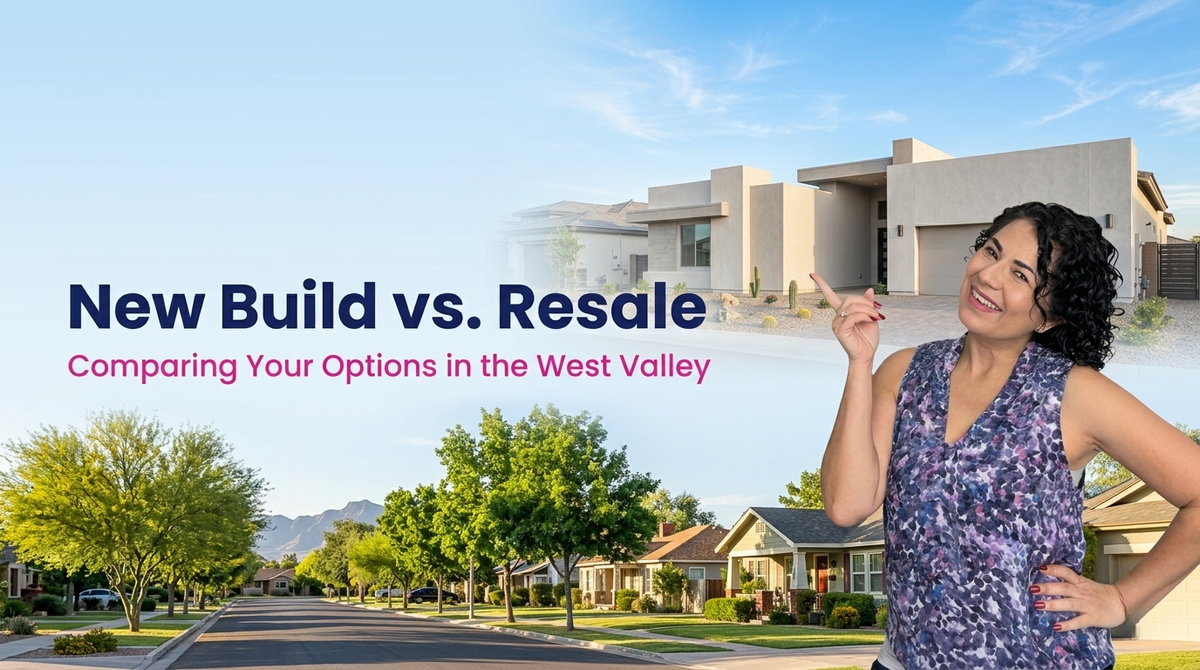
New Build vs. Resale Home in the West Valley: Which Is the Better Buy?
Is it better to buy a new build or resale in the West Valley?
The answer depends entirely on what you need right now — not what you think you should want. New builds offer control and warranties; resale homes typically cost less and give you established neighborhoods. Both can be smart choices. What matters is understanding what you're actually comparing before you sign anything.
Introduction
When you're looking at homes in Goodyear, Buckeye, or Surprise, this question sits underneath almost every decision you make: am I buying a lifestyle now, or an investment for later. That tension is real. You're probably weighing safety — a brand-new roof and builder warranty — against value — a lower purchase price and a mature community with established trees. You might also be wondering whether you're making the right move at all, whether now is even a good time to buy.
This is usually where I slow buyers down. The choice between new and resale isn't actually about the house. It's about timing, cash flow, control, and how you live. In the West Valley, where both options are actively available, the real question is which one fits your life and your financial reality right now. That's what we're unpacking here.
What You're Really Comparing: Cost, Timeline, and Control
When you walk into a builder's sales office or an open house, the comparison feels obvious — price, finishes, location. But you're actually comparing three distinct things: your total out-of-pocket cost, how long the process takes, and how much say you have in what you're getting.
New construction typically carries a higher base price than resale. In the West Valley, a new build in Surprise, Goodyear, or Buckeye often starts $20,000 to $60,000 above the resale median, depending on the builder's incentive structure and the lot. That upfront number is real. But what comes with it is often different. You're getting a builder's warranty covering structural elements, mechanical systems, and cosmetic defects for set periods. You're getting a guaranteed close date — usually 90 to 120 days from purchase. You know exactly what you're getting because you're ordering it.
Resale homes cost less on average, but the total picture is more complex. You may need immediate repairs. You'll likely have a home inspection that surfaces deferred maintenance. Your closing timeline depends on the seller, any title issues, and appraisal timelines — typically 30 days under an AAR contract, but sometimes longer. You have less control over what gets fixed before you take possession, though the inspection period under an AAR contract gives you 10 days to negotiate.
What I watch for here is the net sheet — the number that tells you what you're actually paying after builder incentives, seller concessions, or price adjustments. A new build at $450,000 that includes $20,000 in closing cost assistance is different from a $430,000 resale that needs $15,000 in immediate repairs and carries $3,000 in HOA transfer fees. Do the math before you compare sticker prices.
The Builder Contract vs. the Resale Process
This is where most buyers stumble. A builder contract is not an AAR (Arizona Association of REALTORS) resale contract. They're written from opposite ends of the table. A builder contract protects the builder's interests first. A resale contract, under AAR terms, balances buyer and seller more evenly.
With a builder, you're signing a contract that typically limits your inspection period to shorter windows or phases. You may have limited appraisal contingencies. Change orders — requests to modify specs after you sign — usually come at the builder's standard markup. The builder controls the lot, the timing, and often the terms. You get to choose finishes from their palettes. You don't get to renegotiate the price downward. If you're evaluating builder contracts, incentives, and warranties in Goodyear, understanding these distinctions upfront will save you frustration later. When Gloria worked with us on her Buckeye new build, one critical moment came when her builder initially resisted an independent home inspection. Knowing her rights mattered — that inspection caught issues the builder's own walkthrough had missed.
With a resale purchase, you have more leverage. You can negotiate price, request repairs, conduct independent inspections, and walk away if the inspection reveals problems you don't want to inherit. The 10-day inspection period under an AAR contract is your main window to discover and address issues. According to the National Association of REALTORS, about 86% of recent buyers purchased previously owned homes — the resale process is still the most common path for a reason.
Understanding which contract you're signing matters. Ask questions about change orders, upgrades, closing dates, and what to look for in a new construction final walkthrough.
— Gloria B, Buckeye, AZ
Long-Term Value and Appreciation in the West Valley
Here's what the market is actually doing. According to the Cromford Report, the Greater Phoenix residential resale median currently sits at $458,000 as of February 2026. This represents recovery from the 2023 dip, though it remains below the mid-2022 peak of approximately $480,000. The West Valley specifically — Goodyear, Buckeye, Surprise — has been one of the stronger appreciation zones over the past five years, partly because job growth and infrastructure continue to move west.
• Greater Phoenix residential resale median: $458,000 (February 2026)
• West Valley new construction typically starts $20K–$60K above resale median depending on community and builder incentives
• Resale median has recovered from mid-2023 dip but remains below 2022 peak of ~$480,000
Source: The Cromford Report — data shared per Cromford Associates LLC subscriber policy
New builds in the West Valley tend to start higher than this median, which means you're entering at a premium. That premium reflects the warranty, the control, and the newness. Whether that premium appreciates or depreciates depends on neighborhood demand, builder reputation, and market conditions five to ten years from now. If you're curious about how new construction in North Peoria compares to Phoenix resale, the appreciation patterns tell a similar story.
Resale homes have already absorbed their primary depreciation. A 20-year-old home in a mature Surprise neighborhood with established trees, familiar schools, and community reputation may appreciate more steadily than a brand-new build in a subdivision still under construction. In my experience, the biggest appreciation plays in the West Valley come from stable, built-out neighborhoods with strong school ratings, proximity to jobs, and good infrastructure. Whether that's new or resale matters far less than location and timing.
The Hidden Costs Most Buyers Don't Factor In
This is where conversations get real. A new build feels cheaper because the builder's marketing focuses on base price. A resale feels more transparent because you see the inspection report. Both perspectives miss critical costs that change the equation.
New build hidden costs: builder upgrades often carry 30 to 50 percent markups. A kitchen upgrade quoted at $8,000 might cost $4,000 if you handled it after closing. Closing costs on new construction can be higher because lenders sometimes require builder-specific inspections. HOA fees in new subdivisions often increase as the community matures — those initial low rates are temporary. And though rare, builder defaults do happen. If your builder runs into financial trouble during construction, your closing date evaporates. The U.S. Census Bureau tracks new residential construction starts and completions, and recent data shows construction timelines extending in several metro areas.
Resale hidden costs: deferred maintenance is the big one. You may love the house, but that roof might need replacement in three years. The HVAC system might be original. Plumbing, electrical, foundation — these age at different rates. Understanding the real difference in warranty coverage and long-term repair costs between new builds and resale homes is essential. Appraisal gaps happen: the home appraises lower than the purchase price, and you have to make up the difference or renegotiate. And in the West Valley, especially in older Surprise neighborhoods, irrigation and landscaping maintenance can carry surprise costs.
Here's what I'm seeing with clients: the true cost of a new build is typically 5 to 10 percent higher than the advertised price once you add upgrades, financing, and closing costs. The true cost of a resale is usually 8 to 15 percent higher than purchase price when you factor in inspection repairs, title work, and deferred maintenance. According to Bankrate's comparison of new construction and resale homes, the financial gap narrows significantly once you account for these hidden variables.
— Mariah A, Phoenix, AZ
How to Decide: The Lifestyle Lens
This is the framework I use with buyers, and it works because it stops the price-comparison spiral and forces you to think about how you actually live.
Ask yourself three things. First: How long do you plan to stay. If you're buying a stepping stone — a house you'll own for three to five years before moving up or relocating — a resale in a stable neighborhood usually wins financially. You avoid the premium, you avoid extended HOA ramp-ups, and you can resell into an established market. If you're planning to stay ten years or longer, the warranty peace of mind and quality-of-life benefits of new construction start to justify the premium.
Second: What does maintenance stress cost you. Some buyers sleep fine knowing they might face a major repair in five years. Others don't. If deferred maintenance keeps you up, new construction's warranty covers you for longer and removes that variable from your decision-making. If you're comfortable managing repairs, a resale's lower entry point often makes financial sense.
Third: Do you need the community to be fully built out, or does early-stage development appeal to you. New subdivisions in Goodyear and Buckeye are often under construction for years. That means temporary roads, fewer retail options, and ongoing construction traffic. Mature resale neighborhoods — especially in older sections of Surprise and Goodyear — come with established schools, shopping, and trees. That lifestyle difference is real and doesn't show up in a price comparison.
There's no universal answer. What matters is your answer.
Frequently Asked Questions
Q: Can I negotiate with a builder like I would with a resale seller?
Not in the same way. Builders set prices and terms. You can negotiate incentives like closing cost assistance or upgraded finishes if the market allows, but builders don't typically renegotiate base price. With resale, you can offer below asking and negotiate repairs. The leverage is different.
Q: Should I worry about new construction being overbuilt in the West Valley?
The West Valley continues to attract buyers and job growth, so demand remains steady. However, some subdivisions do experience longer sell-through times if the market softens. Location matters more than whether the home is new. A new build in a desirable Goodyear neighborhood will move. A build in a less-established subdivision may sit longer if the builder overbuilt the area.
Q: What warranty should I expect on a new home in Arizona?
Standard builder warranties in Arizona typically cover structural defects for 10 years, mechanical and electrical systems for 2 years, and cosmetic items for 1 year. Some premium builders extend these. Always request a detailed warranty document before signing.
Q: Is it harder to get a loan for new construction or resale?
Lenders treat both similarly. Appraisals sometimes take longer on new construction because comparable sales are limited in newer communities. Rates and terms are typically the same for both.
Q: What's the real difference in total cost between new and resale in the West Valley?
A resale costs 8 to 15 percent less at purchase but may require early repairs. A new build costs 5 to 10 percent more upfront but comes warranty-backed. Over a 10-year ownership period, total cost of ownership often evens out depending on your specific property and how many major repairs the resale requires.
Closing
The new vs. resale question isn't actually a question about the house. It's a question about you — what you need right now, how long you're staying, and what tradeoffs you're willing to make. Both paths work. Both paths fail if you choose one for the wrong reasons.
The West Valley offers strong options in both categories. Resale homes in established Goodyear and Surprise neighborhoods deliver immediate community and lower entry costs. New construction in Buckeye and newer Surprise subdivisions delivers control, warranty peace of mind, and modern efficiency. Your job is to understand what you're trading — price for warranty, immediate occupancy for choice, established community for new finishes.
Think of whichever home you choose not as your final destination, but as a stepping stone. That perspective removes pressure and helps you focus on what actually matters: does this home work for my life right now.
About the Author
Kasandra Chavez is a REALTOR® and team lead with Chavez Dream Home Team in the West Valley of Greater Phoenix, Arizona, recognized among the top 5% of real estate professionals in the Greater Phoenix area. She works with both buyers and sellers, aligning strategy with lifestyle and financial goals to support confident decision-making. Kasandra prioritizes process control and transparency, ensuring clients understand every step from contract to closing.