
Lake Pleasant-Adjacent Peoria or TSMC-Corridor North Phoenix? Long-Hold Appreciation Patterns Compared
With Phoenix's 2026 market stabilizing, here's how Lake Pleasant-adjacent Peoria communities like Mystic and Northpointe at Vistancia compare to TSMC-corridor North Phoenix for long-hold appreciation.
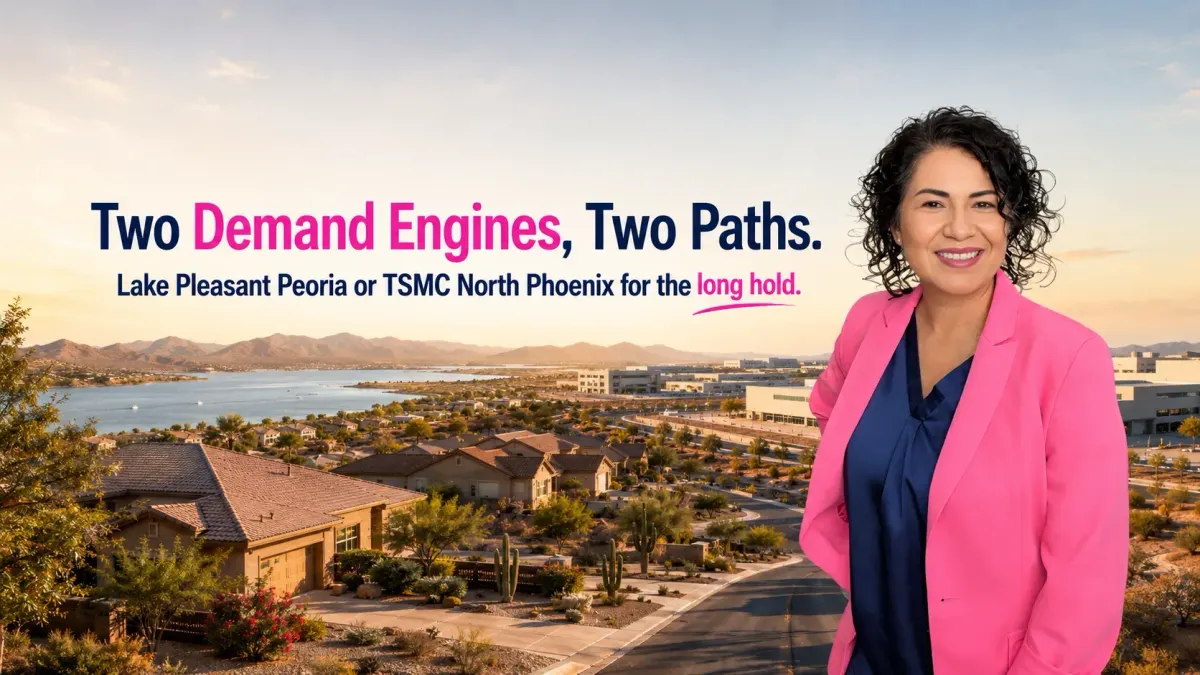
With Phoenix's overall market stabilizing in 2026, are appreciation patterns in Peoria's Lake Pleasant-adjacent neighborhoods like Mystic and Northpointe at Vistancia behaving differently than in North Phoenix's TSMC corridor, and what should that mean for a long-hold buy decision?
The honest answer: both submarkets are tied to broader Phoenix-area dynamics, but they're driven by different demand engines and that difference matters more on a long hold than on a short one. Lake Pleasant-adjacent Peoria communities tend to track West Valley lifestyle and recreation demand, including in-migration from outside Arizona. TSMC-corridor North Phoenix is more directly tied to a specific employment story — semiconductor manufacturing buildout, supplier ecosystem, and the broader Loop 303 / I-17 industrial-technology cluster. On a 7–15 year horizon, those different drivers tend to produce different appreciation patterns, and which one fits you depends on what you actually want out of the home — not just the trajectory.
This is the kind of question that often gets oversimplified into "where will prices go up the most." The more useful question is which growth story matches the kind of buyer you are.
What "Stabilizing" Looks Like in Phoenix Right Now
Greater Phoenix entered 2026 in a more balanced market than the surge years of 2021–2022. The metro median sale price sits in the high $400,000s. Days-on-market are running in the 50–56 range across the area. Supply is at roughly 1.5–1.6 months — still tighter than a "balanced market" textbook would call balanced, but meaningfully looser than the under-1-month inventory levels that defined the peak. Sale-to-list ratios are around 97%, indicating measured but real negotiation room. Mid-6% mortgage rates remain the dominant rate environment.
That backdrop changes how buyers should read individual submarket movements. In a surge market, everything appreciates fast and the differences between submarkets are hidden under the broader tide. In a stabilizing market, the differences between submarkets become visible again. Which demand drivers are real, durable, and locally specific? Which are illusions of the broader market's pace? Stabilizing markets are where the underlying differences in demand engines show up clearly.
Lake Pleasant-Adjacent Peoria: Mystic and Northpointe at Vistancia
Mystic and Northpointe at Vistancia anchor different ends of North Peoria but share key demand drivers. Northpointe at Vistancia is a 3,450-acre community within the broader 7,100-acre Vistancia master plan, with Phase 2 currently active. Mystic and the adjacent Buttes at Mystic offer related North Peoria master-plan inventory with established neighborhood structures. Both sit within reach of Lake Pleasant Regional Park — the major lifestyle and recreation amenity that meaningfully distinguishes North Peoria's character from comparable communities deeper in the West Valley.
The Lake Pleasant-adjacent demand story is different from a pure employment story. It draws relocators looking specifically for lake access and outdoor lifestyle, retirees and active-adult buyers (including those targeting Trilogy at Vistancia), and buyers seeking master-plan amenity environments where the lifestyle is part of the value proposition. As the Vistancia master plan continues to deliver — Five North at Vistancia's medical district agreement with HonorHealth, the Vistancia Commerce Park breaking ground, and continued residential and commercial buildout — that demand engine deepens.
Long-hold appreciation in this submarket tends to track broader West Valley demand patterns plus the specific lift from continued master-plan maturation. The pattern is generally more steady and lifestyle-anchored than employment-spike-driven.
— Gloria B, Buckeye, AZ
TSMC-Corridor North Phoenix
The TSMC corridor in North Phoenix is a different demand engine. TSMC's Arizona commitment now stands at $165 billion across six fabrication plants, two advanced packaging facilities, and a research and development center on a 2,000+ acre campus near Loop 303 and I-17. The first fab is producing on 4nm process technology. The second fab's construction was completed in April 2026 with commercial production targeting 3nm in the second half of 2027. The third fab broke ground in April 2025, targeting 2nm and A16 process technology with production later in the decade. The broader supplier ecosystem (semiconductor materials, advanced packaging, equipment, R&D) is continuing to expand alongside.
That's a specific, large, and locally concentrated employment story. It creates housing demand from TSMC engineers, supplier-side professionals, contractors, and the secondary services that follow large industrial-technology clusters. North Phoenix submarkets within commute range of the TSMC campus — Norterra, Stetson Valley, Sonoran Foothills, Dynamite Mountain Ranch, Deer Valley-adjacent inventory, and more — all draw some piece of that demand.
Long-hold appreciation in this submarket can outpace the broader metro if the TSMC and supplier buildout continues on schedule and the broader semiconductor industry remains strong. It can also underperform if the buildout slows, supplier expansion plateaus, or the broader cycle turns. Single-engine demand stories tend to be both higher-beta on the upside and higher-beta on the downside. That's neither good nor bad — it's a different risk profile.
How Long-Hold Math Looks Different in Each
Over a 7–15 year hold, the question stops being "which submarket goes up faster" and starts being "which submarket's demand engine fits my risk tolerance and lifestyle." A Lake Pleasant-adjacent Peoria home has multiple demand drivers stacked together — lifestyle, master-plan maturation, West Valley population growth, and broader Phoenix metro demand. None of them individually is as dramatic as the TSMC story, but they don't all need to hit at once for appreciation to continue.
A TSMC-corridor North Phoenix home has a more concentrated demand story. If the corridor's employment buildout continues as expected, appreciation can be strong. If it doesn't — for reasons inside or outside Arizona's control — the appreciation case relies more on the broader Phoenix metro picking up the slack. That's not unreasonable as a backup, but it's a different bet structure than the Lake Pleasant-adjacent story.
What I watch for here is whether buyers are aware they're making a bet at all. "Where will appreciation be best" is a question that has no certain answer. The more honest framing is: which kind of growth story am I comfortable owning into for the next decade. For broader corridor context, this Peoria vs. North Phoenix timing post walks through how the two submarkets compare on inventory and commute patterns.
— Mariah A, Phoenix, AZ
Which Buyer Each Pattern Fits Best
Lake Pleasant-adjacent Peoria — Mystic, Northpointe at Vistancia, the Vistancia master plan generally — tends to fit buyers who want lifestyle as part of the value proposition. Retirees and active-adult buyers. Families wanting outdoor recreation built into daily life. Remote workers who can live further from employment centers because they're not driving to one every day. Long-hold buyers who value steadier, multi-driver appreciation over single-driver upside.
TSMC-corridor North Phoenix tends to fit buyers who want exposure to the semiconductor industry's growth, either directly (TSMC engineers, supplier-side professionals, contractors) or indirectly (investors and long-hold buyers betting on the corridor's continued buildout). Buyers comfortable with higher-beta appreciation profiles. Buyers whose work geography is already North Phoenix-aligned.
The wrong fit is what hurts long-hold outcomes more than the wrong demand engine. A buyer who values lake lifestyle ends up unhappy in a TSMC-corridor neighborhood and sells early, regardless of how the prices moved. A TSMC engineer ends up unhappy in Northpointe at Vistancia because the commute eats into the time they wanted back, regardless of how the prices moved. For more on how new-construction trade-offs play out across both corridors, this North Peoria new construction vs. Phoenix resale comparison is a useful read.
What "Long-Hold" Really Means in Practice
A 7–15 year hold sounds long until you actually try to do it. Life circumstances change. Job changes, family changes, market dislocations, mortgage rate movements that make a refinance or a move financially urgent — any of these can shorten a "long hold" without warning. The best long-hold strategies are the ones that don't require everything to go right.
That means the home should work for you in years 1 through 5 as well as years 10 through 15. If your day-to-day life in year 2 doesn't match the neighborhood you bought in, you're going to be unhappy long before the appreciation story has had time to play out. Long-hold appreciation strategies should never override day-to-day fit. For relocating buyers planning that long horizon, this Peoria, AZ relocation home-buying process guide covers the buyer sequence in detail.
The Bottom Line
Lake Pleasant-adjacent Peoria neighborhoods and TSMC-corridor North Phoenix neighborhoods are tied to different demand engines, and over a 7–15 year hold those differences tend to produce different appreciation profiles. Lake Pleasant-adjacent tends to be steadier, with multiple stacked drivers. TSMC-corridor tends to be higher-beta, with a more concentrated single-driver story. Neither is inherently better — the right one for you depends on what you want from the home, your risk tolerance, and your actual life geography. Pick the demand engine that matches the buyer you are, not the one that promises the highest theoretical upside.
FAQ
How is the Phoenix real estate market doing in 2026?
Greater Phoenix entered 2026 in a more balanced market than the surge years, with median sale prices in the high $400,000s, days-on-market in the 50–56 range, supply around 1.5–1.6 months, sale-to-list around 97%, and mortgage rates in the mid-6% range.
Where is Lake Pleasant Regional Park located?
Lake Pleasant Regional Park is in northern Maricopa County, accessible from North Peoria via Lake Pleasant Parkway. Communities like Northpointe at Vistancia and Mystic in Peoria sit within reach of the lake's recreation and amenity offerings.
How big is TSMC's Arizona commitment?
TSMC's Arizona commitment now stands at $165 billion across six fabrication plants, two advanced packaging facilities, and a research and development center on a 2,000+ acre campus near Loop 303 and I-17 in north Phoenix.
Are Lake Pleasant-area neighborhoods appreciating faster or slower than TSMC-corridor neighborhoods?
Both submarkets are tied to broader Phoenix-area appreciation but are driven by different specific demand engines. Lake Pleasant-area neighborhoods are tied to lifestyle and master-plan maturation; TSMC-corridor neighborhoods are tied to semiconductor industry buildout. Long-term comparison depends on which engines actually deliver.
What's the right hold horizon for these submarket bets?
A 7–15 year hold gives any submarket's demand engine time to play out. Shorter holds risk being interrupted by life events or market cycles before the appreciation story matures. The right hold horizon depends on the buyer's life stability, not just the submarket's trajectory.
Closing Thought
A long-hold real estate decision is really a long-hold lifestyle decision with an appreciation overlay. At this stage, I help clients narrow their focus to the part they can control — the day-to-day fit, the lifestyle match, the home that actually works for the years between purchase and resale. The market overlay matters, but it's almost never the right tie-breaker when the buyer profile and the community profile don't already match.
About the Author
Kasandra Chavez is a real estate advisor serving the West Valley of Greater Phoenix, Arizona, recognized among the top 5% of real estate professionals in the Greater Phoenix area. She works with buyers and sellers to build strategy aligned with their lifestyle and long-term goals, supporting confident decision-making at every stage. Her focus is process control and market navigation for long-hold buyers across the Peoria–North Phoenix corridor.