Is Phoenix and the West Valley Still a Good Place to Retire, or Has Growth and Heat Made It Too Expensive and Crowded?
Phoenix and the West Valley keep drawing retirees for real reasons — but the decision deserves a clear-eyed look at costs, heat, and what life actually feels like here before you commit.
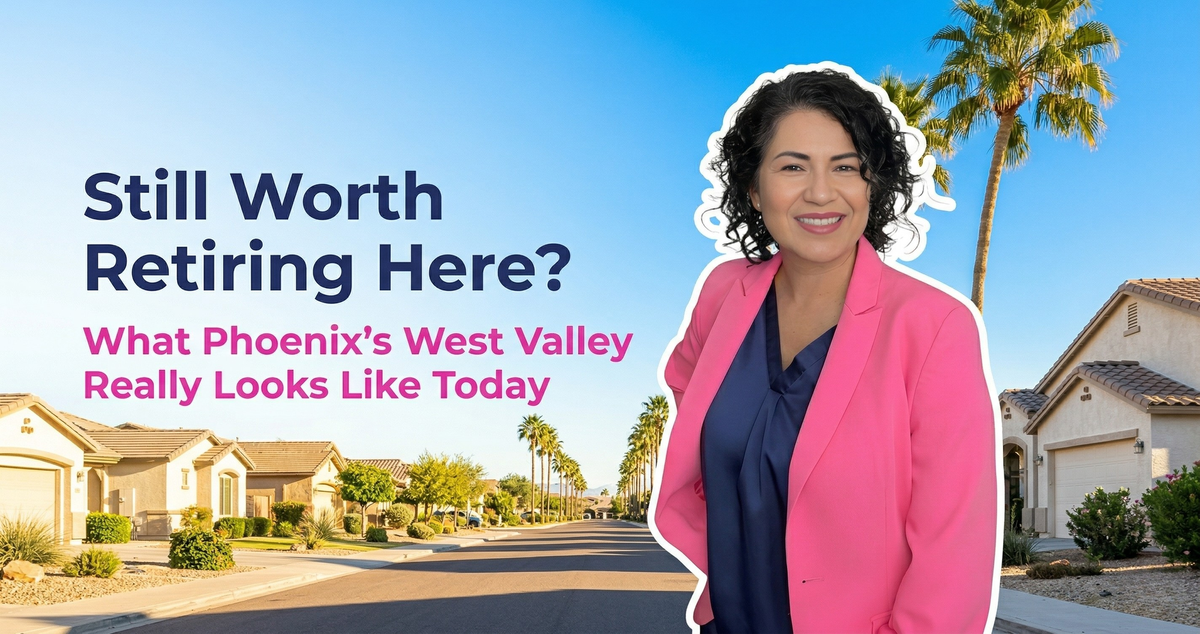
Is Phoenix and the West Valley still a good place to retire, or has growth and heat made it too expensive and crowded?
Yes — for the right retiree, the West Valley of Greater Phoenix remains one of the most compelling places to retire in the country. But the honest answer is more nuanced than that: what works beautifully for some people is a real mismatch for others, and knowing which category you fall into before you buy is the whole game.
What You're Really Asking — and Why It Matters
You've probably read the headlines. Phoenix is one of the fastest-growing metros in the United States. Summers regularly hit 110°F. Home prices rose sharply over the past several years. And the freeways that used to feel manageable now have rush hours that feel familiar to people escaping California or the Midwest.
All of that is true. And none of it automatically disqualifies the West Valley as a retirement destination — but it does mean you need to make this decision with current, specific information rather than the version of Phoenix that existed ten years ago. According to U.S. Census Bureau data, the Phoenix metro area added nearly 85,000 people between 2023 and 2024, making it one of the largest-gaining metro areas in the country. Growth here is not slowing down, which affects prices, traffic, and the pace of community development.
What I hear most from clients considering this move is some version of the same question: Is this still worth it? They've been watching from a distance, weighing the cost of living in their current city against what they see in Arizona, and wondering if they've missed the window. Most of the time, they haven't. But the math has changed, and the lifestyle fit is something you need to think through honestly.
The Cost Picture: What Has Actually Changed
Home prices in the West Valley are higher than they were five years ago — that's simply true. Markets like Peoria, Surprise, and Goodyear saw significant appreciation during the pandemic-era run-up. But in context, the West Valley still offers meaningfully better value than coastal retirement markets and many Sun Belt alternatives. You can still find well-maintained homes in planned communities, with HOA amenities and low-maintenance yards, at price points that would be nearly impossible in comparable markets in California, Florida, or the Pacific Northwest.
Property taxes in Arizona are relatively low, and the state offers programs that directly benefit retirees. The Arizona Senior Property Valuation Protection program — commonly called the "Senior Freeze" — allows qualifying homeowners 65 and older to freeze the taxable valuation of their primary residence for three years, which can help stabilize property tax bills on a fixed income. Income thresholds and residency requirements apply, so reviewing eligibility with your county assessor before you buy is worthwhile. [VERIFY - Arizona Accuracy: confirm current AZ state income tax treatment of Social Security and pension income for your clients' specific situations.]
What has genuinely gotten more expensive: HOA dues. In many of the communities that retirement-age buyers target — Surprise Ranch, Sun City Grand, Trilogy communities in Peoria — dues have increased over the past few years, and it's worth asking not just what dues are today, but how often they've been raised and when the next exterior paint cycle or major capital assessment is coming. Those details aren't buried in the fine print — they're in the HOA documents, and they're worth reading carefully before you close.
— Paul, Surprise, AZ
The Heat Question: What Life Actually Looks Like in Summer
The heat is real, and I'd rather you hear an honest version of it now than be caught off guard in July. Phoenix summers are intense — June, July, and August regularly see daytime highs above 110°F, and overnight lows often stay in the 90s. That is not a week-long heat wave. That's a three-month season.
What most retirees who've made this work will tell you: summer becomes the indoor season. You shift your outdoor walks and golf rounds to early morning. You keep your car parked in the garage. You run errands before 10am or after 6pm. The trade-off is that from October through April, the weather is genuinely extraordinary — warm, sunny days in the 60s and 70s with almost no rain and very low humidity. Many retirees describe those seven months as the best weather they've ever lived in.
The communities most popular with retirees are designed with this rhythm in mind. Covered walkways, community centers with pools and fitness facilities, shaded patios, and landscaping built for desert climates. If you're active and plan to spend most of your time outdoors, summer will be a genuine adjustment. If you've already been dealing with harsh winters and are simply trading one difficult season for another, many retirees find the trade-off favorable — especially when one of those seasons involves 70°F and sunshine in January.
The question worth sitting with honestly: do you want to be somewhere you can be outdoors freely for most of the year, or do you need outdoor access year-round? That one self-assessment will tell you a lot about whether this is the right fit.
Growth and Crowds: What Has Changed and What Hasn't
The West Valley has absorbed enormous growth over the past decade. Surprise, Goodyear, and Buckeye have all expanded significantly. New master-planned communities have brought new residents, new retail, and new traffic — and yes, more congestion than existed ten or fifteen years ago. Phoenix has consistently ranked among the top metro areas nationally for in-migration, drawing people from Los Angeles, Chicago, and across the Midwest for its relative affordability and its reputation as one of the country's most established retirement destinations.
At the same time, the infrastructure has expanded with the growth in ways that matter for daily life: medical facilities, specialty care, grocery options, and restaurants have all scaled up. If access to quality healthcare is a factor in your retirement decision — and it should be — the West Valley is substantially better resourced than it was even five years ago.
What this is useful to know: the inner West Valley (Peoria, Glendale, Sun City) feels different from the outer growth edge (Buckeye, Verrado). Buyers who want more of an established, quieter community often find that Sun City and central Peoria feel like a different pace than the new-build corridors further west. This is usually where I slow buyers down — because a 15-minute drive difference in where you buy within the West Valley can mean a meaningfully different day-to-day experience. If you're also weighing a more urban lifestyle versus the suburban character of the West Valley, our guide on what life in Peoria actually looks like for families and buyers breaks down the neighborhood feel, commute patterns, and HOA-maintained communities in useful detail. Matching the neighborhood to your lifestyle isn't optional; it's the most important part of the search.
HOA Communities: What Retirement Buyers Need to Know Before They Offer
The planned communities that attract the most retirement buyers in the West Valley — Sun City, Sun City Grand, Trilogy at Vistancia, Corte Bella, and similar developments — come with HOAs, and those HOAs come with implications worth understanding before you sign anything.
Transfer fees, monthly dues, and special assessments are the financial side. But there's also the lifestyle side: rules about exterior paint, RV and boat storage, rental restrictions, and guest policies. If you plan to have an RV, know where you'll store it before you fall in love with a community that prohibits them. If you want to park a boat in the driveway, that's a question that needs an answer before you make an offer — not after.
The questions I walk every retirement buyer through before we start: How often have HOA dues increased in the last three years? When is the next scheduled exterior paint review (typically every ten years, but not always)? Are there any pending special assessments? Is there an RV or oversized vehicle plan? These aren't deal-breakers for most buyers — but they shape the true monthly cost of owning in a community, and they need to be part of your budget conversation.
— Dan and Lori G, Sun City, AZ
What the Right Buyer Looks Like — and What Makes This Work
The West Valley works best for retirees who are honest with themselves about a few things. You need to be comfortable in a warm, dry climate and willing to adapt your outdoor schedule in summer. You need to be clear on what kind of community you want — the energy and amenities of a large age-restricted master plan versus a quieter established neighborhood feel very different. And your budget needs to account for the full picture: mortgage or purchase price, HOA dues, property taxes, homeowner's insurance, and the cost of maintaining a home that's designed for desert living.
According to NAR's 2025 Home Buyers and Sellers Generational Trends Report, older Boomer buyers are most likely to purchase in a suburb or subdivision, prioritize convenience to health facilities, and use proceeds from their previous home sale toward the purchase — making the West Valley's master-planned suburban communities a natural fit for this buyer profile.
What this is also: an incredibly well-suited retirement destination for people who want low-maintenance living, access to excellent healthcare, proximity to family in other parts of the Southwest, and winters that make you wonder why you didn't move sooner. The buyers I work with who've relocated from the Midwest and Mountain West overwhelmingly tell me the same thing — they wish they'd done it earlier.
The detail that matters most isn't Phoenix broadly. It's which neighborhood, which community, which orientation of the house relative to afternoon sun, and which HOA structure fits how you actually plan to live. Those specifics are what the search is really about.
Frequently Asked Questions
Is the West Valley of Phoenix affordable for retirees on a fixed income? Affordability depends on your full budget picture. Home prices have risen, but the West Valley still compares favorably to coastal retirement markets. Property taxes are relatively low in Arizona, and the state's Senior Freeze program can help stabilize property valuation for qualifying homeowners 65 and older. A clear monthly budget that includes dues, taxes, and insurance is essential before you start searching.
Which West Valley communities are best for retirement? Sun City, Sun City Grand, Trilogy at Vistancia in Peoria, and Corte Bella in Sun City West are among the most established age-restricted communities. Goodyear and Surprise also have strong active adult options in newer master-planned developments. The right community depends on whether you prioritize amenities, established neighborhood character, or proximity to specific services.
How bad is the Phoenix heat for retirees? Summer in the Phoenix metro — roughly June through August — is genuinely hot, with frequent highs above 110°F. Most retirees who live here year-round adapt by shifting outdoor activity to early mornings and cooler months. October through April is mild, sunny, and often described as some of the best weather in the country. Whether the trade-off works depends on your lifestyle and health considerations.
Do I need to worry about HOA rules in West Valley retirement communities? Yes — HOA rules vary significantly by community and affect paint colors, parking, RV and boat storage, rental policies, and more. Review HOA documents before making an offer, ask about upcoming assessments and how often dues have increased, and confirm any specific lifestyle needs (RV, boat, garden) are permitted.
What does the closing process look like for a retirement buyer purchasing in Arizona? In Arizona, closings are handled by title companies — not attorneys. The standard purchase contract used here is the Arizona Association of Realtors (AAR) contract, which includes a 10-day inspection period. Most transactions in the Phoenix metro close in approximately 30 days. Earnest money is typically 0.5–1% of the purchase price.
What Matters Most
The question of whether Phoenix and the West Valley is still a good place to retire doesn't have a single answer — it has your answer, which depends on your finances, your lifestyle, your health, and your honest sense of what you want daily life to feel like. The growth is real. The heat is real. And so is the extraordinary quality of life that hundreds of thousands of retirees are living here right now.
What makes this decision go well is approaching it with current information, a clear picture of the neighborhoods that match your lifestyle, and a search process that accounts for the full cost — not just the listing price. That's the work that protects you and gives you confidence when you do find the right fit.
About the Author
Kasandra Chavez is a real estate advisor serving the West Valley of Greater Phoenix, Arizona, recognized among the top 5% of real estate professionals in the Greater Phoenix area. She works with buyers and sellers to build strategies aligned with their lifestyle and goals, providing the guidance and decision-making support needed to navigate one of the most complex markets in the Southwest. Kasandra is known for managing the details of every transaction so her clients are always informed, protected, and ahead of each deadline.
More Helpful Real Estate Videos from Kasandra
Stay confident in your real estate journey with Kasandra’s latest Arizona tips and insights.