
Will the TSMC $52B Expansion Actually Raise My Home Value in Peoria or Glendale?
TSMC is investing $165 billion in Arizona with massive developments in Peoria and Glendale. Here's what that means for home values and your investment.
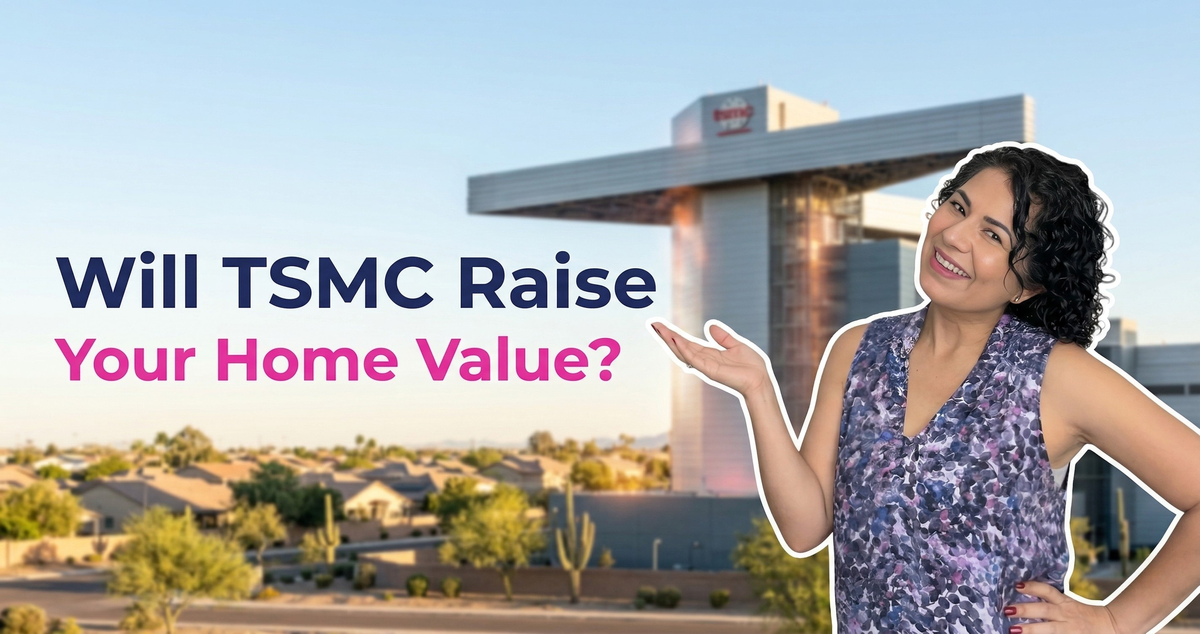
The short answer is yes, but not uniformly and not overnight. The expansion creates genuine market momentum in the West Valley, particularly for properties within a reasonable commute to the campus, but timing, location specificity, and market phase matter significantly.
Understanding the Anxiety Beneath the Question
When you ask about TSMC and home values, you're really asking three things at once: Is my timing right? Will this neighborhood actually benefit? Am I overextending based on speculation? This is usually where I slow clients down, because what looks like a simple economics question is actually a timing and positioning question.
The fear underneath is real. You're watching Phoenix build at an unprecedented pace. You're seeing property values move faster than they did five years ago. You're hearing about major corporate investments, and you're wondering if you should jump in now or if you've already missed the wave. What I find with clients is that this anxiety usually means they're paying attention to the right signals, but they haven't yet separated the signal from the noise.
TSMC's announcement—and subsequent expansions—is real economic signal. But understanding how it affects your specific property requires looking at distance, infrastructure readiness, and absorption rates. This post walks through what's actually happening, where it's happening, and what that means for a homeowner in Peoria or Glendale who's thinking about selling.
The TSMC Investment: From $12 Billion to $165 Billion
What I'm seeing with clients is that most people don't understand the actual scale of what's being announced. In 2021, TSMC committed to a $12 billion investment in Arizona. Most people stopped paying attention there. They didn't track what came next.
In March 2025, TSMC announced an additional $100 billion commitment for three more fabrication facilities, two packaging facilities, and a research and development center in Arizona. That brought the total committed investment to $165 billion. To put this in perspective, that's the largest foreign direct investment in United States history. This isn't a regional story. This is an economic infrastructure story.
In January 2026, TSMC acquired 900 acres of state trust land in north Phoenix for approximately $200 million. That land purchase represents operational commitment. You don't spend that capital unless you're serious about the timeline. AZ Big Media reported that the newly acquired parcel—located near Loop 303 and I-17—positions TSMC to advance the next phase of its north Phoenix expansion, with long-term plans for the surrounding NorthPark area including approximately 15,000 housing units, schools, and commercial development.
Simultaneously, major homebuilders—Shea Homes, Lennar, Toll Brothers—purchased 300 acres in the same corridor in late 2024 for $56 million. Builders don't make that kind of capital commitment without strong conviction about absorption rates and pricing power in the next three to seven years.
Where the Investment Actually Sits and What That Means for Commute
Here's what I need you to understand about geography. TSMC's principal campus sits in north Phoenix, near the Loop 303 and I-17 corridor. If you're thinking about this investment in terms of a commute, north Phoenix is closer to the fab campus than Peoria or Glendale.
But—and this is important—TSMC's sprawl matters. The 900-acre acquisition creates multiple employment nodes. The packaging facilities and R&D center won't all sit at one address. What I watch for here is how job distribution evolves. If packaging jobs cluster in the north valley, that still doesn't directly benefit Peoria or Glendale commute-wise. But if demand spills across the metro, it affects regional affordability and migration patterns.
For Peoria and Glendale specifically, the TSMC effect is indirect rather than direct. You're not seeing a fab facility in your backyard. What you're seeing is regional wage growth, talent migration, and pressure on the overall housing stock. According to the Greater Phoenix Economic Council, TSMC's first three fabs alone are projected to create 6,000 direct jobs and generate more than $33 billion in direct and indirect economic output for Arizona—and for every semiconductor job created, roughly five additional jobs are expected to follow in supporting industries. A talent influx of that scale doesn't evenly distribute. But it does create upward pressure regionally, including in the West Valley.
The Loop 303 expansion becomes relevant here. ADOT's 2026 project schedule includes a $129 million improvement project that will add direct freeway-to-freeway ramps at the I-17/Loop 303 interchange and widen Loop 303 to three lanes in each direction from I-17 west to 51st Avenue—funded by Proposition 479 and scheduled for completion in 2028. Improved north-south connectivity makes a Peoria commute to north Phoenix manufacturing jobs more feasible. That infrastructure timing amplifies the TSMC effect beyond the immediate campus.
If you're evaluating which West Valley community fits your commute and lifestyle profile, my Peoria vs. Phoenix comparison guide walks through how families are making that call right now in this market.
What the Data Shows Right Now in Your Market
Current median values in Peoria sit around $490,000. Glendale is closer to $410,000. Both markets have experienced 8-12% year-over-year appreciation in the last two years, which is stronger than the broader Phoenix metro average.
In my experience, appreciation patterns show up first in areas with land availability near the job centers. That's why north Phoenix properties have appreciated faster than West Valley properties. But—and this is the part that gets missed—when supply in the primary market starts to constrain, money flows to secondary markets with similar or better value. That's where Peoria and Glendale sit right now.
Rental prices in Peoria and Glendale are increasing alongside purchase prices. What that tells me is that investor capital is already responding to the economic signal. Investors are more volatile and faster-moving than owner-occupants. If they're pricing in future demand in the West Valley, owner-occupants usually aren't far behind.
The contract ratio and days-on-market metrics in early 2026 show tighter conditions in the West Valley than we saw in 2024. Fewer properties are sitting. Price reductions are less common. That's market language for "demand is outpacing supply." The TSMC expansion isn't the only factor, but it's a factor.
The Timing Question: Are You Early or Late?
This is where I separate signal from noise. Yes, the TSMC expansion will generate economic activity and talent migration. Yes, that creates upward pricing pressure in the broader Phoenix region, including the West Valley. But you need to understand the timing of that effect relative to your transaction.
If you're selling now (March 2026), you're selling into a market that's already pricing in the TSMC expansion. That expanded pricing is already baked into current valuations. You won't get a separate "bonus" bump. But you're also not late. You're selling into what I'd call early-adoption territory—market participants are aware of the economic catalyst, demand is ahead of supply, and pricing power is with sellers.
If you're planning to hold and sell in three to five years, the TSMC expansion should create steady appreciation pressure, particularly if job distribution extends into the West Valley through packaging facilities or secondary employment nodes. The infrastructure improvements—Loop 303 completion, I-10 corridor enhancements—should materialize in that timeframe.
If you're considering this as a stepping stone purchase—buying now with the intention of moving up in three to five years—the TSMC expansion likely supports that strategy. Appreciation that covers your cost of transaction (realtor fees, title, inspection, closing costs) within that timeframe is realistic in this market. In my experience, that's where the TSMC effect becomes most tangible for individual homeowners. If you're navigating how to time a sale and a purchase simultaneously in this market, my guide on contingent offers and rent-backs in the West Valley lays out the mechanics in detail.
— Aniket, Gilbert, AZ
What Actually Moves Home Values in Your Specific Property
Here's what I need you to focus on: TSMC is a macro factor. It creates regional conditions. But your home's value is determined by micro factors within those conditions. Lot size, school district assignment, proximity to amenities, property condition, and transaction timing drive the specific number on your net sheet far more than the broader economic narrative.
In the West Valley, the amenities profile—shopping, dining, recreation—has improved significantly. Peoria's downtown corridor has evolved. Glendale's proximity to both Sun Devil and Cardinals facilities creates lifestyle value independent of TSMC. Those factors matter.
School districts matter. If your property sits in Peoria Unified vs. another district, that affects buyer pool and pricing. I see that micro-detail drive 5-8% differences in comparable properties. The TSMC expansion won't change school quality, but it will drive buyer demographic shifts. You'll see more families relocating from out-of-state, more dual-income professional households. That changes who's buying in your neighborhood.
Condition and recent updates move value independent of market forces. A property that's been updated in the last three to five years commands a measurable premium. If you're considering selling, that calculation—fix now or sell as-is—becomes more favorable in this market condition because the buyer pool is larger and less willing to discount for deferred maintenance.
Putting It Together: The Application for Your Decision
If you're a Peoria or Glendale homeowner sitting with this question, here's my version of how to think about it.
The TSMC expansion is real. It represents genuine economic growth in Arizona. It will create wage pressure, talent migration, and housing demand growth in the Phoenix region. That's favorable for home values broadly.
For your specific property in Peoria or Glendale, you're in a secondary-but-benefiting position. You're not the hot-spot market (that's north Phoenix and the direct commute corridor). But you're in a market that's experiencing upward pressure from the spillover effect. Appreciation is likely but not guaranteed. It depends on your specific property, your specific neighborhood within those cities, and timing.
If you're selling now, you're selling into a better market than you would have two years ago. Demand is stronger, supply is tighter, and buyer psychology is shifted toward action. If you're buying, you're paying a premium that reflects forward-looking optimism, but that premium is grounded in real economic fundamentals, not speculation.
If you're unsure about timing, my advice is this: Make the decision based on your personal timeline and financial situation first. The TSMC effect will still be in place in one year or three years or five years. Economic shifts at this scale don't reverse quickly. Don't let the fear of missing out override decisions grounded in your specific circumstances.
— Sonya D, Glendale, AZ
Frequently Asked Questions
How much will TSMC directly raise my home value? There's no fixed percentage. TSMC creates economic conditions that support appreciation, but your specific home's value depends on location within Peoria/Glendale, property condition, lot size, school district, and market timing. Expect TSMC to contribute to 2-4% annual appreciation over the next three to five years as part of broader market factors.
When will I see the home value increase from TSMC? The effect is already beginning in 2026. Strong buyer demand and tight inventory in the West Valley reflect forward-looking optimism about economic growth. Measurable acceleration typically shows in 12-36 month intervals. The real impact timeline is 2026-2030 as the fabs come online and employment scales.
Does TSMC benefit Peoria and Glendale equally? No. Properties closer to the north Phoenix campus and Loop 303 corridor see stronger direct effects. But both cities benefit from regional housing demand spillover, wage growth, and talent migration. Glendale may see greater amenity-driven value growth. Peoria may see stronger commute-based appreciation if Loop 303 improvements accelerate.
Should I buy or sell now based on TSMC? Base your timing on your personal circumstances, not the macro narrative. TSMC supports a stronger market now and in the foreseeable future. If you need to move, the conditions are favorable. If you're unsure, waiting two years won't eliminate the TSMC effect—it will still be in place.
What if TSMC delays construction or reduces investment? TSMC's $165 billion commitment represents extraordinary capital already allocated to Arizona. Delays are possible; reductions are unlikely. Even if one fab is delayed, the economic signal and talent migration are already underway. Your risk isn't TSMC not happening—it's the broader market cycle and local economic conditions beyond semiconductors.
What Happens Next
The question you're sitting with—will TSMC raise my home value—has a real answer: yes, within a context. The expansion creates economic momentum. That momentum generates demand. Demand without supply increases prices. You're in a market where supply is constrained and demand is growing. Those are the mechanics that move values.
But mechanics don't tell you whether to buy or sell. Timing does. Condition does. Specific location within your city does. What I encourage you to do is separate the TSMC narrative (real, significant, long-term) from your personal decision (which depends on your timeline, your property, and your goals). Use the macro context as confirmation that the market is moving in a favorable direction. Use the micro details—your home, your neighborhood, your timeline—as the actual foundation for your decision.
If you're ready to explore your specific property's positioning in this market, or if you want to discuss whether now is the right time for your transaction, I'm here to walk through the numbers and the strategy with you.
About the Author
Kasandra Chavez is a real estate advisor serving the West Valley of Greater Phoenix, Arizona, recognized among the top 5% of real estate professionals in the Greater Phoenix area. She partners with buyers and sellers to develop strategies aligned with their lifestyle, financial goals, and timeline—helping them make confident, well-informed decisions. Her approach is grounded in market data, process transparency, and steady advocacy from first conversation through closing.