
Is the Harquahala Valley water transfer enough to guarantee 100-year supply for new Buckeye developments?
Is the Harquahala Valley water transfer enough to guarantee a 100-year supply for new Buckeye developments? Here is what the deal actually covers, what it does not, and how buyers should weigh the risk.
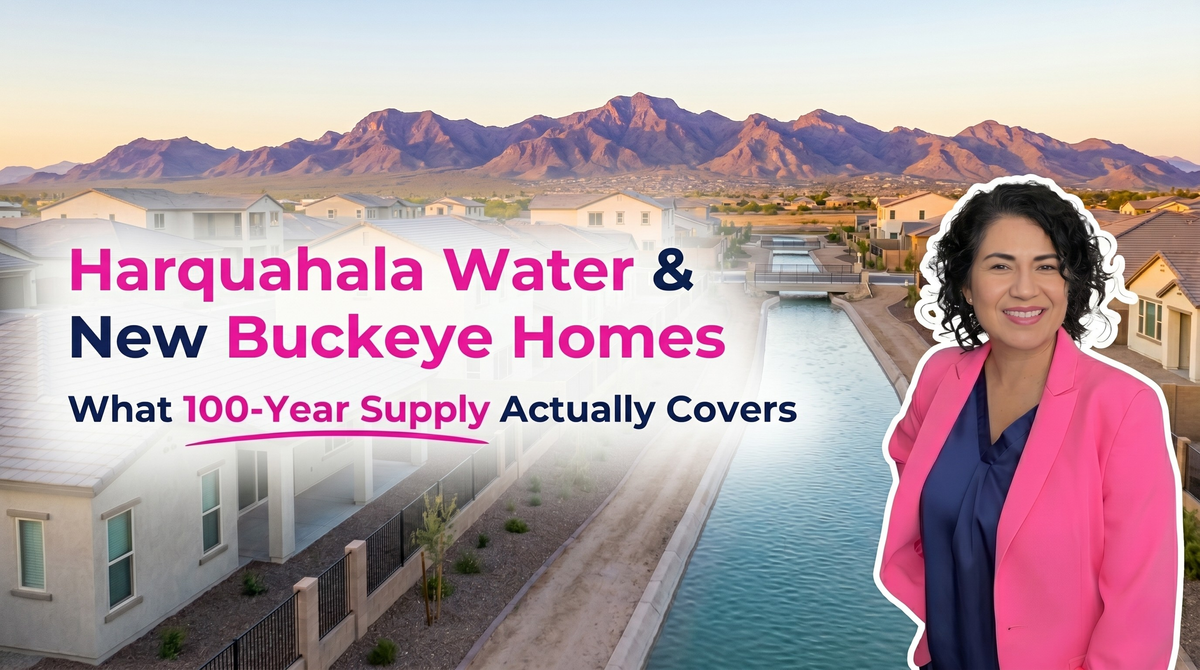
For developments served by the City of Buckeye municipal water system, yes — the Harquahala transfer adds enough water for roughly 17,000 new homes and counts toward the state's 100-year Assured Water Supply requirement. For developments outside Buckeye's service area or relying on private wells, no. The deal is significant, but it is one piece of a larger water portfolio, not a universal guarantee.
Water is the question that shows up in every Buckeye buyer conversation now. Out-of-state buyers read the headlines about Colorado River cuts and groundwater shortages and want to know whether buying in the far West Valley is a long-term mistake. The honest answer is more nuanced than the headlines suggest. The Harquahala Valley water transfer is real, it is approved, and it materially changes Buckeye's water position — but it does not apply uniformly to every parcel of dirt with a "coming soon" sign on it. Knowing which homes it covers and which it does not is the difference between a confident purchase and a risk you did not understand at the time.
What the Harquahala Transfer Actually Approved
In July 2025, the Arizona Department of Water Resources approved the first-ever legal transfer of groundwater from one of Arizona's three statutorily designated transfer basins into a regulated active management area. The transportation order allows the City of Buckeye to withdraw up to 5,926 acre-feet per year from the Harquahala basin in western Arizona for up to 110 years. According to the City of Buckeye's water portfolio documentation, that allocation is enough to serve roughly 17,000 new homes. Queen Creek received a parallel approval for 5,000 acre-feet per year. Governor Hobbs's office described the approval as unlocking a new water source that adds to Arizona's broader supply portfolio.
The reason this approval mattered is procedural as much as physical. Two years earlier, in 2023, the state water director concluded that Buckeye's underlying aquifer modeling could not demonstrate the 100-year supply legally required to permit new subdivisions. That decision effectively froze permitting for new ground-up developments in parts of the city. The Harquahala transfer is the legal mechanism that thaws it — for the homes the city is positioned to serve.
Who the Transfer Covers — and Who It Does Not
This is usually where I slow buyers down. The Harquahala water belongs to the City of Buckeye municipal water system, not to Buckeye the geographic area. If you are buying a home in a master-planned community served by Buckeye's water utility, the transfer counts toward the development's Assured Water Supply certification. If you are buying in an unincorporated area with a private well, or in a development served by a smaller private water company, the transfer does not directly apply to your situation.
The state's Assured Water Supply program requires every new residential development to demonstrate that water will be "physically, legally, and continuously available for the next 100 years." Cities and major private water companies that hold their own portfolios — Colorado River allocations, CAP contracts, recovered groundwater credits, Harquahala water — meet that standard at the utility level. Anyone the utility agrees to serve inside its territory inherits that approval. Outside that territory, the water question gets answered on a parcel-by-parcel basis, and the answer is often less reassuring.
What Buckeye's Full Water Picture Looks Like
The Harquahala deal does not stand alone. Buckeye is also pursuing the Bartlett Dam project for renewable surface water, expanding effluent reuse for outdoor irrigation, treating previously unusable groundwater from the Buckeye Waterlogged Area, and exploring Colorado River leases from smaller communities and tribal partners with unused allocations. According to the city's published water plan, the existing Certificates of Assured Water Supply on the books support roughly 20–25 years of growth at current rates, and the Harquahala addition extends that runway materially.
What I watch for here is whether the development you are considering already has its Certificate of Assured Water Supply issued. That document, available through the developer or the city, is the actual proof that your specific parcel is covered. A "Buckeye home" without a CAWS attached is not the same product as a Buckeye home with one, even if they sit on the same street.
— Gloria B, Buckeye, AZ
The Risk That Buyers Should Weigh
The honest concerns about Buckeye water are not about whether your home will run dry — homes inside the city's service territory with an existing CAWS are about as protected as Arizona's regulatory framework gets. The concerns are about cost, resale, and pace of growth. Water rates in cities that import supply from outside their boundaries tend to rise faster than rates in cities sitting on top of an abundant aquifer with renewable surface allocations. Cave Creek recently considered a "water resource fee" specifically to fund its own Harquahala purchase. Buckeye's published material acknowledges that its portfolio cost structure differs from cities with significant Salt, Verde, or Colorado River rights baked in from decades ago.
There is also the resale question. As more buyers become educated about Arizona water and start asking the same questions you are asking now, homes with documented water security will hold value better than homes where the answer to "is your water secured?" is a shrug. That is a near-term advantage for newer Buckeye master-planned communities with explicit CAWS coverage. It is a longer-term risk for anything sitting outside that umbrella.
For buyers comparing new construction options carefully, the red flags in builder contracts in Goodyear and the West Valley overview is worth reading alongside this one — the water question is one part of a broader new construction due diligence list.
What to Verify Before You Sign
When I work with buyers considering a new build in Buckeye, the water-specific questions I run through with them are short but non-negotiable. Confirm that the development is inside the City of Buckeye municipal water service territory, request the Certificate of Assured Water Supply for the specific parcel or subdivision, and ask the builder for any disclosed information about water rate trajectories or pending special assessments tied to water infrastructure. The state's Department of Water Resources publishes its assured water supply rules and basin modeling reports if you want to dig deeper into the underlying data.
A home that checks all three boxes is materially safer than a home that does not, and the verification cost is essentially zero.
— Eli R, Buckeye, AZ
How This Affects Your Buying Decision
Buying in Buckeye is not the same risk it was in 2023, when permitting was effectively frozen and the long-term water picture looked precarious. The Harquahala approval is a substantive policy change that unlocks tens of thousands of new homes inside the city's service territory and carries the state's assured supply blessing. At this stage, I help clients narrow their focus to developments that explicitly carry that protection rather than developments where the water question is being left vague. The math on Buckeye works for the right buyer, in the right community, with the right paperwork. It does not work universally, and pretending otherwise is how buyers get into homes they later regret.
Frequently Asked Questions
Does the Harquahala water transfer apply to all new Buckeye homes?
Only to homes served by the City of Buckeye municipal water system. Developments served by private water companies or relying on private wells are not directly covered by this allocation.
How much new development does the Harquahala water support?
The Harquahala transfer allocates up to 5,926 acre-feet per year to Buckeye, which the city estimates is enough to serve roughly 17,000 new homes over the 110-year permit term.
What is a Certificate of Assured Water Supply?
A CAWS is the state-issued document confirming that a specific development has demonstrated 100 years of legally and physically available water. Always request this document for any new construction purchase in Buckeye.
Is my Buckeye home at risk of running out of water?
Existing homes with an issued CAWS are protected for 100 years from the date of certification under Arizona law. The Harquahala addition strengthens this protection for the city's portfolio.
Will my water bill go up because of the Harquahala purchase?
Cities that import water generally have different cost structures than cities sitting on abundant local aquifers. Buckeye has acknowledged this in published material, though specific rate impacts depend on future city budgeting decisions.
The Bottom Line
The Harquahala Valley water transfer is a meaningful addition to Buckeye's water portfolio and removes a specific permitting bottleneck that had stalled new construction in parts of the city. For buyers purchasing inside the City of Buckeye municipal service territory in developments with an issued Certificate of Assured Water Supply, the deal effectively closes the 100-year supply question. For buyers outside that territory, the water question remains open and needs to be answered parcel by parcel. Verify the service territory, request the CAWS, and weigh the rate trajectory before you sign. The water security question is real, but it is also answerable.
About the Author
Kasandra Chavez is a real estate advisor serving the West Valley of Greater Phoenix, Arizona, and is recognized among the top 5% of real estate professionals in the Greater Phoenix area. She works with buyers and sellers to build strategy aligned with lifestyle and goals, providing decision-making support through complex transitions. Her process emphasizes due diligence, paperwork verification, and clear market navigation rather than sales pressure.