What Happens If I Sell My Phoenix Home FSBO vs. Using a Flat-Fee Broker in 2026?
FSBO vs flat-fee broker vs full-service agent in Phoenix 2026. Compare net sheets, MLS exposure, liability, and what each path really costs.
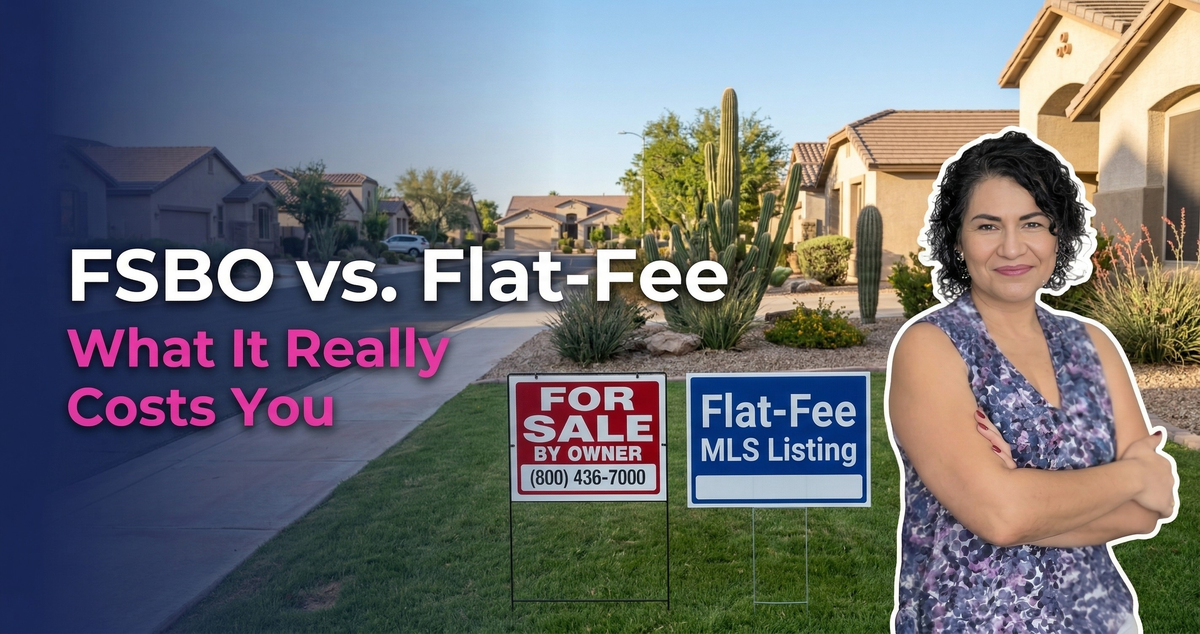
What Really Happens When You Sell Your Phoenix Home FSBO vs. Using a Flat-Fee Broker?
You're sitting with a home to sell and a decision looming: handle it yourself, use a flat-fee broker to save on commission, or work with a full-service agent. The fear is real — you don't want to leave money on the table, but you also don't want to pay 5–6% to an agent for work you think you can do yourself. Let me name the fear directly: you're afraid that paying for professional help will hurt your bottom line more than skipping it will.
The truth is more nuanced. National Association of Realtors data shows FSBO homes sell for approximately 6% less on average than agent-listed homes. Flat-fee brokers cost $3,000–$5,000 to place your home on the MLS, but the rest? You're still managing pricing, marketing, buyer negotiations, contracts, and inspections. In Arizona, that responsibility includes navigating AAR contract complexity, SPDS (Seller Property Disclosure Statement) compliance, title company coordination, and disclosure requirements. A balanced 2026 market requires stronger strategy than most sellers expect.
Let's walk through what each path really means for your net sheet.
FSBO: The Hidden Costs of Going Alone
Selling for sale by owner feels like the obvious money-saver. You eliminate commission and pocket the difference, right? The contract ratio suggests otherwise. Homes sold without agent representation average 6% less in sale price — that's roughly $20,000 less on a $350,000 Phoenix home.
The gaps show up in four places. First, pricing. Professional agents use comparable market analysis (CMA) to position your home competitively. Without data access and market intuition, FSBO sellers often overprice initially, then reduce asking price multiple times. Each price cut signals weakness to the market and attracts fewer serious buyers. Second, marketing. MLS exposure alone isn't marketing; it's distribution. Agents invest in professional photography, staging recommendations, virtual tours, open house coordination, and targeted buyer outreach. FSBO sellers typically post on Zillow and hope. Third, buyer representation. FSBO sellers negotiate directly with buyers or buyer agents, many of whom see unrepresented sellers as vulnerable. Fourth, compliance and contracts. Arizona real estate contracts contain specific contingency timelines, disclosure obligations, and inspection protocols. One missed deadline or miscommunicated term can unwind a deal and cost weeks or months.
The out-of-pocket costs add up quickly. Professional photography ($300–$600), staging consultation ($200–$500), marketing materials ($200–$400), open house hosting (your time, plus refreshments), title search ($200–$400), and document preparation ($300+) easily reach $2,000–$2,300. Add legal review for contract questions, and you're approaching the cost of a flat-fee broker anyway — except you've absorbed the risk.
Flat-Fee Brokers: The MLS Listing Without the Full Support
A flat-fee broker places your home on the MLS for $3,000–$5,000. You get distribution to buyer agents, MLS visibility, and a licensed broker to handle transaction paperwork. What you don't get: marketing strategy, pricing guidance, buyer negotiation support, or someone accountable if things go sideways.
Here's the critical detail: buyer agents still work on commission incentives. When your flat-fee listing appears, the typical buyer agent compensation is built into the MLS remarks (usually 2.5–3%). That incentivizes showing, but it doesn't guarantee aggressive marketing on your behalf. You're responsible for all buyer outreach, open houses, staging, showings coordination, and negotiation posture. Many flat-fee sellers still hire photographers and spend on marketing because they realize the MLS alone isn't enough.
The contract ratio advantage exists here — flat-fee sellers often price strategically and market actively themselves — but the lack of professional negotiation and buyer psychology support means concessions and inspection requests can feel overwhelming. You're managing competing offers, appraisal issues, contingencies, and closing coordination with minimal guidance. Arizona's title company coordination, SPDS disclosures, and AAR contract specifics require attention; one oversight delays closing by weeks.
Flat-fee works best for sellers who are highly motivated, patient, and comfortable with complexity. If you sell in 30 days at full asking price, it's a huge win. If it takes 90 days, sits on market twice, or requires negotiation finesse, you've given away more than you saved.
— Julie S, Goodyear, AZ
Full-Service Agents: The Strategic Partnership Model
A full-service agent charges 5–6% commission, but that fee covers an entire ecosystem: competitive market analysis, professional staging and photography, targeted buyer marketing, open house logistics, buyer agent negotiations, contract management, appraisal coordination, inspection response strategy, title and disclosure oversight, and closing facilitation.
In a balanced 2026 Phoenix market, this support directly impacts net sheet. A skilled agent prices competitively (avoiding price reductions), markets to the right buyer pool (reducing days on market), negotiates appraisal shortfalls and inspection requests (protecting your sale price), and manages the Arizona regulatory and title process (preventing closing delays). These moves often preserve $10,000–$30,000+ on a $350,000 sale compared to FSBO or flat-fee outcomes.
The contract ratio speaks: homes represented by agents sell faster, for higher prices, with fewer contingency issues. According to NAR's most recent Profile of Home Buyers and Sellers, 91% of sellers used a real estate agent — a record high — while FSBO transactions fell to an all-time low of just 5%. Buyer agents actively show represented homes because they trust the listing agent and expect professionalism. Inspections and appraisals encounter fewer surprises because the agent's pricing and disclosure transparency were thorough. Negotiations happen through seasoned professionals who understand market psychology and Arizona law.
Commission feels expensive in a single transaction view. Net sheet view — sale price minus all costs and lost time — favors agent representation in most scenarios.
The Arizona-Specific Variables: AAR Contracts, SPDS, and Title Coordination
Arizona adds layers that amplify the benefit of professional guidance. AAR (Arizona Association of Realtors) contracts contain specific contingency windows, inspection timelines, and communication protocols. Missing a 3-day inspection deadline or mishandling a Seller Property Disclosure Statement (SPDS) addendum can void a contract. Under Arizona disclosure law, sellers are required to disclose all known material facts that could affect a buyer's decision — and failure to do so can expose you to civil liability long after closing. Title companies in Arizona handle many closing processes, but coordination with agents, lenders, and buyers is essential for on-time closings. FSBO and flat-fee sellers often underestimate these technical requirements.
One missed SPDS deadline or misdated inspection contingency can cost $5,000–$15,000 in delayed closings, appraisal renegotiations, or deal collapse. Full-service agents manage these timelines as part of their service model. For a deeper look at the specific contract deadlines that trip up even experienced Arizona sellers, see this breakdown of the most common AAR contract mistakes.
The 2026 Market Reality: Why Strategy Matters More
Phoenix's 2026 market sits in balance. Inventory is moderate, buyer competition exists but isn't frenzied, and pricing discipline is rewarded. In hot seller markets, FSBO homes sometimes sell despite weak positioning. In buyer-leaning markets, an unrepresented seller is vulnerable to low offers and extended contingencies.
Right now, the market rewards strategy: smart pricing, professional marketing, strong buyer negotiation, and flawless compliance. FSBO and flat-fee sellers who execute all of this themselves occasionally win. Most don't.
The lifestyle lens matters too. Selling a home is a temporary role, not your profession. If you're working, managing family, or under time pressure, the hours required for FSBO or flat-fee success compound stress and risk. Full-service agents make space for you to focus on life while they manage the sale. If you're also navigating the timing of buying your next home while selling, understanding how contingent offers and rent-backs work can save you from costly rushed decisions.
— Kathy T, Peoria, AZ
Frequently Asked Questions
How much do I save by selling FSBO vs. paying commission?
You save the 5–6% commission upfront, but FSBO homes sell for ~6% less on average. After accounting for marketing costs and lower sale price, net savings are minimal or negative.
Is a flat-fee broker cheaper than a full-service agent?
Yes, flat-fee brokers charge $3K–$5K for MLS listing only. Full-service agents charge 5–6% commission. However, flat-fee sellers often spend more on marketing and negotiation support to compensate.
What's the biggest risk of selling FSBO in Arizona?
Missing AAR contract deadlines, mishandling SPDS disclosures, or poor pricing strategy. These errors can delay closings or unwind deals, costing far more than agent commission.
Can I use a flat-fee broker and still hire an agent for negotiation?
Some sellers do this, but it creates confusion about representation and conflicts of interest. Most brokers and agents advise against splitting roles.
How much time does FSBO selling actually take?
Plan for 15–25 hours weekly for showings, marketing, buyer calls, negotiation, and paperwork. Many FSBO sellers underestimate this commitment and sacrifice quality as a result.
The Bottom Line: Name the Fear, Then Choose Clarity
The fear of "paying too much" is real, but FSBO and flat-fee selling replace one cost (commission) with three others: lower sale price, hidden out-of-pocket costs, and your time and stress. In a balanced 2026 Phoenix market, professional guidance often preserves net sheet that exceeds the commission paid.
A full-service agent isn't an expense — it's a strategic investment in your home's presentation, positioning, negotiation, and compliance. The contract ratio, market psychology, and Arizona regulatory complexity all favor representation. Your home is likely your largest asset. Treating its sale as a temporary DIY project exposes you to risks that commission-based guidance eliminates.
If FSBO or flat-fee aligns with your skills, time availability, and risk tolerance, move forward intentionally. If you're uncertain, the professional partnership model protects your timeline, price, and peace of mind.
The question isn't "Can I sell my home myself?" It's "Should I risk thousands in equity and months of effort to save what a full-service agent often preserves anyway?" In most Phoenix scenarios, the answer guides toward representation.
About Kasandra Chavez
Kasandra Chavez is a real estate advisor serving the West Valley of Greater Phoenix, Arizona, recognized among the top 5% of real estate professionals in the Greater Phoenix area. She partners with buyers and sellers to develop strategies aligned with their lifestyle, financial goals, and timeline — helping them make confident, well-informed decisions. Her approach is grounded in market data, process transparency, and steady advocacy from first conversation through closing.