What Are the Downsides of Living in Phoenix Before Moving?
Phoenix isn't for everyone. Before you move, understand the real downsides — from brutal summer heat to sprawl, water concerns, and the cost of living surprises that catch most relocators off guard.
What Are the Downsides of Living in Phoenix Before Moving?
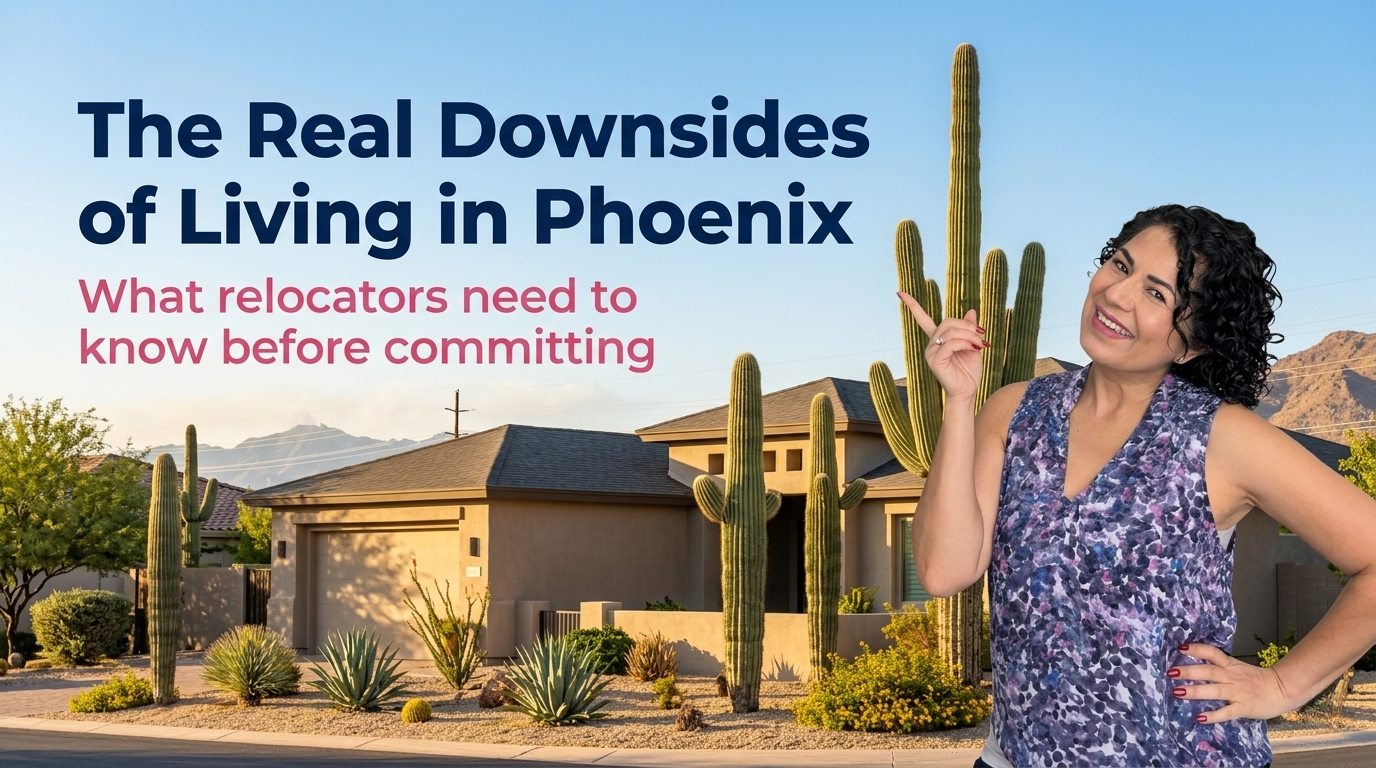
"What are the downsides of living in Phoenix before moving?" Yes, there are real ones — and knowing them now, before you relocate, is how you make a decision you won't regret in three years. The heat is relentless, the metro is sprawling, and the cost of living has surprises that most out-of-state buyers don't anticipate. Let me walk you through them.
When you're moving from out of state, every decision feels higher-stakes because you can't easily course-correct. You commit to a mortgage, you plant roots, you enroll your kids in schools — and then you realize the lifestyle you imagined doesn't match the reality you're living. That's the fear underneath most relocation questions, and it's legitimate.
I work with families relocating to the West Valley and greater Phoenix Metro constantly. According to the NAR Profile of Home Buyers and Sellers, a growing share of buyers are moving across state lines, and Phoenix is one of the top destinations. People come here from California, Colorado, the Midwest, the Northeast. They're drawn by affordability (compared to coastal markets), job opportunity, and the idea of year-round sunshine. But sunshine isn't the whole story, and affordability comes with trade-offs. My job isn't to sell you on Phoenix — it's to make sure you understand what you're signing up for, so that when you do decide to move, you're moving with eyes wide open.
The Summer Heat Is Not a Marketing Problem — It's a Daily Reality
Let's start with the obvious one, because it's the most underestimated. Phoenix summers are extreme. From June through September — that's four months of your year — the average high temperature sits between 103 and 115 degrees Fahrenheit. This isn't dry heat that feels manageable. This is heat that reshapes how you live.
Here's what that means in practice: You don't walk to errands. You don't let your kids play outside after 11 a.m. or before 7 p.m. You don't go for a casual hike or spend an afternoon at a park. Your car steering wheel becomes too hot to touch. Your seatbelt can burn your leg. Hiking trails close. And if you're someone who thrives on outdoor activity — trail running, hiking, gardening, spending time outside without planning logistics around heat windows — your lifestyle lens shifts dramatically. You're trading outdoor freedom for four months of the year.
This is usually where I slow buyers down: I ask them to be specific about what they do in summer where they're moving from. Do they spend weekends hiking? Do they have young kids who need outdoor play space? Are they planning to run or cycle outdoors? If the answer to most of these is yes, Phoenix summers will feel like a loss of lifestyle, not just a temperature change. And that loss compounds over years.
The heat also drives up your electricity costs. Summer power bills regularly exceed $250–$350 per month for a 2,000-square-foot home, and that's with a newer, efficient unit. If you're running air conditioning from June through mid-October, that's five months of peak rates. The Salt River Project's summer energy tips can help you manage costs, but you're still paying a premium just to be comfortable indoors.
Urban Sprawl and Commute Reality — The Car Dependency Trade-Off
Phoenix is one of the most car-dependent metros in the United States. There is no meaningful public transportation. Light rail exists in limited corridors, but it doesn't serve most residential neighborhoods or job centers. You will need a car. Your partner will probably need a car. If you have teenagers, they'll need cars.
The West Valley — Peoria, Goodyear, Surprise, Litchfield Park, Avondale — is booming because housing is cheaper than Phoenix proper. But those savings come with commute costs. If you're working in Tempe, Scottsdale, or central Phoenix, and you live in Surprise, you're looking at 40–50 minute commutes in light traffic. In peak hours, it's often an hour or longer. That commute happens four or five days a week. Over a year, that's 200–250 hours in your car.
Here's what I'm seeing with clients: We start by mapping where they actually work or plan to work, and then we look at neighborhoods that minimize commute time without sacrificing quality of life. Sometimes that means looking at whether Peoria or Phoenix proper is a better fit for your family's commute and lifestyle. Sometimes it means reconsidering whether a West Valley location makes sense, even if the home prices are attractive. The home price difference can evaporate quickly when you factor in gas, vehicle wear, and the psychological toll of daily long commutes.
The sprawl also means less walkability in most newer developments. Master-planned communities — and most of Phoenix's residential growth is master-planned — prioritize car movement, not pedestrian experience. You don't pop out to grab a coffee or run a quick errand on foot. You plan a trip, get in your car, drive to a plaza, park, and do your business. That's not terrible, but it's a fundamentally different lifestyle rhythm than walkable neighborhoods in older urban areas.
— Christopher, Goodyear, AZ
Water: The Long-Term Sustainability Question
Arizona's water situation is real, and if you're planning to stay in Phoenix for a decade or longer, it's worth understanding. Phoenix relies heavily on the Colorado River, and drought conditions have persisted for over two decades. Lake Mead and Lake Powell — the region's primary water storage — have hit historic lows. Water allocations have been cut. The long-term sustainability of rapid population growth in the desert is a conversation happening at the state and federal level, and it directly affects your property value, your lifestyle, and your peace of mind.
Here's what that looks like in practical terms: Water restrictions are common. During drought years, municipalities implement outdoor watering limitations. If you want a green lawn, a pool, or extensive landscaping, you're either investing in xeriscaping (desert-adapted plants) or you're accepting restrictions on what you can maintain. Some HOA communities mandate desert landscaping. Others allow traditional lawns but charge premium water rates. The cost of water itself is rising, and it will likely continue to rise.
In my experience, this is the downside that matters most to families thinking 10–20 years ahead. If you're buying a home as a stepping stone that you'll sell in five years, water sustainability is an abstract concern. If you're considering this your long-term home, or if you're planning to retire here, it's worth thinking seriously about. The Arizona Department of Water Resources maintains current data on allocations and conservation efforts that are worth reviewing before you commit.
This doesn't mean you shouldn't move to Phoenix. It means you should factor water costs into your long-term budget and be honest about your relationship with outdoor space. If you need a lush garden to be happy, Phoenix might require you to rethink that expectation or accept the cost and water restrictions that come with it.
Cost of Living Surprises — It's Not Just Housing
Yes, housing prices in Phoenix are cheaper than coastal metros. That's real. But the total cost of living has surprises that catch most out-of-state relocators.
Summer electricity bills are the first shock. We touched on this earlier, but I'll be specific: Budget $200–$350 per month for June through October for a standard air-conditioned home. That's five months of peak rates. Older homes with less efficient systems can run higher. If you're used to paying $80–$120 a month in a temperate climate, this is a significant budget increase.
Home insurance is higher in Arizona than national averages, and significantly higher than some states. Arizona has elevated rates of property crime in certain areas. Newer homes and homes in established, lower-crime neighborhoods have lower premiums, but you're still looking at a premium relative to equivalent homes in many other states.
Property taxes in Arizona are relatively low compared to California or the Northeast, but they're not as low as some surrounding states. And when you look at the complete picture — how housing costs, property taxes, and utilities compare when moving to Phoenix — the gap between Phoenix and your previous location shrinks.
HOA fees are another variable. Many West Valley communities have HOA fees ranging from $150–$350 per month. Some are higher. These fees cover common area maintenance, landscaping, security, and amenities. Over 30 years, a $250/month HOA fee is $90,000 on top of your mortgage. That's not insignificant. What I watch for here is whether clients actually value those amenities and maintained spaces or whether they'd prefer a non-HOA home without those restrictions and fees.
— Paul, Surprise, AZ
The "Sameness" Problem — Character and Walkability in Newer Communities
Most of Phoenix's growth over the past 20 years has been in master-planned communities. These are new developments — often built from scratch — with modern homes, planned amenities, and consistent architecture. They're safe, well-maintained, and efficient. They're also remarkably similar, and if you're someone drawn to neighborhoods with character, history, and mature trees, Phoenix can feel sterile.
New neighborhoods lack the sense of place that older communities have. There are few 50-year-old trees. Parks are new and small. Streets are wide and car-oriented. Sidewalks exist but aren't naturally trafficked. You don't run into neighbors randomly. You don't walk to a local coffee shop or restaurant. The homes themselves are built to a formula: open concept, modern finishes, cookie-cutter floor plans that differ only slightly from their neighbors.
If you're moving from a place with established neighborhoods — older suburbs, walkable urban areas, tree-lined streets — Phoenix's newer communities can feel like a downgrade in lifestyle, even if the homes are larger and newer. The trade-off is that you're getting more house for less money, but you're trading neighborhood character and walkability for it.
If you genuinely spend time walking your neighborhood, engaging with neighbors naturally, and value a sense of place, then you should look seriously at older Phoenix neighborhoods or consider whether family-friendly neighborhoods in the West Valley with more established character might be a better fit than brand-new master-planned developments.
Frequently Asked Questions
Q: Is the Phoenix heat actually unbearable, or is it just hot?
It's genuinely extreme from June through September, and it fundamentally changes how you live for four months of the year. If you're someone who thrives on outdoor activity, it's worth taking seriously. If you spend most of your time indoors during summer anyway, it's less of a lifestyle shift. The key is being honest about your summer habits where you're moving from.
Q: Do I really need a car if I live in Phoenix?
Yes, in the vast majority of Phoenix and the West Valley, you need a car. There's limited public transit, and most errands, work, and social activities require driving. Plan your housing search around job location and minimize commute time, because that daily drive is a real cost in time and money.
Q: Will water restrictions affect my ability to have a yard?
Water restrictions vary by municipality and year. If you want a green lawn, expect restrictions during drought years and higher water costs year-round. Xeriscaping (desert landscaping) is becoming standard in new developments and is increasingly an HOA requirement. If you need significant outdoor water use, budget for it and expect constraints.
Q: How much more will utilities cost me in Phoenix?
Summer electricity is typically 2–3 times higher than non-peak months, so budget $250–$350 per month June through October. Water costs are moderate but rising. Heating costs are minimal in winter. Overall, expect total utilities to run 20–30% higher than many northern states due to air conditioning demand.
Q: Is buying in Phoenix right now a good investment?
That depends entirely on your timeline, your financial situation, and whether renting or buying makes more sense for your situation right now. If you're planning to stay five-plus years and have stable income, buying likely makes sense. If you're uncertain about your commitment to Phoenix or expect major life changes in the next few years, renting lets you course-correct without the commitment.
Closing
The downsides of living in Phoenix are real, and they matter. The summer heat limits outdoor living. The sprawl forces car dependency. Water sustainability is a long-term concern. The cost surprises — utilities, insurance, HOA — add up. And the sameness of new developments can feel like a lifestyle trade-off if you value character and walkability.
But here's what matters: These downsides don't make Phoenix a bad choice. They make it a choice that works for some people and not others. Your job is to be honest about which category you fall into. If the outdoor activity limitations feel tolerable, the commute trade-off acceptable, the cost surprises manageable, and the newer-neighborhood aesthetic fine, then Phoenix can be a fantastic market with real equity-building potential and lifestyle opportunity.
The people who thrive in Phoenix understood the trade-offs upfront and decided they were acceptable. Take the time now to think through how these realities align with your actual lifestyle — not the lifestyle you think you should want.
About the Author
Kasandra Chavez is a REALTOR® and team lead with Chavez Dream Home Team in the West Valley of Greater Phoenix, Arizona, recognized among the top 5% of real estate professionals in the Greater Phoenix area. She works with both buyers and sellers, including families relocating from out of state, aligning strategy with lifestyle and financial goals to support confident decision-making. Kasandra prioritizes process control and transparency, ensuring clients understand every step from contract to closing.