Can I Afford to Buy a Home in the West Valley With Today's Phoenix Prices and Interest Rates?
With today's Phoenix prices and interest rates, many West Valley buyers wonder if homeownership is still within reach. Here's how to find out where you actually stand — and what to do next.
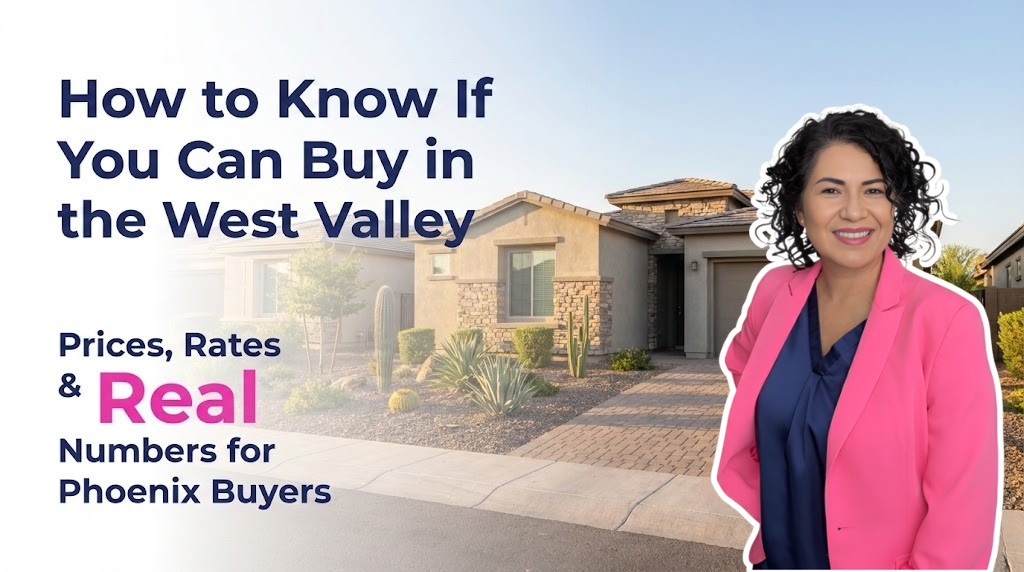
Can I afford to buy a home in the West Valley with today's Phoenix prices and interest rates?
Yes — but the answer depends on your full financial picture, not just the listing price. In the West Valley, there are still price points and loan options that work for real buyers, and the first step is understanding exactly where you stand before you start searching. What I help buyers do is separate the noise from the numbers so they can move forward with clarity instead of anxiety.
If you've been watching Phoenix area prices and wondering whether the window has already closed for you — you're not alone. This is one of the first questions I hear from buyers in Peoria, Surprise, Goodyear, and Avondale right now. The market feels intimidating from a distance. Up close, it's actually more navigable than the headlines suggest — but only if you're working with accurate, current numbers and a realistic picture of what your purchasing power actually looks like.
This is where I slow buyers down. Not to discourage them, but to make sure the decision they're about to make is grounded in facts, not fear or hope.
What "Affordability" Actually Means in Today's West Valley Market
When buyers ask if they can afford a home, they're usually thinking about the monthly payment. That instinct is right — but the number has to account for more than principal and interest. In Arizona, your total housing cost includes property taxes, homeowner's insurance, and — in most West Valley communities — HOA dues.
In neighborhoods across Peoria, Surprise, and Goodyear, HOAs are common. Before I run any numbers with a buyer, I make sure we're factoring in current HOA dues and any history of rate increases. Some communities also have upcoming exterior paint cycles or pending special assessments that can affect your budget. A home that looks affordable on a listing sheet may look different once all the monthly costs are stacked.
What I watch for here is the gap between what a lender approves you for and what actually fits your lifestyle. Those two numbers are often not the same.
Understanding Your Real Purchasing Power Right Now
Your purchasing power today is shaped by three things: your credit profile, your down payment, and the current interest rate environment.
Here's what matters more than watching national rate headlines: what rate can you qualify for, given your specific financial profile? A buyer with strong credit and a solid down payment is going to experience this market very differently than a buyer who's working with a minimum down payment and a mid-range credit score. Both scenarios are workable — they just require different strategies.
I always encourage buyers to get pre-approved before we talk about homes. Not pre-qualified — pre-approved, with documentation reviewed by a lender. That step transforms a general sense of "I think I can afford around X" into a real number you can make decisions from. Mortgage pre-approval carries significantly more weight with sellers than a pre-qualification — and in a market where sellers are evaluating multiple offers, that distinction matters. It also tells sellers you're serious, which matters when competition shows up.
Earnest money in the Phoenix Metro typically runs 0.5% to 1% of the purchase price, depending on market conditions. Knowing that ahead of time means there are no surprises when it's time to make an offer.
— Gloria B, Buckeye, AZ
What West Valley Prices Actually Look Like Right Now
The West Valley remains one of the more accessible submarkets in the greater Phoenix area. Year-end 2025 data shows median prices in Surprise at $430,000 and Avondale at $418,000, with Goodyear reporting strong sales activity — all meaningfully below the broader metro median. New construction remains active in several communities, and cities like Buckeye continue to offer some of the most square footage per dollar in the entire Valley.
What this means practically: depending on your pre-approval range, you may have more options than you think — but the inventory picture varies significantly by zip code and price point. I pull that data for every buyer before we start touring homes, because knowing whether you're shopping in a market with 30 days of inventory or 90 days changes your strategy entirely.
This is also where seller concessions come into play. In the Phoenix market right now, more than half of transactions between $200,000 and $600,000 include seller concessions — including closing cost contributions and rate buydowns. That can make a meaningful difference in how far your cash goes at the table. It's data I track and factor into every buyer's net sheet from the start.
Loan Programs That Can Expand What's Possible
This is often where the real answer to the affordability question lives. The right loan program — matched to your situation — can shift your monthly payment, reduce the cash you need at closing, or both.
In Arizona, buyers using VA or FHA financing have access to programs designed to reduce the upfront burden of homeownership. VA purchase loans can offer eligible buyers no down payment and no private mortgage insurance requirement — two of the largest financial barriers for first-time buyers in any market. The West Valley has communities that work well for these loan types. One thing to be aware of: VA and FHA loans do require the buyer to occupy the home within 60 days of closing, which affects how post-possession agreements are structured with sellers.
At this stage, I help clients work closely with a lender who knows the West Valley market — not just the national guidelines, but how specific loan types land in specific neighborhoods. There are meaningful differences, and the right match can open doors that a buyer searching on their own might not find.
The AAR Contract and What You Need to Know Before You Offer
Once you know your purchasing power and your target neighborhoods, the next thing that matters is understanding how the process actually works in Arizona. Here, closings are handled by a title company — not an attorney. The Arizona Association of Realtors (AAR) residential purchase contract is the standard form, and it contains five contingencies — each with its own timeline that both buyer and seller must respond to.
The inspection period in Arizona is typically 10 days. That's your window to bring in inspectors, review findings, and negotiate any repairs or credits. I manage these timelines carefully so my clients are never accidentally in breach of contract. Understanding the structure of the AAR contract before you're under contract removes a significant source of stress from the process.
— Donna R, Peoria, AZ
The Real Question Is: Are You Ready to Find Out?
Affordability in today's West Valley market is not a yes or no answer you can get from a headline. It's a number you arrive at through a pre-approval, a realistic look at total monthly costs, and an honest conversation about what loan programs fit your situation. NAR research shows that first-time buyers continue to face real affordability headwinds nationally — which is exactly why a local, market-specific approach matters more than ever. What I've found is that most buyers who are worried they can't afford a home haven't actually run the real numbers yet — they've run the fear-based estimate.
The structure is there. The data is available. What most buyers need is someone to walk them through it without pressure, so the decision they make is grounded in what's actually true for their finances — not what feels scary from a distance.
Frequently Asked Questions
Can I still afford to buy a home in Peoria or Surprise with today's interest rates? It depends on your credit profile, income, and down payment — but the West Valley still offers price points that work for a range of buyers. The best way to find out is to get pre-approved with a local lender who understands the Phoenix Metro market.
What is the typical earnest money deposit in the Phoenix West Valley? In the Phoenix Metro, earnest money typically runs 0.5% to 1% of the purchase price. The amount can vary based on market conditions and the strength of your offer.
How long does it take to close on a home in Arizona? Typical timeline from contract to close is 30 days.
Do sellers in the West Valley contribute to closing costs? In some West Valley markets and price points, sellers are currently contributing to buyer closing costs as part of negotiations. This varies by area and is something I review with every buyer based on current zip-code-level data.
What is the inspection period in Arizona? The standard inspection period under the Arizona Association of Realtors (AAR) contract is 10 days. During this window, buyers have the right to conduct inspections and negotiate based on findings.
Moving Forward Without the Overwhelm
The affordability question has a real answer — it's just not the same answer for everyone. What I've watched happen too many times is buyers who could have moved forward staying on the sidelines because the question felt too big to answer. The process of answering it is actually much simpler than the anxiety around it.
Start with your pre-approval. Add in the real carrying costs — taxes, insurance, HOA. Look at loan programs that match your situation. Then look at what the inventory actually shows in the zip codes that fit your life. That sequence turns a vague fear into a clear decision. And a clear decision — even if the timing isn't right yet — is always better than a guess.
About the Author
Kasandra Chavez is a real estate advisor serving the West Valley of Greater Phoenix, Arizona, recognized among the top 5% of real estate professionals in the Greater Phoenix area. She helps West Valley buyers and sellers align their real estate decisions with their lifestyle, family needs, and long-term financial goals — with clear strategy at every step. Her approach centers on process control and local market knowledge so clients move forward with confidence, not confusion.