Will the Buc-ee's Opening in Goodyear Actually Increase Nearby Home Values?
Arizona's first Buc-ee's opens in Goodyear on June 22, 2026. Here's what buyers and sellers actually need to know about whether it moves the needle on nearby home values.
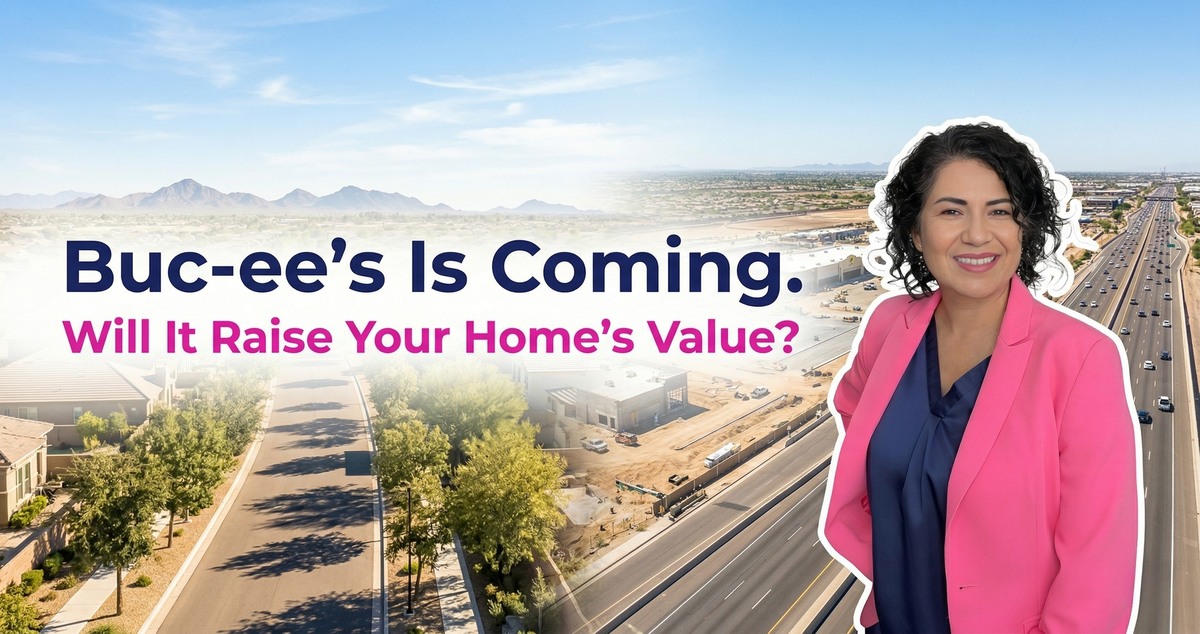
Will the Buc-ee's opening in Goodyear actually increase nearby home values?
The short answer: not automatically, not for every home, and not in the ways most people assume. The Buc-ee's at Bullard and I-10 is a genuine economic signal for the Goodyear market — but whether it benefits your specific home depends on where you are, what's already priced in, and how broader West Valley dynamics play out over the next two to three years.
What the Buc-ee's Goodyear Development Actually Is
Arizona's first Buc-ee's is scheduled to open June 22, 2026, on a 22-acre site at the southeast corner of Bullard Avenue and I-10 in Goodyear. The facility spans over 74,000 square feet, includes 120 fueling stations for passenger vehicles, and is expected to bring more than 200 full-time jobs to the city. The Goodyear City Council approved rezoning back in January 2024, and the city's own mayor has said that roughly 80% of Buc-ee's business comes from outside the city — meaning it functions as a destination that draws traffic through Goodyear rather than serving primarily local residents.
That last detail matters for how you evaluate its real estate impact. Buc-ee's isn't a neighborhood grocery store or a walkable amenity. It's a regional travel destination anchored to the freeway corridor. That changes the analysis.
Why Commercial Developments Don't Automatically Lift Home Prices
This is usually where I slow buyers and sellers down, because the assumption is often that any major development is automatically good for home values nearby. The research on commercial-to-residential price effects is more nuanced than that.
Studies on large commercial developments consistently find what researchers call a "rough quadratic" relationship: home values tend to be higher within a meaningful radius of a major retail center, but the effect drops off with both distance and proximity. Homes very close to the site — within a few hundred feet — can actually see downward pressure from traffic noise, increased congestion, and changes to neighborhood character. Homes in a wider band, roughly a half mile to two miles out, often see the more measurable positive spillover.
For Goodyear specifically, the I-10 and Bullard corridor is already a commercial zone. The homes most exposed to the Buc-ee's footprint are not the quiet residential subdivisions several miles east or west. The development's impact on those established neighborhoods is likely to be indirect — driven more by the secondary investment activity and economic signals it sends than by any direct proximity effect.
— Ankita C, Gilbert, AZ
What the Data Actually Says About Goodyear Right Now
Before attributing future appreciation to Buc-ee's, it's worth looking at where the Goodyear market stands today. As of early 2026, the median home sale price in Goodyear is around $475,000, down roughly 3% compared to the prior year — a pattern consistent with the broader West Valley adjustment happening across Phoenix metro. Homes are sitting on the market longer than they were in 2023 and 2024, and inventory has expanded.
This context matters because it's easy to credit an upcoming development with value movement that was already in motion — or to expect appreciation that the broader market isn't positioned to deliver right now. The West Valley continues to attract buyers through affordability and new community development, and Goodyear remains a legitimate long-term growth market. But the Buc-ee's alone isn't a price catalyst. It's one signal among many.
What I watch for here is the secondary development activity. When a destination anchor like Buc-ee's commits to a location, it tends to invite additional commercial investment nearby — restaurants, hotels, services. That follow-on buildout is often what generates the broader neighborhood-level economic lift. It doesn't happen overnight, and it doesn't happen uniformly.
How Distance from the Site Actually Affects Your Home
If you're a seller asking whether to mention Buc-ee's in your listing strategy — or a buyer wondering whether to pay a premium for being "close to it" — distance and street access are the right questions to work through first.
Homes that sit along or near Bullard Avenue, especially south of I-10, are going to feel the traffic impact as the location opens and draws visitors. For some buyers, that's neutral or a non-factor. For others, particularly those prioritizing quiet residential streets, it's a deterrent. Pricing those homes correctly means accounting for both the destination appeal and the congestion reality.
Homes in established subdivisions in southern and central Goodyear — several miles from I-10 — are unlikely to see measurable price movement tied directly to this one development. What they may benefit from over time is the general economic strengthening that comes when a city attracts major employers and high-profile commercial investment. Goodyear has been intentional about positioning itself as a business-friendly city — recent wins include a 530,000-square-foot manufacturing facility from GTI Energy bringing 600 jobs to the city — and Buc-ee's is part of that story.
What Buyers and Sellers in Goodyear Should Actually Do With This Information
For sellers: Buc-ee's is a legitimate talking point in conversations about Goodyear's economic trajectory, but it shouldn't anchor your pricing strategy. Buyers in today's market are working through detailed numbers — what they can afford monthly, how much inventory they have to choose from, and what comparable homes have actually sold for recently. A destination travel center opening a few miles away is not a line item in their offer calculation.
For buyers: If you're drawn to Goodyear specifically because of growth signals like this development, that instinct isn't wrong — but do the full analysis. Look at what's already selling in the zip codes you're targeting, what direction inventory is trending, and whether your timeline gives the market room to catch up to the optimism. West Valley markets including Goodyear entered 2026 with more supply relative to demand than the East Valley, which means buyers currently have more negotiating room and longer search timelines to work with. Goodyear is a long-term growth story. Whether it's the right move for your specific situation depends on factors well beyond one high-profile opening.
— Michael R, Avondale, AZ
FAQ: Buc-ee's and Goodyear Home Values
Does living near the Buc-ee's in Goodyear make my home worth more?
Proximity to a large commercial destination is a mixed factor in residential pricing. Homes closest to the I-10 and Bullard site may see increased traffic; homes in a wider radius may benefit from the secondary economic development activity over time. There is no automatic premium tied to the address alone.
How far does a commercial development like this actually affect home prices?
Research on large retail centers suggests positive spillover effects can extend roughly a half mile to two miles from the site's boundary, while homes immediately adjacent may actually experience some downward pressure from noise and congestion. The effect also dissipates over time as the development becomes part of the established landscape.
Should I wait to sell my Goodyear home until after Buc-ee's opens?
Timing a sale around a commercial opening rarely produces the result sellers expect. Your pricing position, the condition of your home, and current buyer demand in your specific zip code will have far more influence on your outcome than any single nearby development. The better question is whether the overall market conditions align with your goals right now.
Will Buc-ee's bring more buyers to Goodyear?
It may contribute to broader awareness of Goodyear as a destination and growth city, which can support buyer interest over the long term. But buyers relocating to the West Valley are primarily driven by home prices, commute patterns, school districts, and quality of life — not proximity to a travel center.
Is Goodyear a good place to buy in 2026?
Goodyear continues to attract families and relocators for its relative affordability, new community development, and infrastructure investment. The Buc-ee's is one signal among several that the city is actively building its economic base. Arizona's overall job creation reached a record 24,285 new positions in fiscal year 2025, with Goodyear specifically named among the cities seeing major business expansions — a broader tailwind that matters more for long-term home values than any single retail opening. Whether it's the right fit for your specific situation depends on your timeline, budget, and priorities. [VERIFY - Arizona Accuracy: Goodyear-specific school district details and current HOA landscape for specific subdivisions should be confirmed against current MLS data before advising clients.]
The Bottom Line on Buc-ee's and Goodyear Real Estate
Economic development signals matter — and Goodyear has been collecting them consistently. But the honest answer to whether Buc-ee's will increase your home's value is: it depends on where you are, what's already in the market, and how the broader West Valley story continues to unfold over the next few years.
What I help clients do is separate the headlines from the actual numbers. A major opening generates buzz. What moves prices is sustained demand, employer growth, and the secondary investment activity that follows. Those take time, and they don't land the same way in every subdivision or every price point.
If you're trying to make a buying or selling decision in Goodyear right now, the right starting point is the current data — what's selling, what's sitting, and what comparable homes in your specific area look like. If you're also navigating the logistics of selling and buying at the same time, understanding how contingent offers work in Goodyear is a smart next step. That's the conversation worth having.
About Kasandra Chavez
Kasandra Chavez is a real estate advisor serving the West Valley of Greater Phoenix, Arizona, recognized among the top 5% of real estate professionals in the Greater Phoenix area. She works with buyers and sellers to build strategy aligned with their lifestyle, goals, and financial clarity — supporting informed decisions at every stage of the process. Her approach centers on managing timelines, pricing with precision, and protecting clients from the kind of confusion that derails transactions.
More Helpful Real Estate Videos from Kasandra
Stay confident in your real estate journey with Kasandra’s latest Arizona tips and insights.