
60-Day Home Buying Timeline in Surprise or Goodyear, AZ: What's Realistic and What Delays Closing
If you’re relocating for work and only have 60 days, a 30–45 day close is possible in Surprise or Goodyear—but only when the contract, lender timeline, and contingency deadlines stay tight.
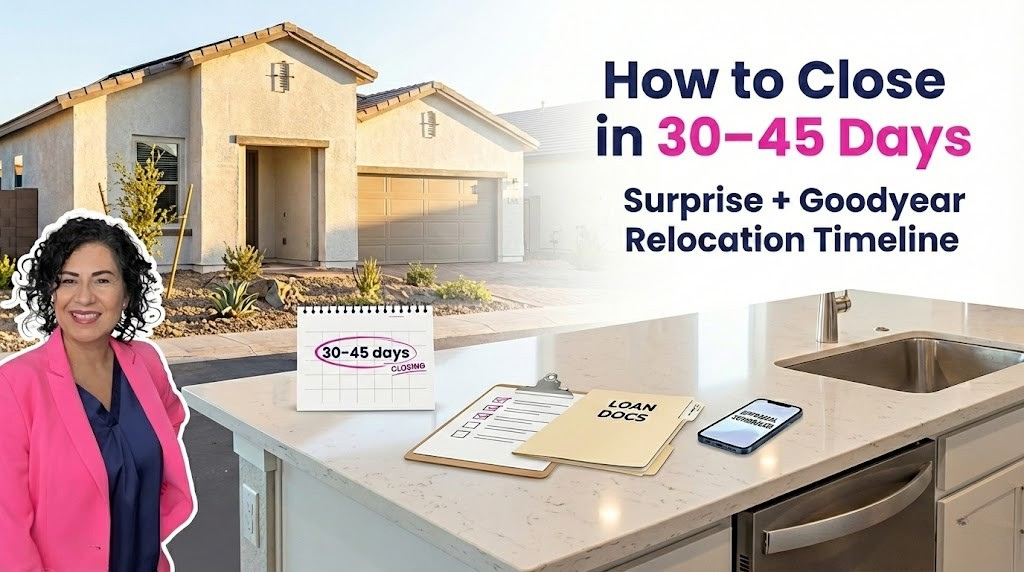
Realistic Closing Timeline for Buying in Surprise or Goodyear When You Only Have 60 Days
I'm moving to Arizona for a job and only have 60 days—what's a realistic closing timeline to buy in Surprise or Goodyear, and what could delay closing once I'm under contract?
A realistic closing timeline in Surprise or Goodyear is typically 30–45 days once you're under contract, with some loans needing closer to 45–60 days depending on underwriting, appraisal timing, and how quickly documents are returned. Most closing delays come from a short list: lender documentation gaps, appraisal issues, title/HOA surprises, and insurance or wire-transfer timing—and all of those can be managed when the process is sequenced correctly.
Why "60 days" feels short (and where buyers lose time first)
When you're relocating for a job, your brain naturally treats the move date as immovable—and everything else feels like it should snap into place around it. This is usually where I slow buyers down, because the fastest closings aren't the ones where you rush—they're the ones where you remove uncertainty early.
In Surprise and Goodyear, you can absolutely find homes that align with a 60-day window. The question is whether your financing and contingency plan match the timeline you're expecting. A 30-day close can happen, but not if you're still "figuring out" lender conditions, insurance requirements, HOA docs, or how you'll sign and wire from out of state.
What a realistic timeline looks like once you're under contract in Surprise or Goodyear
Most purchase contracts in Arizona are structured around a clear sequence: earnest money deposit, inspections, appraisal, lender conditions, title and HOA review, and a final walkthrough. When each step moves on schedule, closing stays on track. When one piece slows down, the entire timeline shifts.
Here’s the practical expectation I set with buyers relocating into the West Valley:
Most common timeline (around 30 days):
A 30-day close is the norm in Arizona. This typically works when the borrower file is solid, the lender is responsive, the appraisal comes in without issue, inspection negotiations are straightforward, and there are no title or HOA delays. When everything is aligned, this timeline is both realistic and efficient.
Extended timeline (about 35–45 days):
A slightly longer timeline may be needed if underwriting moves at a more conservative pace, appraisal scheduling takes longer than expected, or there’s a reasonable repair request or credit negotiation after inspections. These situations aren’t red flags—but they do require coordination and patience from both sides.
Longer or situational timeline (about 45–60 days):
Timelines tend to stretch further with condos or townhomes that require extensive HOA documentation, appraisal complications, tighter loan guidelines, or prolonged back-and-forth on repairs or seller responses. Whether this works often depends on the seller’s next move and their flexibility.
What I watch closely is whether the contract deadlines actually match the lender’s real workflow. If a lender says, “We can close in 30 days,” I still verify what that means for appraisal ordering, underwriting turn times, and how quickly conditions can be cleared—because that’s where timelines quietly break if no one is paying attention.
The "under contract" week-by-week milestones that keep you on track
Relocation buyers do best when the timeline is treated like a project plan. Not a checklist—an actual sequence where each step protects the next one.
Week 1: Deposit, inspections scheduled, lender file fully opened
This is where time gets lost if you're not careful. I help clients prioritize three things immediately:
Make sure your lender has everything needed to submit to underwriting (not "most things," everything).
Schedule inspections quickly, especially if you're flying in.
Confirm how you'll handle negotiations and signatures if you're back out of state.
Week 2: Inspection results, negotiation strategy, appraisal ordered
Inspection is where emotions spike—especially when you're far away and paying for travel. At this stage, I help clients narrow their focus to: safety, major systems, and big-ticket unknowns. Cosmetic findings can be annoying, but they're rarely the reason a timeline collapses.
Appraisal should be ordered and moving. If it isn't, that's an early red flag.
Week 3–4: Underwriting conditions cleared, title/HOA review, insurance finalized
This is the "paperwork tunnel." You may not feel like anything is happening, but this is actually where closing is won or lost. Lenders request conditions, title delivers documents, HOA disclosures arrive (if applicable), and insurance gets bound.
This is where stress tends to show up if expectations aren't clear—because buyers assume, "We already agreed on the house, so we're basically done." In reality, this is where the file either becomes "clear to close" or gets stuck.
Week 4–6: Final approval, closing disclosure, utilities, walkthrough, funding
A clean ending depends on timing:
The lender must issue the closing disclosure with enough time for review.
Utilities need to be scheduled and transferred.
If you're wiring funds, the wire plan has to be coordinated early (especially from out of state).
This is usually where I'm most protective, because last-minute "small" items—like insurance binders, identity verification, or wire instructions—are what cause preventable closing delays.
What can delay closing once you're under contract (and how I plan around it)
Most delays fall into predictable categories. The mistake is treating them as random. They aren't.
1) Lender documentation gaps and slow condition clearing
Delays often come from missing documents, self-employed income complexity, job transfers, bank deposits that need sourcing, or last-minute credit changes. Even highly qualified buyers get slowed down if they're traveling and not responding quickly.
What I do here is set up a rhythm: when lender requests come in, you don't "get to them later." You clear them in a tight window so underwriting stays moving.
2) Appraisal scheduling or value complications
Appraisal delays can happen when schedules are tight or if the property type requires a specialized appraiser. Value issues can also trigger renegotiation, a change in loan structure, or a dispute process—all of which can add time.
The key is speed: the faster we know what the appraisal says, the faster we can decide whether to renegotiate, adjust terms, or move forward confidently.
— Christopher, Goodyear, AZ
3) Title issues, HOA documents, and disclosure timing
Title problems can be as simple as a payoff delay or as complex as an old lien that needs resolution. HOA docs can cause timeline pressure if they arrive late or contain unexpected requirements.
This is where I push for early document ordering and early review. You don't want to discover an HOA restriction, special assessment, or missing disclosure when you're two days from closing.
4) Repair negotiations that drag out
Inspections don't delay closings—negotiations do. The longer it takes to ask, respond, counter, and agree, the more likely your lender's schedule gets squeezed.
At this stage, I help clients keep the negotiation tight: identify what truly matters, make a clear request, and set realistic boundaries so the timeline doesn't drift.
5) Insurance, utilities, and wire transfer logistics (especially out of state)
These are "simple" until they aren't. Insurance can get slowed down by roof age, claims history, or needing additional underwriting. Utility transfers can take lead time. Wire transfers can be delayed by bank security holds, different time zones, or identity verification.
This is usually where I step in and carry the weight of the decision: we set the wire plan, confirm the title company's secure process, and keep utilities and insurance aligned with the closing date so there are no last-second surprises.
How I help you choose Surprise vs Goodyear when the clock is ticking
Surprise and Goodyear both have strong housing options, but the "right" choice under a short timeline depends on what you're optimizing for: commute patterns, neighborhood feel, home style, and inventory.
What I watch for is decision fatigue. Relocating buyers often try to solve everything at once: the perfect area, the perfect house, the perfect timing. In practice, we sequence it:
Confirm commute and daily-life anchors.
Narrow the neighborhoods that actually support that.
Match inventory to a timeline that won't force desperate decisions.
This keeps you from buying a home you like on paper but regret once real life starts.
— Eli R, Buckeye, AZ
FAQ: Closing timelines and delays for Surprise and Goodyear home buyers
How fast can I realistically close on a home in Surprise, AZ?
Most buyers close in about 30–45 days once under contract, depending on the loan type, appraisal timing, and how quickly lender conditions are cleared.
Can I close on a Goodyear home without traveling back to Arizona?
Often, yes. Many closings can be handled with remote signing or a mobile notary, but it depends on the title company and lender requirements for identity verification and funding.
What's the most common reason closings get delayed after inspection?
Repair negotiations that stretch out, slow seller responses, and waiting too long to finalize agreements are common causes—especially if lender and appraisal timelines are already tight.
Does an appraisal issue automatically mean I lose the house?
Not automatically. It can trigger renegotiation, a change in loan structure, or a decision to move on, but the outcome depends on the contract terms and how both sides respond.
When should I set up homeowners insurance and utilities during escrow?
Insurance should be finalized well before closing so the lender can review the binder, and utilities should be scheduled early enough to avoid service gaps—especially if you're moving in right after closing.
Closing: The timeline is realistic when the process is controlled
If you only have 60 days, the goal isn't to force a perfect scenario—it's to run a clean sequence that prevents avoidable delays. The moment you go under contract, the timeline becomes less about the calendar and more about how quickly the lender, appraisal, title/HOA documents, and negotiations move.
This is why I focus on structure over stress: when you know what has to happen first, what can happen in parallel, and what can't be late, you stop guessing—and you start making decisions that hold up.
About the Author
Kasandra Chavez is a real estate advisor serving the West Valley of Greater Phoenix, Arizona, recognized among the top 5% of real estate professionals in the Greater Phoenix area. She helps West Valley buyers and sellers move forward with strategy aligned to lifestyle and family needs, with clear decision support from search through closing.