Is the 303 Expansion Making Verrado Too Crowded or More Valuable?
Is the Loop 303 expansion making Verrado too crowded or actually more valuable? Analyze traffic, growth data, and what it means for homeowners.
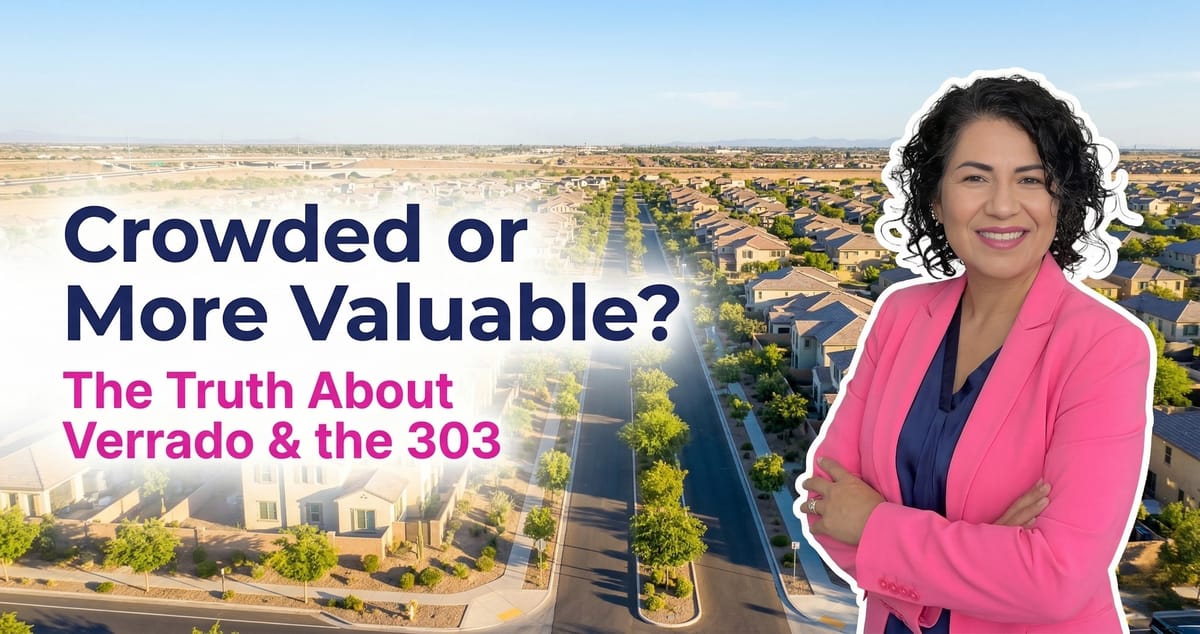
Is the Loop 303 Expansion Making Verrado Too Crowded or Actually More Valuable?
You bought in Verrado for the peace, the master-planned feel, the promise of controlled growth and lifestyle convenience. Now the 303 is expanding. The Loop 303/I-10 interchange is complete. New retail is coming. Schools are full. Nearby Prasada is under development. The fear is direct: is Verrado becoming too crowded, losing the appeal you paid for? Or is all this infrastructure and growth actually increasing your home's value and lifestyle accessibility?
Let me name the fear plainly. You're worried that growth will strip away what made Verrado attractive — the cohesion, the space, the feeling of being in a desirable but uncrowded place. Meanwhile, you also wonder if you should be celebrating because more traffic and more people sometimes means more property appreciation.
The answer isn't either/or. It's both. The 303 expansion and Buckeye's fastest-growing-city status are reshaping Verrado simultaneously: adding value through infrastructure and amenities while introducing density pressures and traffic reality. Understanding the lifestyle lens — not just the price lens — helps you navigate what's happening and what it means for your decision to stay, sell, or invest further.
Verrado's Foundation: Master-Planned Community in Buckeye's Path of Growth
Verrado is an 8,800-acre master-planned community in Buckeye, Arizona, developed by DMB Associates. When Verrado launched in the early 2000s, it was a statement: a high-quality residential destination with architectural standards, amenity infrastructure, and lifestyle vision. Homes range from $300K–$700K+, and HOA (Homeowners Association) fees typically run $200–$350/month, supporting community amenities like parks, pools, trails, and event programming.
The master-planned model is designed to control density and maintain property values through deed restrictions and community governance. Verrado's location in Buckeye — 40+ miles west of Phoenix downtown — was intentional: far enough to feel removed, close enough for work commutes and shopping via I-10. That geographic sweet spot is now under pressure. Buckeye is one of Arizona's fastest-growing cities, with population growth that has pushed its population past 119,000 residents as of 2025. That growth wasn't speculative; it was driven by employment centers in west Phoenix, new schools, infrastructure investment, and developers betting that Interstate 10 commutes would remain tolerable.
The 303 Expansion: Shorter Commutes, More Traffic, New Competition
ADOT completed all four ramps of the Loop 303/I-10 interchange in Goodyear, linking west Phoenix residential developments to job centers, shopping, and Phoenix proper. For Verrado residents, this means:
Commute Improvement: Drives to employment in northwest Phoenix (Glendale, Peoria, Litchfield Park) and central Phoenix (Downtown, Airport) are now 15–25 minutes shorter. For families with dual commutes, this is material lifestyle improvement and property appeal.
Retail & Amenity Access: The 303 corridor is attracting new retail, dining, and services. A $275 million Verrado Marketplace — a 500,000-square-foot shopping center anchored by Target, Harkins, Safeway, and dozens of national brands — is opening spring 2026 at the I-10/Verrado Way interchange. For Verrado residents, this means shopping, dining, and services are no longer exclusively in distant Surprise or Phoenix; they're accessible in 10–15 minutes. Lifestyle convenience increased.
Competition from Nearby Development: Prasada and other new residential projects in Buckeye's growth zones now compete for buyers in similar price and lifestyle segments. Verrado's value proposition shifts from "only master-planned option nearby" to "premium master-planned option among several." This can pressure home appreciation in Verrado because newer builds and comparable homes are available at similar or lower price points nearby.
Traffic Density: Expanded freeway capacity doesn't eliminate traffic; it often encourages it. Buckeye and west Phoenix are now easier to commute through and to, meaning more vehicles use the 303 corridor daily. Verrado residents experience more traffic noise near I-10, more congestion on local roads during rush hours, and a busier feeling overall compared to 5–10 years ago.
— Eli R, Buckeye, AZ
The Density Question: Schools, HOA, and Lifestyle Pressure
Verrado's HOA and community design assume controlled density. New homes are built to strict architectural standards; open space is preserved; community amenities are scaled to population. However, Buckeye's overall growth pressures Verrado's lifestyle experience in four ways.
School Enrollment: Buckeye schools are experiencing rapid enrollment growth. Verrado residents' children often attend schools within the Litchfield Elementary, Agua Fria Union High, and Saddle Mountain Unified school districts. Class sizes are growing, and overcrowding concerns are legitimate. Parents originally attracted to Verrado partly for school quality now report larger classes and fewer enrichment opportunities. This is a lifestyle cost that doesn't directly show up in home price but affects actual day-to-day experience.
HOA Density: While Verrado itself maintains controlled density, surrounding Buckeye neighborhoods are building at higher densities. Walking, biking, and parks that felt spacious now have more foot traffic. The feeling of being in a quiet, exclusive community erodes as surrounding areas fill in.
Commute Tradeoff: Yes, the 303 shortens commutes. But it also means Verrado is no longer "quiet escape from Phoenix." It's now a convenient commute base within a busy growth corridor. For some residents, that's a positive (lifestyle efficiency). For others, it undermines why they bought there initially (peace and space).
Traffic and Noise: Living near a major freeway interchange means traffic noise and congestion during peak hours. New residents sometimes report surprise at how audible freeway traffic is, especially during morning and evening commutes.
The Value Lens: Appreciation, Equity, and Market Position
Despite density concerns, Verrado homes have appreciated. The master-planned positioning, newer construction, amenities, and improved freeway access all support property value. However, the appreciation rate matters, and here the complexity emerges.
Verrado homes appreciated ~4–6% annually 2015–2023 in most price ranges. Post-2023, appreciation has slowed — closer to 2–3% annually — as interest rates stabilized and nearby competition increased. New builds in Prasada and other nearby communities now offer newer homes at comparable price points, which caps what Verrado resale homes can command. According to AZ Big Media's 2026 Phoenix housing market outlook, the broader metro market is in a normalization phase where pricing strategy and presentation matter more than ever for sellers — a trend that applies directly to master-planned communities like Verrado.
The contract ratio reveals the pattern: master-planned homes in growth corridors appreciate when infrastructure is scarce (improving commutes, new schools, new retail). Once infrastructure is delivered and competing options appear, appreciation moderates. Verrado is in the moderation phase.
This doesn't mean Verrado is a bad investment. Master-planned communities hold value longer than non-planned neighborhoods. HOA-maintained infrastructure, community programming, and deed restrictions create floor on value. But if you're banking on 6–8% annual appreciation, you're likely disappointed.
The lifestyle lens is more telling: homes in Verrado now appeal less to "escape growth" buyers and more to "convenient commute base" buyers. The buyer pool shifted. That shift doesn't destroy value, but it changes who buys and how much they'll pay.
The Strategic Perspective: Should You Stay, Sell, or Invest?
The decision hinges on your lifestyle priorities and timeline. If you value commute efficiency, new retail, and modern amenities: Growth is positive for your property. You're living in a location that's becoming more connected and convenient. Appreciation will be steady, not explosive. If you value peace, space, and removal from urban pressure: Verrado is less what you originally bought. Growth has compromised the lifestyle appeal. Your property likely hasn't lost value, but it's not appreciating as fast as undiscovered growth markets.
Stay: Works if you enjoy your home, community, and the now-shorter commute. Master-planned communities typically maintain property values better than neighborhoods in growth flux. Plan for 3–4% annual appreciation; count on lifestyle convenience as the real return.
Sell while values remain strong: Works if you want to capture equity while Verrado is still positioned as a premium master-planned choice. New builders in Prasada and elsewhere will eventually siphon demand. If you're considering a move, the next 12–24 months may be optimal timing before the market recalibrates further. If you're also planning to buy your next home simultaneously, understanding how contingent offers and rent-backs work in the West Valley can help you manage both transactions without unnecessary pressure.
Invest further in Verrado: Works if you believe master-planned communities outperform in long-term value stability and if you're comfortable with 3–4% appreciation. Verrado will remain desirable for families seeking HOA-maintained communities, but it's not a high-growth opportunity anymore.
The lifestyle lens says this clearly: Verrado is transitioning from a growth-phase community to a stabilized, mature community. That's actually healthy — it means wild inflation cycles moderate, schools stabilize, and community character solidifies. But it also means the original appeal (exclusivity, space, quiet) has diminished. Your experience and equity trajectory reflect that reality.
— Christopher, Goodyear, AZ
Frequently Asked Questions
Will the 303 expansion increase my Verrado home's value?
Modestly. Infrastructure improvements support appreciation, but nearby competition moderates gains. Expect 3–4% annual appreciation post-2023, down from 4–6% pre-2023.
Is Verrado a good investment in 2026?
Yes, as a stable master-planned community with controlled density and maintained amenities. No, if you expect high-growth appreciation like emerging neighborhoods offer. Stable return, moderate growth.
Are Verrado schools affected by Buckeye's growth?
Yes. Enrollment is increasing rapidly. Class sizes are larger, and some enrichment programs are stretched. This is a real lifestyle impact for families with school-age children.
Should I sell my Verrado home before values peak?
If you're concerned about moderated appreciation and want to capture current equity, the next 12–24 months may be optimal before competing developments recalibrate pricing. Otherwise, hold for stability. Before you list, review the Arizona contract deadlines that catch even experienced sellers off guard so your transaction stays on track.
Is traffic noise a problem in Verrado near the 303?
For homes closest to the freeway interchange, yes. For homes deeper in the community, traffic noise is minimal. Ask current residents specific to your subdivision for honest feedback.
Growth as Transition, Not Destination
Verrado is experiencing a natural lifecycle: from emergent growth community to stabilized, mature neighborhood. The 303 expansion and surrounding development accelerate this transition. The fear that growth will destroy Verrado's appeal isn't unfounded — it's real, measurable, and reflected in property lifestyle and appreciation rates. But the belief that growth automatically increases value is equally incomplete.
The honest answer: the 303 expansion makes Verrado more convenient and more accessible. It also makes Verrado more crowded, busier, and less exclusively positioned. Your home's value stabilizes within that new normal. Appreciation will be steady rather than explosive. Your lifestyle experience depends entirely on whether you value commute efficiency and retail access more than peace and space.
This isn't unique to Verrado. Every growing West Valley community faces the same transition. The master-planned model helps — deed restrictions, HOA oversight, and architectural standards preserve value better than unplanned neighborhoods. But nothing stops growth from reshaping the places we choose to live.
The lifestyle lens says this: if you're in Verrado because you believed it was an undervalued growth opportunity, the 303 expansion confirms you were right about growth — but wrong about the timeline and magnitude of appreciation. If you're in Verrado because you love the community, the homes, and proximity to work, the 303 makes your daily life easier while trading away the quiet that attracted you. Both are valid perspectives. Neither is wrong. But they point to different decisions.
Evaluate your home through the lens that matters to you. If that lens has shifted — if commute ease now matters more than peace, or vice versa — that insight might guide whether Verrado remains your long-term home or whether capturing current equity and moving makes sense.
About Kasandra Chavez
Kasandra Chavez is a real estate advisor serving the West Valley of Greater Phoenix, Arizona, recognized among the top 5% of real estate professionals in the Greater Phoenix area. She partners with buyers and sellers to develop strategies aligned with their lifestyle, financial goals, and timeline — helping them make confident, well-informed decisions. Her approach is grounded in market data, process transparency, and steady advocacy from first conversation through closing.